
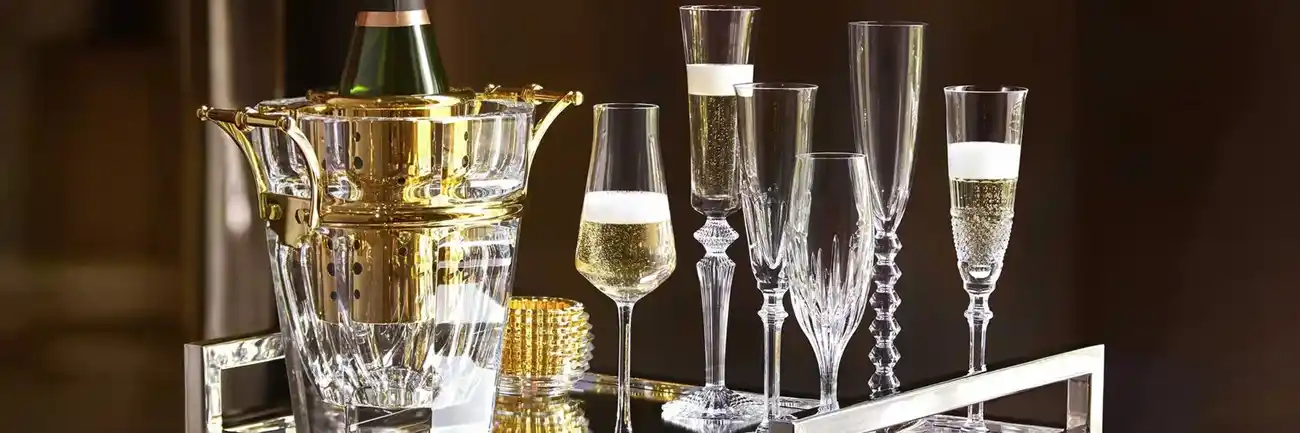
Crystal champagne flutes are the glasses most of us reach for without thinking — and that instinct is mostly right, for reasons that are genuinely scientific rather than merely traditional. The tall, narrow bowl is doing real work every second the wine sits in it. But the flute also has a well-known weakness, and the finest Champagne houses will tell you so themselves. Here is how to choose flutes properly, and when to reach for something else.
What the flute is actually doing
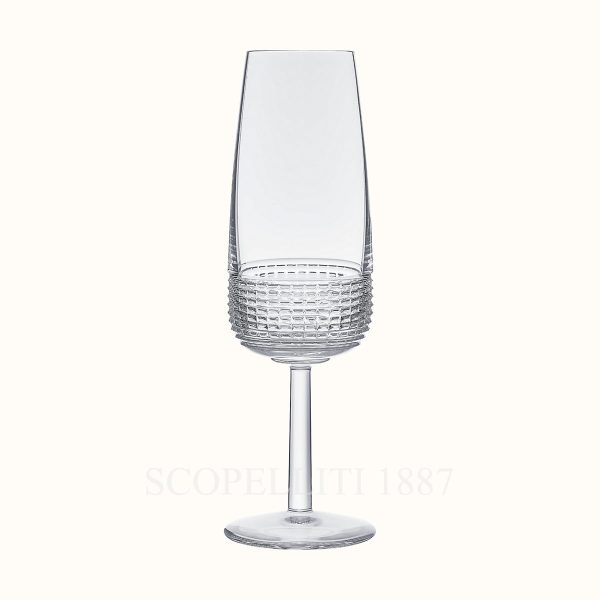
The shape is a bubble-preservation device. Carbon dioxide escapes wherever the wine meets air, so a narrow bowl with a small surface area simply gives it fewer places to leave. The result is a mousse that lasts, and that hypnotic column of fine bubbles rising in a straight line — which is not only beautiful but a genuine indicator of quality, since a fine, persistent bead is the signature of a well-made traditional-method wine (the design principle behind the flute).
There is a detail here most people never notice. Those bubbles need somewhere to form, and in the best flutes they rise from a deliberate nucleation point — a tiny etched mark at the base of the bowl that gives the CO₂ a site to gather. Without it, bubbles form randomly on dust and imperfections. With it, you get that perfect single column. It is a small piece of engineering hiding inside an object most people think of as purely decorative.
The flute’s weakness — and the tulip solution
Now the honest part. Everything that makes a flute good at holding bubbles makes it poor at releasing aroma. That narrow opening funnels the wine’s perfume straight past your nose, and with a serious Champagne — a vintage cuvée with real depth of brioche, toast and hazelnut — you end up drinking a wine you cannot properly smell. For a young, simple, vivacious fizz that hardly matters. For a great bottle it is a genuine loss.
Which is why the tulip has quietly won over the professionals. It keeps enough height and narrowness to protect the mousse, but widens through the belly and draws gently back in at the rim — gathering aroma and then concentrating it exactly where your nose is. Many Champagne houses now pour their prestige cuvées into tulips or even white-wine glasses for precisely this reason.
And the coupe sits at the opposite pole: maximum aroma, minimum bubble retention, maximum glamour. It has its own moments, and our guide to champagne coupes makes the case for them. A well-equipped cabinet holds flutes for the toast and something wider for the bottle you actually want to taste.
How to choose a set of flutes
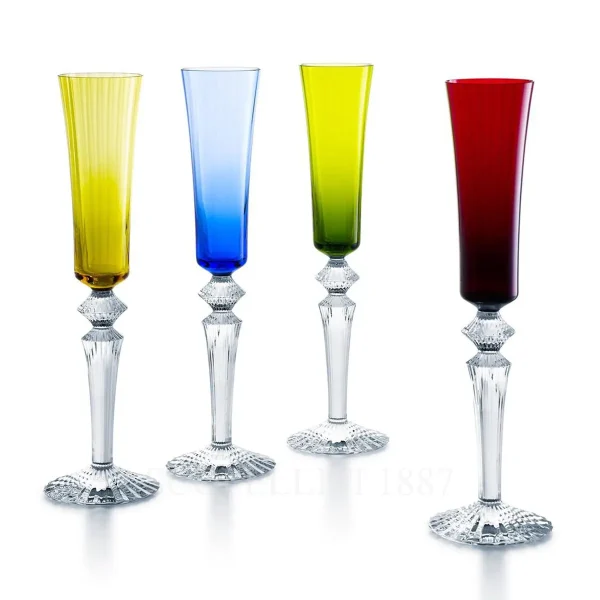
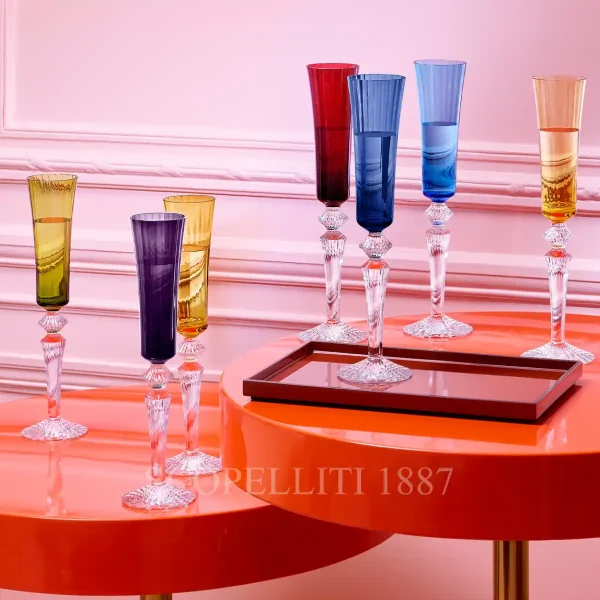
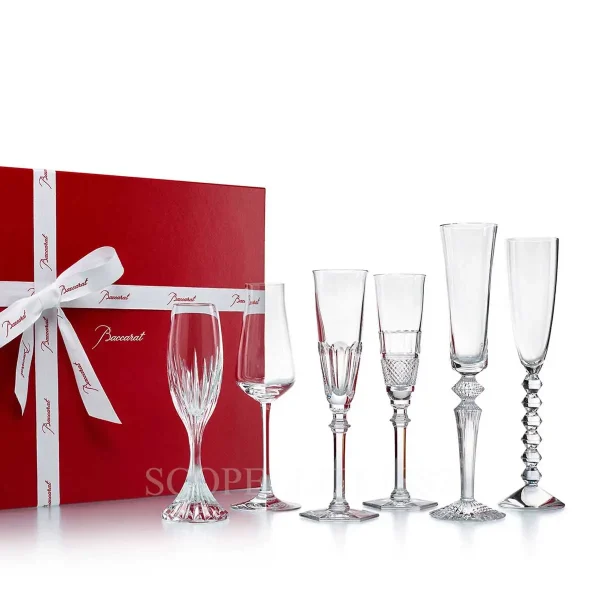
Look first at the rim. A finely cut, polished edge delivers the wine cleanly; a thick, rolled rim gets between you and the Champagne and you will taste the difference immediately. Then consider the bowl: pure tall cylinders look striking but stifle aroma, so a bowl with a little width through the middle almost always drinks better.
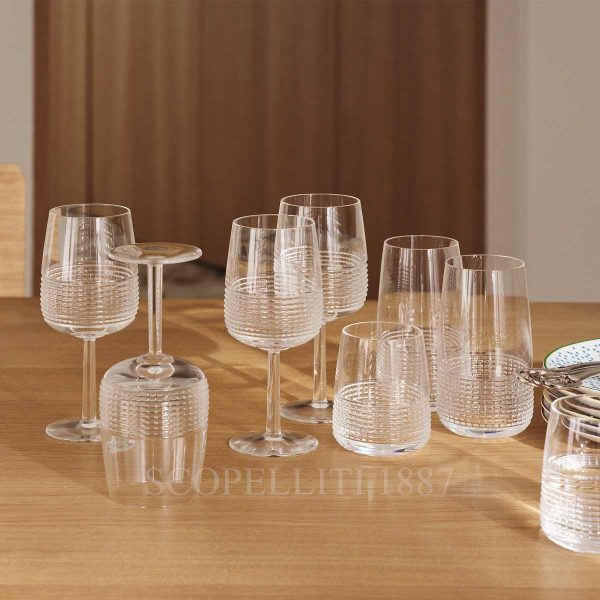
The stem should be long enough that your hand never approaches the bowl — with a wine served this cold, that is not a nicety but the whole point — and the foot wide enough to keep a tall glass steady on a crowded table. Finally, the material. Fine crystal earns its place here through clarity that shows the wine’s colour and bead, a rim that can be blown thin, and a resonance that makes the toast itself sound like an occasion. The five tests for judging any piece of crystal — clarity, brilliance, ring, weight, precision of cut — are laid out in our guide to luxury crystal glassware.


Serving Champagne properly
Chill the bottle to roughly 8–10°C — an ice bucket with water and ice for twenty minutes beats an hour in the freezer, which dulls the aromatics. A mature vintage can be served a degree or two warmer; over-chilling a complex wine mutes exactly what you paid for.
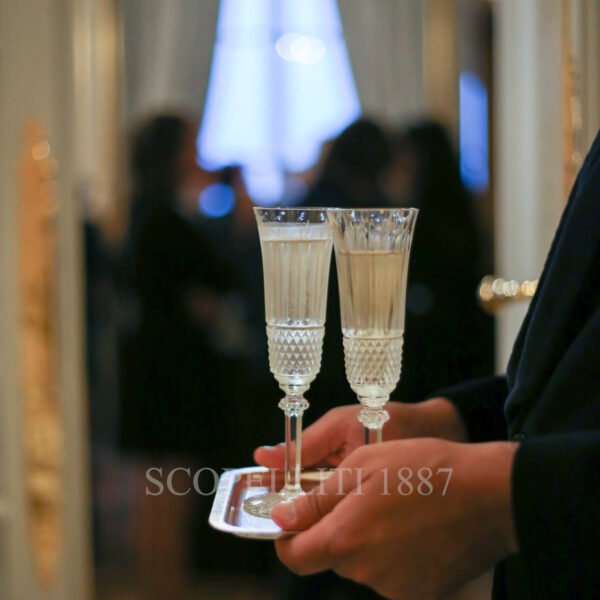
Pour against the inside wall of the flute in two stages, letting the first measure settle before topping up to about two-thirds. Pouring straight down the middle creates a mound of foam and wastes the mousse you were trying to preserve. Then hold the stem — never the bowl — and resist the urge to swirl, which only chases the bubbles out of a wine designed to keep them.
Caring for flutes
One rule matters more than all the others here: rinse away every trace of detergent. Soap residue is the enemy of Champagne — it kills the mousse on contact, flattening a beautiful wine within seconds of the pour. Many serious hosts wash flutes in hot water alone for exactly this reason. Equally, avoid drying with a fluffy cloth that sheds lint into the bowl, since those fibres become unwanted nucleation sites.
Beyond that, the usual courtesies: warm rather than hot water, one glass at a time over a padded sink, dry with a soft lint-free cloth while supporting the bowl rather than twisting the stem, and store upright to protect the rim. Browse the full range of champagne glasses to compare flutes, tulips and coupes side by side.
Key points at a glance
Crystal champagne flutes preserve the mousse: a narrow bowl means less surface area, so carbon dioxide escapes slowly and the bubbles rise in a fine, persistent column, often from a deliberate etched nucleation point. The trade-off is aroma — a narrow rim funnels perfume past the nose, which matters with serious vintage Champagne.
The tulip shape solves this, keeping height while widening through the belly and drawing in at the rim; coupes go further still, trading bubbles for aroma and glamour. Choose flutes with a finely cut rim, some width through the bowl, a long stem and a stable foot. Serve at 8–10°C, pour against the wall in two stages to two-thirds, and hold the stem. Above all, rinse away every trace of detergent — soap residue destroys the mousse instantly.
Frequently asked questions about crystal champagne flutes
Why are champagne flutes tall and narrow?
The narrow bowl gives the wine a small surface area, so carbon dioxide escapes slowly and the bubbles last longer. The height also displays the rising column of fine bubbles, which is a genuine indicator of a well-made traditional-method sparkling wine.
Is a flute or a tulip glass better for Champagne?
For young, simple sparkling wines the flute is ideal. For serious vintage Champagne, a tulip is generally better: it keeps enough narrowness to protect the mousse while widening through the bowl to gather aroma and concentrate it at the rim, so you can smell what you are drinking.
Why does my Champagne go flat so quickly?
Usually detergent residue in the glass, which destroys the mousse on contact. Rinse flutes exhaustively — many hosts wash them in hot water alone — and avoid fluffy cloths that leave lint in the bowl. Pouring straight down the middle rather than against the wall also wastes the bubbles.
At what temperature should Champagne be served?
Around 8–10°C, achieved best with twenty minutes in a bucket of ice and water rather than an hour in the freezer. Mature vintage Champagne benefits from a degree or two warmer, since over-chilling mutes the complexity you want to taste.
Toast with something worth holding
A great flute protects the bubbles, lets you smell the wine, and feels like an occasion in the hand. Choose a fine rim, a bowl with a little generosity in it, and a house whose crystal you can hear when the glasses meet.
Discover crystal champagne flutes at Scopelliti 1887 — explore our champagne glasses collection, or speak with our advisors to choose the right glass for the bottles you open.