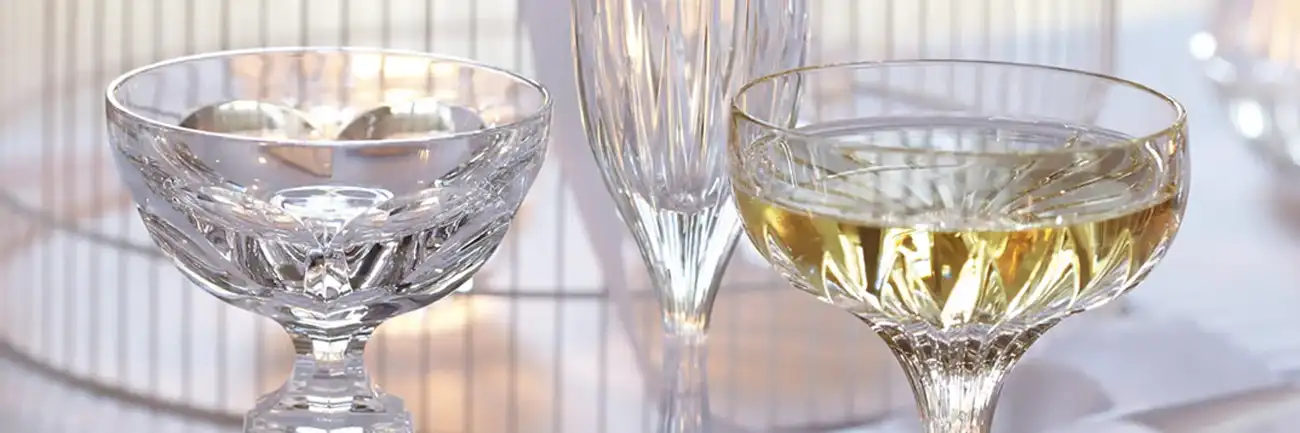
Champagne coupes have come roaring back, and not by accident. For decades the flute ruled every celebration while the shallow, wide-bowled coupe gathered dust as a period curiosity. Then bartenders rediscovered it, hosts followed, and the glass that defined the Jazz Age returned to the front of the cabinet. Understanding why — and knowing when the coupe is the right choice rather than simply the prettier one — is what separates a stylish table from a merely fashionable one.
The glass with the best story in the cabinet
You have probably heard that the coupe was moulded from the breast of Marie Antoinette. It is a wonderful story. It is also almost certainly untrue — the shape predates her by decades, and the same tale has been attached to several other famous women over the years, which rather gives the game away.
The real history is less scandalous and more interesting. The broad, shallow bowl emerged in England in the seventeenth century and rose to glory in the 1920s and 30s, when it became the glass of choice for a generation that took its celebrating seriously. Stacked into towers, raised in black-and-white films, it carries more glamour per centimetre than any other piece of stemware ever made (as the history of the champagne glass records). That association never really faded — it simply waited.
Coupe versus flute: the honest comparison
Let us be straightforward about the trade-off, because the coupe’s critics have a point.
The flute is tall and narrow. That small surface area holds the bubbles longer and channels them upward in an elegant column, which is why it became the standard for serious Champagne service. The coupe is wide and shallow, so the wine meets far more air: the mousse dissipates faster and the fine bead disperses more quickly. On pure preservation, the flute wins.
But preservation is not the only thing a glass does. That same generous surface releases aroma far more freely, and for a mature, complex Champagne — one with real depth of brioche and hazelnut — the coupe lets you smell what you are drinking rather than sending the perfume straight past your nose. It is also, frankly, more sociable: easier to hold, easier to clink, harder to knock over than a tall flute on a crowded table. The trick is knowing which quality your evening needs. If you would like the full picture on flutes, our guide to crystal champagne flutes covers them properly.
When to reach for the coupe
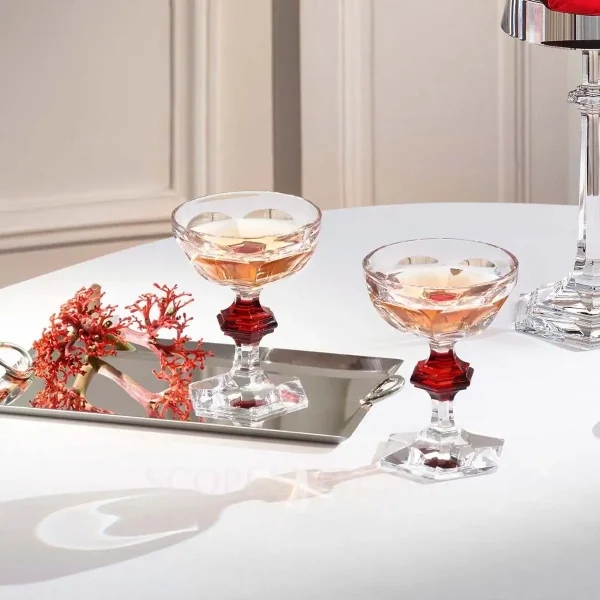
Some occasions were made for this glass. A reception or a toast, where the wine is drunk quickly and the impression matters more than the twentieth minute of mousse, is coupe territory — and a stacked tower of them remains one of the great party spectacles. Cocktails are the coupe’s other home: the champagne cocktail, the daiquiri, the sidecar, the martini all look and behave beautifully in that shallow bowl, and it has become the default of the modern cocktail bar for exactly that reason.
Reach instead for a flute when you are drinking a young, vivacious Champagne slowly, and you want the bead to last all evening. Neither glass is wrong. They are simply built for different moments, and a well-stocked cabinet holds both.
How to choose a set of coupes
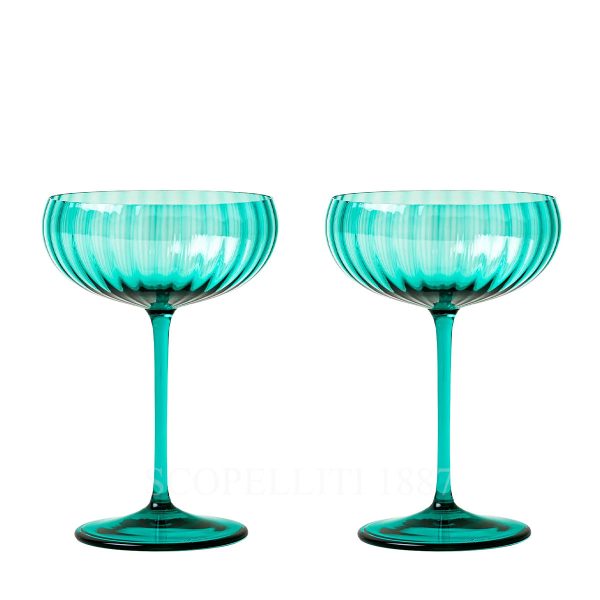
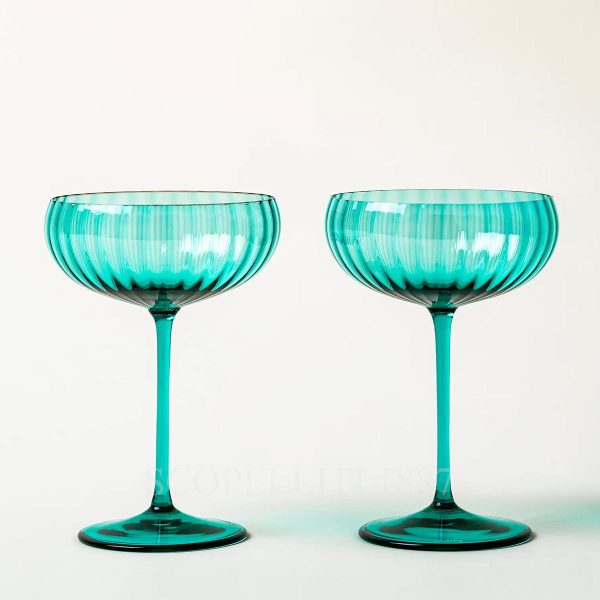
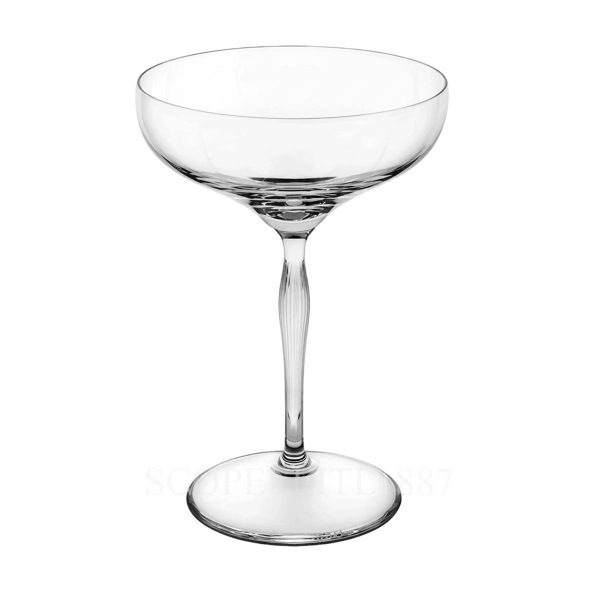
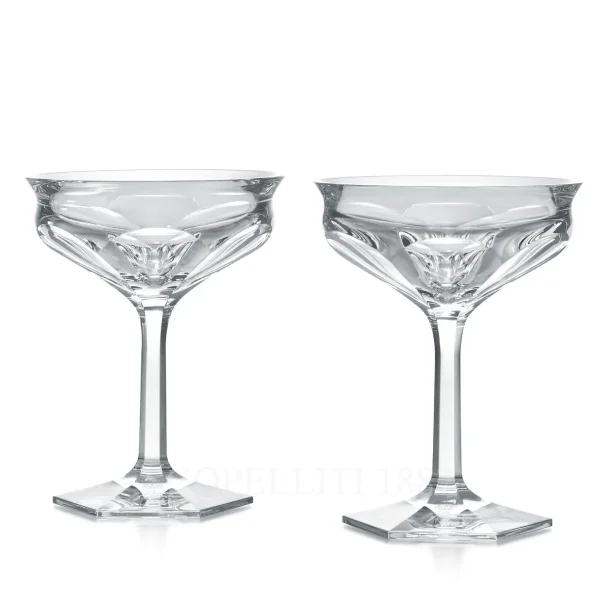
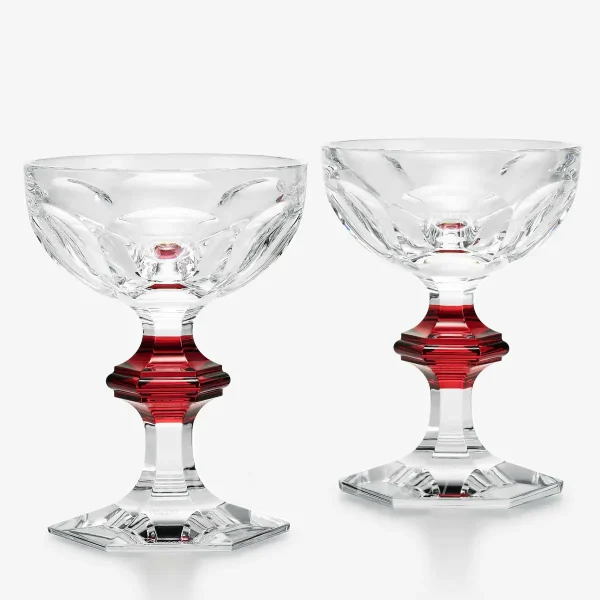
Start with the bowl. A coupe that is too shallow spills at the slightest gesture; one with a little depth and a gentle inward curve at the rim holds its contents and its aromas far better. Look, too, at the fineness of the rim: a thin, cleanly cut edge delivers the wine to the lip without interruption, while a thick, rolled rim announces itself and dulls the experience.
Then the stem and foot. The stem should be long enough that your hand never warms the wine — that is its entire purpose — and the foot broad enough to keep the glass steady. Weight should feel balanced rather than top-heavy. Finally, the material: fine crystal gives the clarity and the light-catching brilliance that make a coupe sing, and its resonance is half the pleasure of the toast. The five tests that apply to all fine crystal — clarity, brilliance, ring, weight and precision of cut — are set out in our complete guide to luxury crystal glassware, and they apply here exactly.
Serving Champagne in a coupe, properly
Chill the wine, not the glass — around 8–10°C for most Champagne, a touch warmer for a mature vintage that deserves to show its complexity. Pour in two stages, letting the first measure settle before topping up, and fill the coupe no more than two-thirds. Overfilling is the single most common mistake and it guarantees a spill.
Hold the glass by the stem. Always. The bowl of a coupe sits directly under your fingers if you cradle it, and body heat is the fastest way to flatten a beautiful wine. Pour, hold, raise — and drink it while it is at its best, which with a coupe is a slightly more urgent proposition. That is not a flaw. It is an invitation.
Caring for coupes
Hand wash in warm — never hot — water with a mild detergent, one glass at a time, over a cushioned sink. Dry immediately with a soft, lint-free cloth, supporting the bowl rather than twisting the stem, which is where most breakages happen. Store upright to protect that delicate rim.
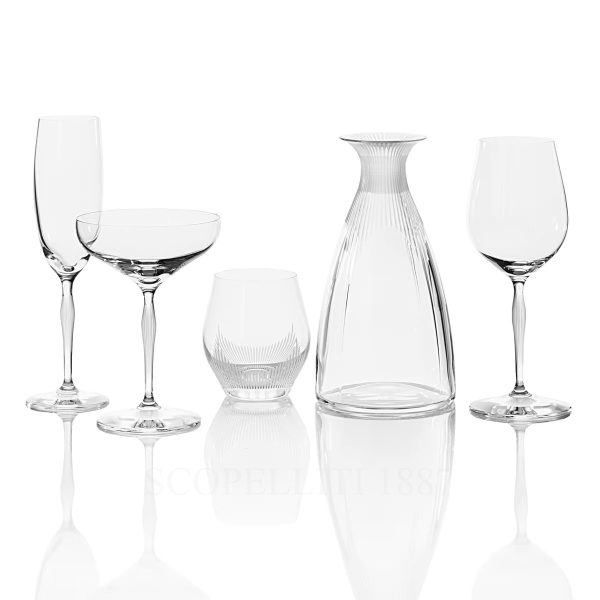
Treated this way, a set of fine coupes will outlast the fashion that brought them back — and they will still be raised at celebrations long after the next glass trend has come and gone. Explore the full range of champagne glasses to see the shapes side by side.
Key points at a glance
Champagne coupes are the shallow, wide-bowled glasses that defined 1920s glamour and have returned to fashion. The Marie Antoinette origin story is a myth — the shape emerged in seventeenth-century England. Compared with the flute, the coupe loses bubbles faster but releases aroma far more generously, making it ideal for mature complex Champagne, receptions, toasts and cocktails, while the flute suits slow drinking of young vivacious wines.
Choose a coupe with a little bowl depth and a gentle inward curve, a fine rim, a stem long enough to keep your hand off the bowl, and a stable foot. Serve Champagne at 8–10°C, fill no more than two-thirds, and always hold by the stem. Hand wash in warm water, dry with a soft cloth and store upright.
Frequently asked questions about champagne coupes
What is the difference between a champagne coupe and a flute?
A coupe has a wide, shallow bowl while a flute is tall and narrow. The flute preserves bubbles longer thanks to its smaller surface area; the coupe releases aroma more generously, making it better for mature, complex Champagne, toasts and cocktails.
Were champagne coupes really modelled on Marie Antoinette?
No — it is a charming legend but historically unfounded. The coupe shape appeared in England in the seventeenth century, well before Marie Antoinette, and the same story has been attached to several other figures over time.
Are champagne coupes suitable for cocktails?
Yes — the coupe is now a staple of the modern cocktail bar. Its shallow bowl suits champagne cocktails, daiquiris, sidecars and martinis beautifully, serving drinks without ice while showcasing colour and aroma.
How full should you fill a champagne coupe?
No more than two-thirds. Pour in two stages, letting the first measure settle before topping up, and always hold the glass by the stem so your hand does not warm the wine.
Raise a glass worth looking at
The coupe asks you to drink a little faster and enjoy the moment a little more — which, for a glass invented for celebration, seems entirely fair. Choose one with a well-judged bowl and a fine rim, and it will earn its place at every occasion worth marking.
Discover champagne coupes at Scopelliti 1887 — explore our champagne glasses collection, or speak with our advisors to find the set that suits your celebrations.