
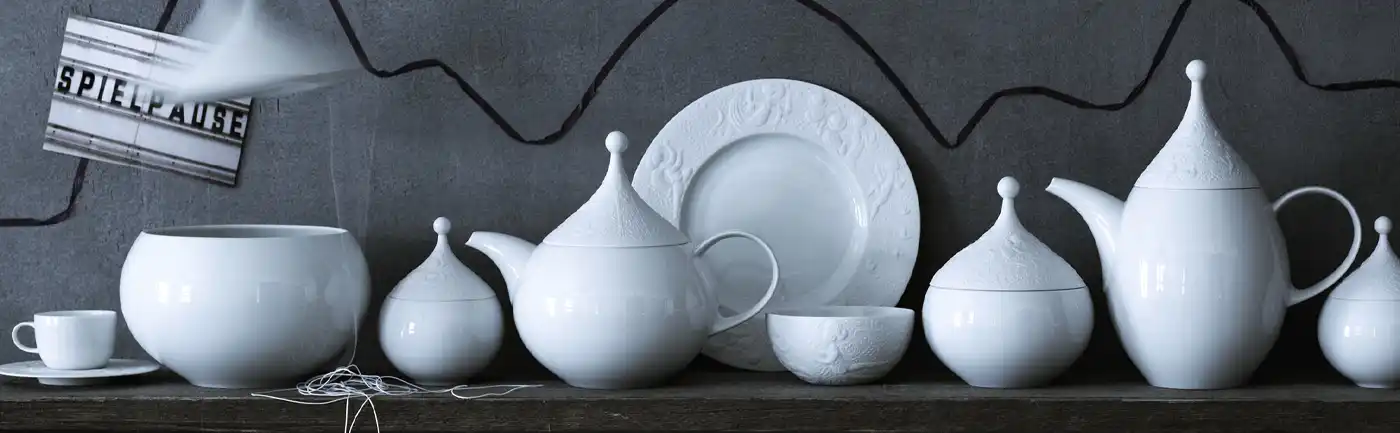
Bone china vs porcelain is one of the questions we are asked most often at our counter, usually by someone holding a plate up to the light and wondering whether the difference is worth caring about. It is. The two materials look similar on a laid table, but they are made differently, fired differently and behave differently in daily use. One is warmer in tone and surprisingly tough; the other is cooler, whiter and capable of great precision. Neither is simply “better”. After more than a century of advising hosts and collectors, our view is that the right choice depends on how you eat, how you entertain and what you want your table to feel like. This guide sets out the real differences, clears up the confusion around terms such as fine china, and ends with practical advice on which to choose.
First, a matter of words
Much of the confusion comes from vocabulary. “China” began as the English name for porcelain imported from China, and over time it became a loose word for any fine white tableware. “Porcelain” is the technical term for a white, vitrified ceramic body that is usually translucent. “Bone china” is a specific type of porcelain with bone ash in its recipe. And “fine china” is a trade description rather than a defined material, often used for porcelain bodies that are thinner and more refined than everyday stoneware.
So is bone china porcelain? Yes. Britannica describes it as a hybrid hard-paste porcelain containing bone ash, which is why comparing the two is really a comparison between bone china and the other main families of porcelain: hard-paste and soft-paste.
Hard-paste porcelain: the “true” porcelain
Hard-paste is the porcelain first perfected in China. Its body is a combination of kaolin (china clay), quartz and feldspar, fired until the particles fuse into a dense, glassy mass. According to the Victoria and Albert Museum’s A to Z of ceramics, its raw materials and firing temperature, between 1200°C and 1450°C, produce a very hard, strong body that can withstand boiling water.
Europe spent decades trying to reproduce it. Saxony succeeded first in the early eighteenth century, a story we tell in our article on Meissen porcelain, and France followed once kaolin deposits were found near Limoges. Today hard-paste is the material of most great Continental houses, from French and Italian manufactories to German and Hungarian ones.
In the hand, hard-paste feels cool and slightly heavier than bone china of the same size. Its colour is a crisp white, sometimes with the faintest grey or blue cast. The glaze fuses intimately with the body, giving a hard, glassy surface that takes decoration beautifully and resists scratching.
Soft-paste porcelain: Europe’s first answer
Before Europeans had the recipe for hard-paste, they improvised. As the French Porcelain Society explains, soft-paste combined a glassy frit, calcined and ground to powder, with white clay and chalk. “Soft” refers to the lower firing temperature it needed, not to the feel of the finished piece.
The results could be exquisite, and the soft, luminous glazes of eighteenth-century Sèvres are still admired. But the material had drawbacks. It lacked kaolin, it could crack if exposed to boiling water, and production was expensive because of losses from sagging and firing cracks. Sèvres began making hard-paste in 1769 and abandoned soft-paste altogether in 1804. You will meet soft-paste mainly in antiques and museum collections rather than in modern dinner services.
Bone china: England’s contribution
England took a different path. Animal bone ash was first added to porcelain at the Bow factory in East London in the 1740s, and in the 1790s Josiah Spode refined its use into the formula that became bone china. By around 1800 the term was established, and the material went on to dominate English tableware.
The classic recipe is striking. The Maryland Archaeological Conservation Laboratory gives the standard formula as 25% china clay, 25% Cornish stone and 50% bone ash. Modern makers vary the proportions, and Wedgwood’s guide to bone china notes that the accepted minimum for bone china is a bone content of 30% or higher, which is why you may see pieces described as “fine bone china” when the bone content is high.
What does bone ash do? It allows the body to vitrify at a lower temperature than hard-paste while remaining remarkably strong and translucent. The outcome is a material that can be made very thin and light without being fragile. The great English houses built their reputations on it, and our guide to Wedgwood china follows one of them through two and a half centuries.
Bone china vs porcelain: the differences that matter
With the history clear, here is how the materials compare in the ways that affect your table. We refer to hard-paste as “porcelain” below, since that is what most people mean.
Strength and chip resistance
This is the point that surprises people most. The delicate-looking material is the tougher one. Britannica notes that bone china is strong and does not chip easily, whereas hard porcelain chips fairly easily. Hard-paste is very hard, which means excellent resistance to scratching and heat, but hardness and toughness are not the same: a harder, more brittle body can chip at the rim under a sharp knock. Bone china absorbs those knocks a little better. Both, if well made, will last for generations with sensible care.
Translucency
Hold a plate up to a window. Bone china is typically more translucent, letting a warm glow through even fairly substantial pieces. Hard-paste porcelain is translucent too where it is thin, but many everyday porcelain services are made thicker and appear almost opaque. Translucency is a good quick test when a backstamp is missing.
Colour
Bone china has a soft ivory or milky white tone. Hard-paste porcelain is a cooler, brighter white, sometimes described as tinged with blue or grey. Neither is superior, but the difference changes the mood of a table. Ivory tones flatter candlelight, linen and gold; bright white suits contemporary food presentation, strong colour and silver or platinum.
Weight and thickness
Because bone china can be made thinner for the same strength, a bone china plate often feels lighter than a porcelain one of the same diameter. Porcelain pieces vary more: a fine hard-paste teacup can be very light, while restaurant-weight porcelain is deliberately heavy.
Glaze and surface
Hard-paste glaze fuses with the body into a very hard, glassy surface that is highly resistant to cutlery marks. Bone china glazes are fired at lower temperatures and can be slightly softer; over decades of use, some older bone china shows fine crazing in the glaze.
Heat, dishwasher and microwave
Here the answer depends less on the body and more on the decoration. Undecorated or colour-decorated pieces in both materials are often dishwasher safe, and Wedgwood’s guide describes bone china as microwave, oven and dishwasher safe while still recommending hand washing with a mild detergent. The rule that overrides everything is metal: any piece with gold, platinum or silver trim must never go in the microwave, and hand washing will keep the metal bright for far longer. Always read the maker’s care instructions for the specific collection.
Which should you choose?
We rarely recommend one material outright. Instead, we ask a few questions.
For everyday use
If your service will be used daily, go through the dishwasher and be handled by children or guests, both materials can work, so choose on style and practical design. Bone china’s chip resistance and light weight make it pleasant for daily meals. A well-made, slightly thicker hard-paste porcelain is equally at home and often more resistant to cutlery marks. Avoid heavy gold decoration on anything meant for the dishwasher.
For formal dining
For a formal table, the question becomes aesthetic. Do you want the warmth and translucency of bone china, which pairs naturally with an English or traditional setting? Or the crisp white of Continental porcelain, which gives painted and gilded decoration a sharp, luminous clarity? Many of the most celebrated formal services, from Paris to Florence, are hard-paste; many of the most celebrated English ones are bone china.
For mixing and layering
You do not need to choose only one. A layered table might combine bright porcelain dinner plates with a bone china tea service, or place a decorated porcelain charger under simpler white plates. The key is to keep whites close enough in tone that they look intentional. Ivory beside a cool white can look accidental unless there is a clear pattern or colour linking them.
When you have settled on the material and want to compare complete services, our buyer’s guide to bone china dinner sets covers set sizes, pieces and patterns in detail, while our dinnerware collection brings together both bone china and fine porcelain from the houses we represent.
How to tell which one you own
Inherited a service with no paperwork? Start with the backstamp: English pieces frequently say “bone china” or “fine bone china” outright, while Continental porcelain may simply carry the factory mark. Then hold a plate to the light, compare its tone against a sheet of bright white paper, and feel its weight. A warm, glowing translucency and ivory tone point towards bone china; a cooler white with a very glassy glaze suggests hard-paste. French porcelain from Limoges, for instance, is hard-paste, whereas most English tableware marked “bone china” is exactly that.
Key takeaways
Bone china is a type of porcelain, not an alternative to it. The meaningful comparison is between three families. Hard-paste or “true” porcelain is made from kaolin, quartz and feldspar fired at 1200°C to 1450°C, giving a very hard, cool white body with a glassy glaze. Soft-paste was an eighteenth-century European substitute based on glassy frit, fired lower and now found mainly in antiques. Bone china, developed in England and refined by Josiah Spode in the 1790s, adds bone ash to the body, traditionally about half the recipe and at least 30% by accepted standards. In practice, bone china is lighter, more translucent, warmer in tone and more resistant to chipping, while hard-paste is whiter, harder on the surface and more resistant to scratching. “Fine china” is a trade term, not a defined material. Care depends mostly on decoration: many pieces in both materials are dishwasher safe, but anything with gold or platinum trim should be hand washed and kept out of the microwave. Choose on how you use your table, and keep whites consistent if you mix the two.
Frequently asked questions about bone china vs porcelain
Is bone china porcelain?
Yes. Bone china is a type of porcelain whose body includes bone ash alongside china clay and china stone. Britannica describes it as a hybrid hard-paste porcelain. The bone ash gives it a warmer ivory tone, greater translucency and good resistance to chipping.
What is fine china?
Fine china is a commercial term rather than a defined material. It usually refers to thin, refined porcelain tableware without bone ash, fired to a white, vitrified body. Fine bone china, by contrast, specifically contains a high proportion of bone ash.
Which is more durable, bone china or porcelain?
Bone china is generally more resistant to chipping, despite its delicate appearance, while hard-paste porcelain has a harder glaze that resists scratches and heat very well. Both last for generations when well made and cared for sensibly.
Can bone china and porcelain go in the dishwasher and microwave?
Many modern pieces in both materials are dishwasher safe, and some bone china is also microwave safe. Pieces with gold, platinum or silver decoration must never be microwaved and are best washed by hand. Always follow the manufacturer’s instructions for the collection.
How can I tell bone china from porcelain?
Check the backstamp first, since bone china is often marked as such. Then hold the piece to the light: bone china usually glows with a warm translucency and has an ivory tone, while hard-paste porcelain looks cooler and whiter and is often more opaque in thicker pieces.
Choosing the material that suits your table
The debate between bone china and porcelain has no single winner, and that is good news. It means you can choose on the qualities that matter to you: the warmth and lightness of English bone china, or the cool brilliance of Continental hard-paste. Look at the tone, feel the weight, check the care instructions and imagine the pieces on your own table with your own linen and glassware. That simple exercise usually settles the question faster than any specification.
Contact us: our team will be glad to advise you on bone china and porcelain services for your home.
Discover the collection: explore our selection of fine tableware from the great houses.