
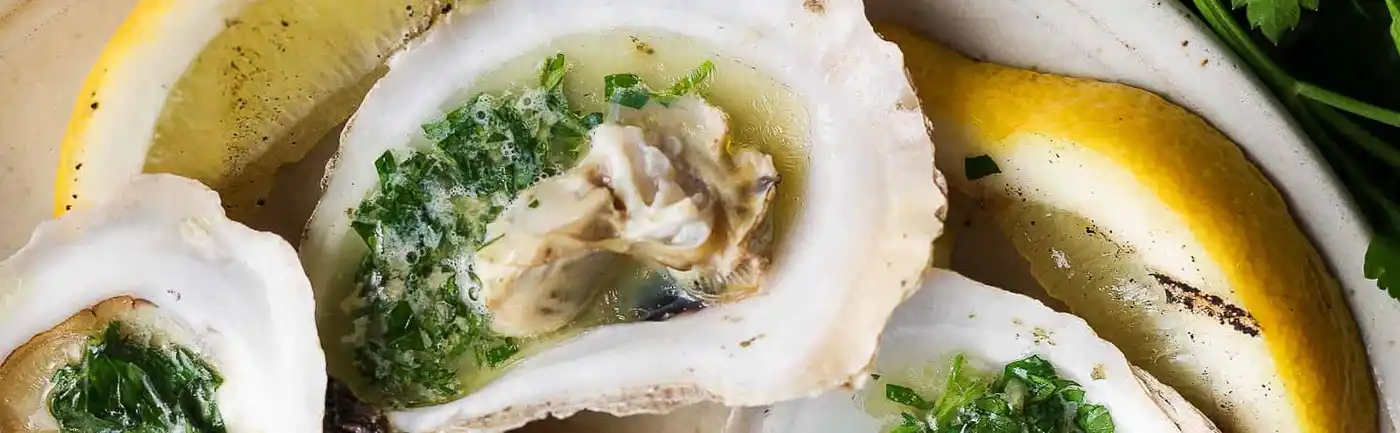
An oyster plate is one of the most specialised pieces ever made for the dining table, and one of the most rewarding to own. Shaped with individual wells that cradle each shell, it keeps oysters upright, holds their liquor and turns a plain first course into something ceremonial. For more than a century our family has set tables for hosts who care about these details, and this is a piece we are asked about more and more, by collectors hunting nineteenth-century Limoges and by hosts who simply want to serve oysters well. This guide covers where they come from, how to read their shapes and wells, how to set and serve oysters at a formal table, what to pair with them and how to look after the plates themselves.
A short history of the oyster plate
Oysters were not always a luxury. In much of the nineteenth century they were abundant and eaten across social classes, sold from street stalls as readily as they were served in grand dining rooms. What changed at the top of society was the ritual around them. The Victorian and Gilded Age table multiplied specialised serving pieces, from asparagus cradles to sardine boxes, and a dedicated plate for oysters was a natural addition to that vocabulary.
Two ceramic traditions shaped the form. The first was majolica, the moulded earthenware with bright lead-based glazes that, according to the Walters Art Museum, debuted at London’s Great Exhibition of 1851 through Minton, with the designer Léon Arnoux behind its development. Majolica examples, with their seaweed greens, shell pinks and cobalt blues, remain among the most sought-after pieces for collectors today.
The second tradition was French hard-paste porcelain from Limoges, and here Haviland is the name that matters. Founded by an American family who set up production in Limoges, the house supplied fine porcelain to both sides of the Atlantic. Its shellfish plates were produced in a remarkable range of forms and decorations, from delicate hand-painted flowers to the famous turkey-shaped wells.
The Hayes service at the White House
The most celebrated example sits in a museum. The Metropolitan Museum of Art holds an oyster plate from the Hayes White House service, designed by the American artist Theodore Russell Davis and manufactured by Haviland & Co. in Limoges, completed in 1880. The Met describes naturalistically moulded oysters, five of them open with wells to receive the raw oyster, surrounded by green seaweed extending beyond the rim. The White House Historical Association notes that First Lady Lucy Webb Hayes commissioned Davis to create 130 distinct designs celebrating North American flora and fauna. The designs were so lifelike that Clover Adams reportedly complained she could hardly eat soup peacefully with a coyote leaping at her from behind a pine tree.
That service explains much of the collecting appeal of the antique pieces: they sit at the intersection of decorative art, social history and the table. Few plates tell as much about how people once dined.
Shapes, wells and materials: how to read an oyster plate
At first glance these plates look endlessly varied. Look more closely and a clear grammar emerges.
The wells
Most have five or six wells arranged around the rim, each shaped like a shell. Six is the classic single portion at a formal dinner. Larger platters carry twelve or more wells and are intended for sharing. The shape of each well matters: a deep, slightly tilted well holds the oyster steady and keeps its liquor from spilling, which is the whole purpose of the design.
The centre
Many plates have a central well, sometimes smaller and round, sometimes shaped as a shell or a scallop. It is intended for a sauce, such as mignonette or a little cocktail sauce, or for lemon wedges. On some designs the centre is left flat for decoration, or holds an empty shell well for discarded shells.
The forms collectors look for
Beyond the round plate with shell wells, you will find crescent or half-moon shapes, fan and scallop forms, fish and seaweed motifs and the turkey or “turkey oyster” plates, whose wells are arranged like a tail. Haviland, Minton and several American makers produced these forms in porcelain and majolica. Colour, condition, the clarity of the maker’s mark and the rarity of the pattern all shape desirability.
Porcelain, majolica, glass or metal
Porcelain versions, particularly from Limoges, are fine, relatively light and suited to regular use when treated with care. Majolica is heavier and more colourful, but its glaze is more vulnerable to chipping and crazing. Glass and silver-plated oyster platters exist too, and contemporary makers produce stoneware versions designed for dishwashers and restaurant use. For a formal table, porcelain still remains the most elegant and practical choice.
How to serve oysters at a formal table
Knowing how to serve oysters well is mostly a matter of temperature, timing and a few rules of placement. The plate does the rest.
Preparing the oysters
Buy oysters from a reputable, certified supplier and keep them refrigerated, cupped side down, under a damp cloth until you shuck them. Shuck as close to serving as possible, taking care to keep the liquor in the shell and to cut the adductor muscle cleanly so guests can lift the oyster easily. Remove any grit or shell fragments with the tip of the knife rather than by rinsing, which washes away flavour.
Chilling the plates
Place the plates in the refrigerator for half an hour before service. Porcelain holds cold well, and a chilled plate keeps the oysters at their best through the course. If you prefer a dramatic presentation for sharing, use a deep oyster platter with a bed of crushed ice and seaweed instead, and keep individual plates for plated service.
Setting the place
In a formal table setting, oysters are usually the first course. The plate is placed on top of the charger plate, which stays in position until the main course. Six oysters per guest is the traditional portion. Place a small lemon wedge, ideally wrapped in muslin to catch pips, and a spoonful of mignonette in the central well.
The oyster fork is the one fork traditionally placed to the right of the knives, laid at an angle across the soup spoon or parallel to it, tines pointing up. It has three short, curved tines, one often slightly wider to help release the oyster from the shell. Our guide to the formal table setting and complete multi-course layout shows exactly where it sits relative to the other cutlery.
Eating etiquette
At a formal dinner, guests release the oyster with the fork, dip it lightly in the sauce if they wish, and eat it in one piece. Lifting the shell to the lips to drink the liquor is acceptable at most tables today, although at the most formal dinners it is still done discreetly. Empty shells stay in their wells.
Food safety when serving raw oysters
A beautiful setting does not change the fact that raw shellfish carries real risks, and a responsible host should know them. The US Centers for Disease Control and Prevention points out that an oyster containing harmful germs does not look, smell or taste different from any other oyster, and that hot sauce, lemon juice and alcohol do not kill Vibrio bacteria. The CDC also notes that about one in five people infected with Vibrio vulnificus die, and that infections have been reported year-round, not only in warmer months.
In practice this means sourcing only from certified suppliers, keeping the cold chain unbroken, discarding any oyster that is open before shucking or has a cracked shell, and asking guests discreetly about health conditions in advance. For anyone at higher risk, cooked oysters, for example grilled or baked, served on the same plates, are a gracious alternative.
What to pair with oysters
Pairings are where an oyster course becomes memorable. The classic partner is champagne, especially a crisp blanc de blancs or an extra brut, whose acidity and fine bubbles cut through the brine. Served in elegant champagne coupes or slender flutes, it sets the tone for the whole dinner. Chablis and Muscadet are equally traditional, and a very dry sherry or a clean vodka can be striking choices for a more unusual menu.
On the table, keep accompaniments simple. A shallot mignonette, lemon, thin slices of buttered rye bread and freshly ground pepper are enough. For a truly celebratory menu, oysters pair naturally with caviar; our guide to caviar serving sets and how to serve caviar like a connoisseur covers the pieces that complement an oyster course, from mother-of-pearl spoons to crystal bowls on ice.
Think about the whole setting too. Crystal glasses from Baccarat or Saint-Louis, silver oyster forks from Christofle or Puiforcat and porcelain from Haviland or Bernardaud create a harmonious first course. Mixing an antique majolica plate with contemporary crystal can work beautifully, provided the palette is coherent.
Caring for oyster plates
How you care for these pieces depends entirely on their age and material.
Contemporary porcelain. Rinse plates soon after service, as dried brine and lemon can mark gilding. Check the manufacturer’s guidance before using a dishwasher; plates with gold or platinum rims should always be washed by hand in warm water with a mild detergent. Dry immediately with a soft cloth, paying attention to the wells, where water collects.
Antique porcelain and majolica. Hand wash only, never soak, and avoid sudden changes of temperature, which can crack old glazes. Because majolica was traditionally decorated with lead-based glazes, many collectors keep antique majolica pieces for display and serve on contemporary porcelain. Hairline cracks and crazing in old pieces can also trap moisture and residue, another reason to use them with care.
Storage and display. Store plates with felt or soft paper dividers to protect the wells and rims. For display, use plate hangers with padded clips, or group plates on a wall in a composition. They look particularly striking in a dining room or a kitchen with a sea view, and a collection built over time becomes a conversation piece in its own right.
Choosing an oyster plate for your table
If you are buying your first set, start with how you will use them. For regular dinners, a set of six or eight porcelain plates in a timeless pattern will serve you for decades. Haviland, with its long Limoges heritage and its role in the history of the form, is an obvious place to begin; you can explore the Haviland porcelain collection to find patterns that work with your existing service. For collectors, a single rare antique piece can be a lifelong starting point.
Consider the rest of your table before choosing colour. A white or cream plate with gold edging sits comfortably with almost any service; a strongly coloured plate works best as a deliberate contrast. And think about quantity: these plates are rarely bought singly for use, so buy enough for the largest dinner you expect to host.
Key takeaways
An oyster plate is a specialised serving plate with shell-shaped wells that hold each oyster upright and keep its liquor. The form flourished in the nineteenth century, in colourful majolica introduced by Minton at the Great Exhibition of 1851 and in Limoges porcelain by Haviland, whose Hayes White House oyster plate designed by Theodore Davis is now held by the Metropolitan Museum of Art. Most plates have five or six wells and a central well for sauce or lemon; larger oyster platters carry twelve or more. To serve oysters formally, chill the plates, place them on the charger as a first course, allow six oysters per guest and lay the oyster fork to the right of the knives. Pair with champagne, Chablis or Muscadet, and keep accompaniments simple. Raw oysters carry real food safety risks: contaminated oysters look and taste normal, and lemon or hot sauce do not kill Vibrio, so source carefully and offer cooked alternatives. Hand wash gilded and antique plates, avoid temperature shocks and consider keeping antique majolica for display.
Frequently asked questions about oyster plates
What is an oyster plate used for?
An oyster plate is used to serve oysters on the half shell. Its shell-shaped wells hold each oyster steady so that it does not tip and lose its liquor, while a central well usually holds sauce, mignonette or lemon. Such plates became popular in the nineteenth century as part of the formal multi-course dinner.
How many wells does an oyster plate have?
Most individual plates have five or six wells, often with an additional central well for sauce. Six is the traditional portion per guest at a formal dinner. Oyster platters designed for sharing can have twelve wells or more.
Are antique oyster plates valuable?
Antique examples are widely collected, particularly nineteenth-century Minton majolica and Haviland Limoges porcelain. Desirability depends on the maker’s mark, the rarity of the form and decoration, colour and condition. A Haviland plate from the Hayes White House service is held in the collection of the Metropolitan Museum of Art.
How do you serve oysters on an oyster plate?
Chill the plates in advance, shuck the oysters just before serving while keeping their liquor, and place one oyster in each well. Add mignonette or lemon to the central well, set the plate on the charger as a first course and lay an oyster fork to the right of the knives. Serve with champagne or a crisp white wine.
Can oyster plates go in the dishwasher?
Some contemporary designs are dishwasher safe, but porcelain with gold or platinum decoration and all antique or majolica plates should be washed by hand in warm water with mild detergent, then dried immediately. Always follow the manufacturer’s care guidance.
Bringing the oyster course back to the table
These plates carry a century and a half of dining history, from Minton majolica to the Hayes White House, yet they remain entirely practical. Chilled, well set and paired with good champagne, they turn a simple first course into the moment guests remember. Whether you are starting a collection or setting your first oyster dinner, choose plates that suit how you entertain and treat them with the care they deserve.
Our advisers can help you choose porcelain, cutlery and crystal for an oyster course, or complete an existing service.
Contact us: ask a Scopelliti 1887 tableware adviser. Or discover the collection: explore our fine porcelain, silver and crystal.