
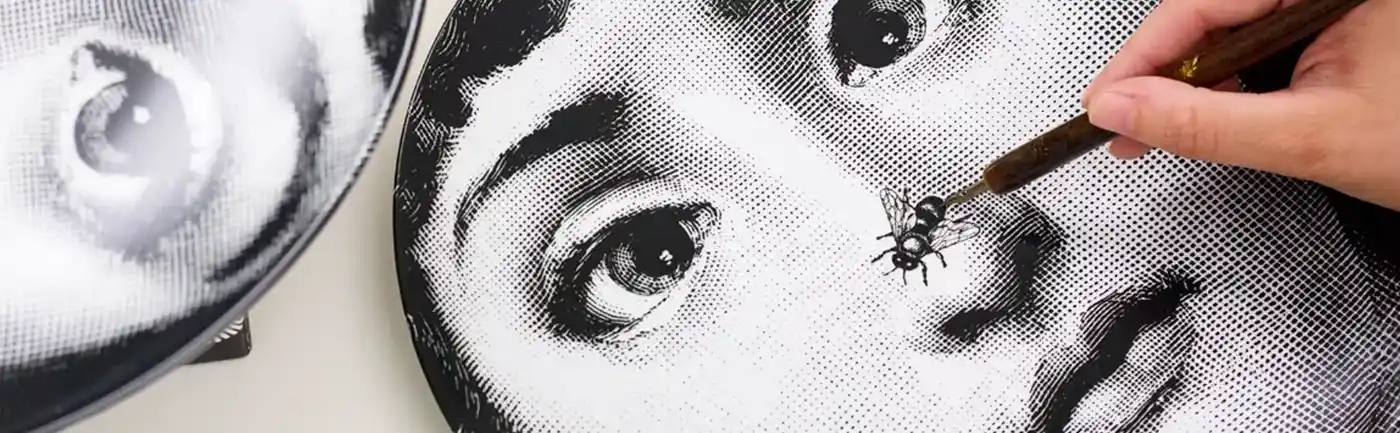
Fornasetti is the Milanese atelier that turned a single woman’s face into more than four hundred plates, and it remains one of the few design houses whose objects are collected as seriously as they are used. For hosts and collectors, the name raises practical questions as much as romantic ones. Who was Piero, and why did Gio Ponti believe in him? What exactly is Tema e Variazioni, and who was Lina Cavalieri? How are the plates made today, and how should you hang them, pair them and care for them? As a family retailer that has advised collectors since 1887, we hear these questions every week. This guide answers them in order, from the printshop of the 1930s to the wall of your dining room.
Who was Piero Fornasetti?
Piero Fornasetti was born in Milan in 1913 and died there in 1988. He was, by temperament, a printer before he was anything else. He enrolled at the Brera Academy in 1932 and left two years later after clashing with the institution, then turned to engraving and printing, producing lithographs and artist’s books for figures such as Giorgio de Chirico and Lucio Fontana. The biographical record of Piero Fornasetti describes his art printshop as a reference point for artists of his generation.
That background matters more than it first appears. Everything he later decorated, from umbrella stands to trays, grew out of a printmaker’s way of seeing: line, contrast, repetition and the pleasure of a motif that can be transferred from one surface to another. When the Milan Triennale celebrated his centenary in 2013, the exhibition was titled “100 anni di follia pratica”, a hundred years of practical madness. The phrase fits. His imagery is dreamlike, full of suns, keys, fish, playing cards and classical ruins, yet it was always meant to live on ordinary things.
The meeting with Gio Ponti
Around 1940, a proposal of printed silk scarves that Piero presented at the Milan Triennale caught the eye of Gio Ponti, architect, founder of Domus and former artistic director of Richard-Ginori porcelain. Ponti encouraged the younger man to apply his decoration to everyday objects and furniture. If you want to understand why Ponti was so receptive to the idea of art on functional ware, our history of Ginori 1735 and Ponti’s years at the manufactory gives the context.
The partnership produced some of the most recognisable pieces of Italian post-war design. Their Architettura cabinet, shown at the 9th Triennale in 1951, is now in the collection of the Victoria and Albert Museum. The V&A catalogue entry for the Ponti and Fornasetti cabinet explains the method: lithographs were created for each section, printed onto transfer sheets and then applied to fibreboard panels before varnishing. The museum also notes that the imagery drew on printed books and engravings rather than on real buildings. It is, in short, a cabinet built out of prints. Ponti and Piero went on to collaborate on furniture and interiors for years, and the architect’s confidence gave the atelier the commercial footing it needed.
Tema e Variazioni and the face of Lina Cavalieri
The series that made the atelier famous began with a photograph. Piero found the portrait of Lina Cavalieri, the Italian soprano celebrated in the Belle Époque as “the most beautiful woman in the world”, in an old magazine. In 1952 he started to draw her. He did not stop for the rest of his life.
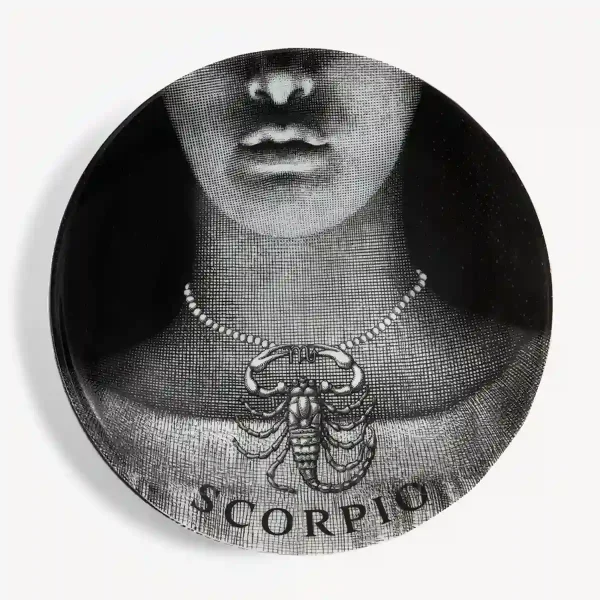
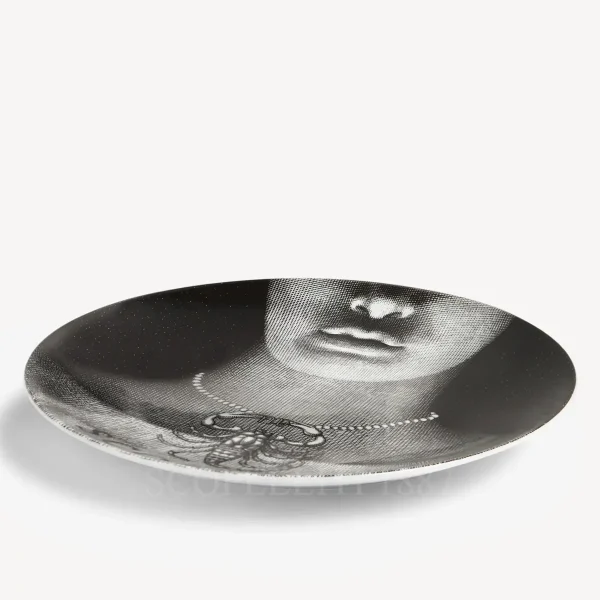
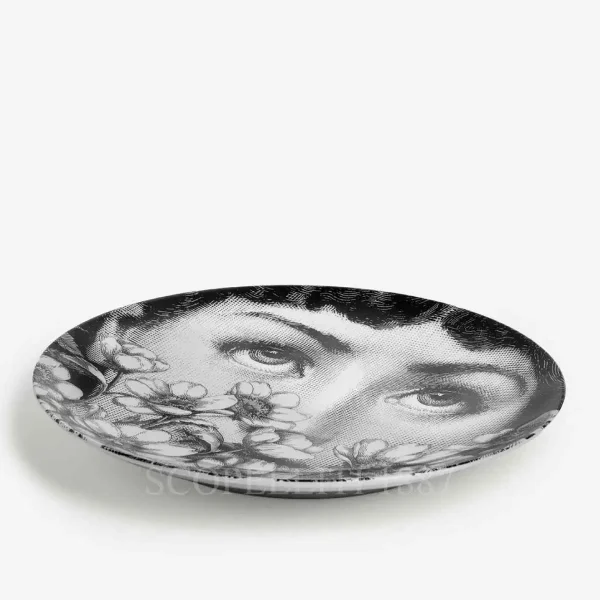
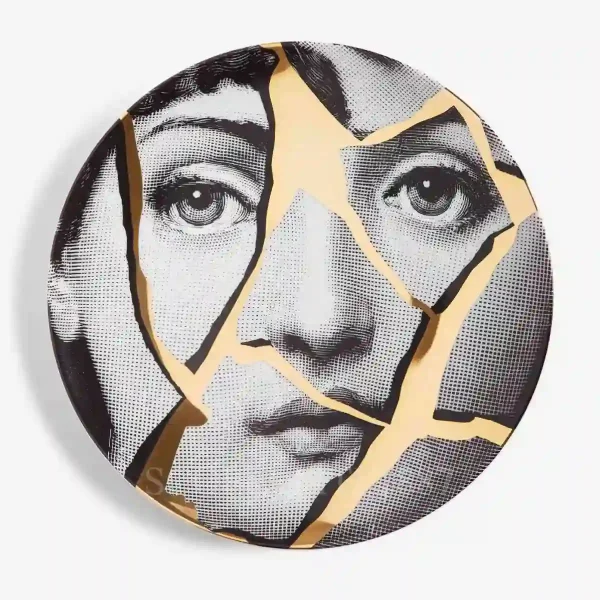
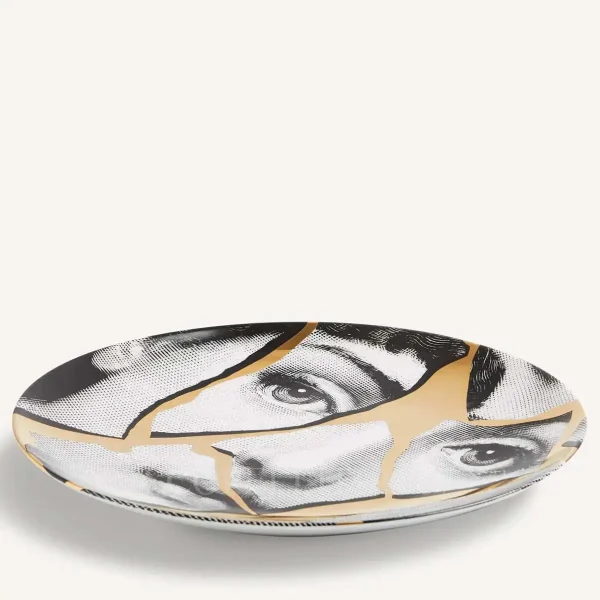
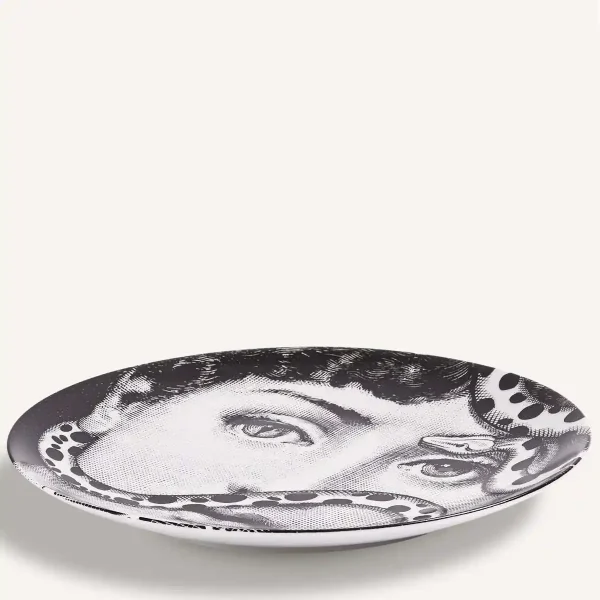
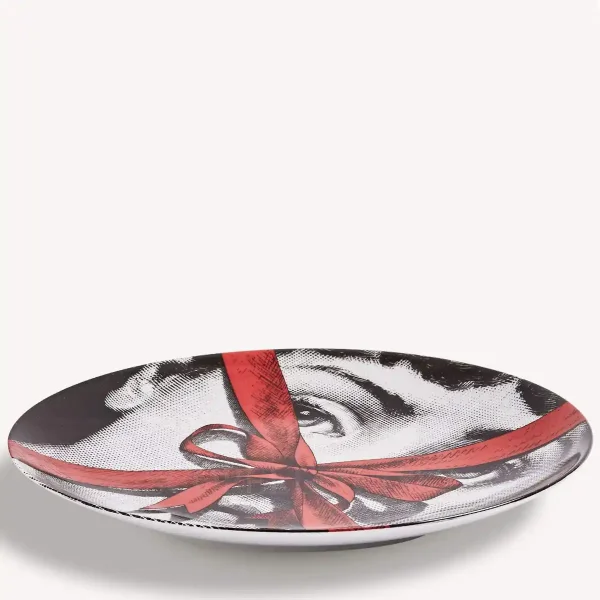
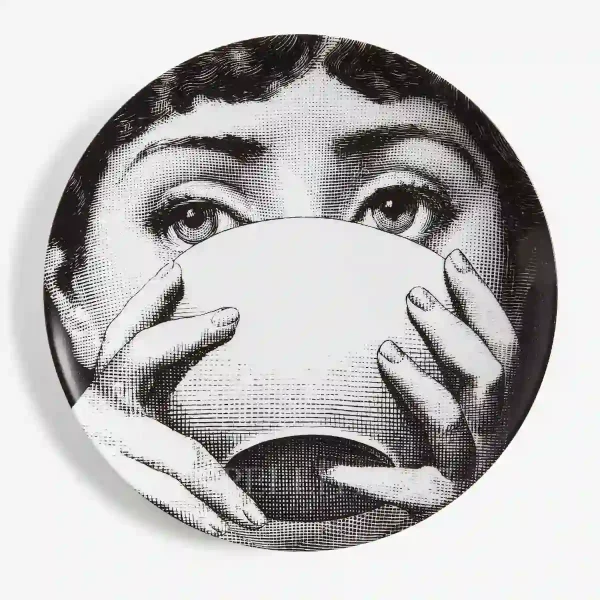
Why one face? Piero never offered a tidy explanation, and perhaps that is the point. Cavalieri’s features are calm, symmetrical and slightly remote, which makes them an ideal blank page. Over the decades she appears winking, masked, crowned, wearing spectacles, split into puzzle pieces, hidden behind a keyhole, turned into a moon, a chess piece or a bowl of fruit. As designboom’s account of Tema e Variazioni records, there are now around four hundred interpretations, some given a Chaplin moustache, others a ski mask or a crown.
The title is borrowed from music: a theme stated once, then transformed again and again. Every plate is numbered, which is what turned the series from a decorative line into a genuine collecting field. The numbers are not a chronology you need to memorise, but they give each variation an identity. Collectors speak of “the 1” or a particular number the way stamp enthusiasts speak of an issue.

Other plate series worth knowing
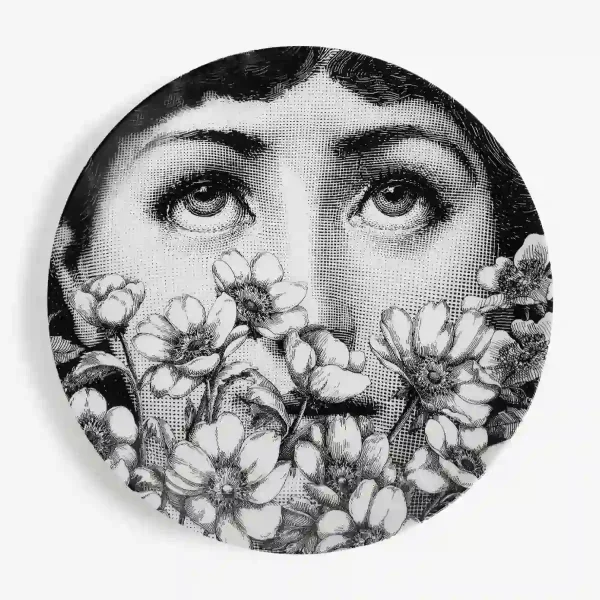
Tema e Variazioni is the headline, but it is not the whole story. The atelier’s archive contains thousands of motifs, and several plate families have their own following:
- Architettura and Prospettiva, with columns, arches and impossible perspectives that echo the Ponti furniture.
- Fiori, botanical plates drawn with the precision of an old herbarium.
- Adam and Eve, Pesci, fruit and vegetables, early tableware motifs often found in black on white.
- Astronomici and Astrolabio, drawn from old scientific engravings.
Mixing these with Cavalieri plates works well, provided the palette stays disciplined. We come back to that below.
Barnaba Fornasetti and the atelier today
After Piero’s death in 1988, his son Barnaba took over the studio in Milan. He did two things that shaped the brand we know. First, he drew on the enormous archive to keep classic designs in production with the same printmaking logic his father used, and oversaw projects such as a handmade book of the first hundred Cavalieri illustrations. Second, he kept adding variations, so the Cavalieri series is still alive rather than frozen. “From Piero, I have inherited the desire to imagine, to invent, to dream, as it were, with my eyes open,” Barnaba has said, a line quoted in the designboom feature above.
The atelier is still in Milan, and the production remains close to the house. That continuity is a large part of what collectors are paying attention to. A plate designed in the 1950s and a variation released last season share the same graphic language, the same black and white restraint and the same wit. Few decorative arts houses can make that claim across three generations of taste.
How Fornasetti plates are made
People are often surprised to learn that the plates are not freehand paintings. They are prints, and that is not a compromise. Piero’s genius was in the drawing and in the transfer of that drawing onto objects, exactly the technique the V&A describes for the Architettura cabinet.
For decorated porcelain of this kind, the work broadly follows a sequence that has changed little in spirit:
- The drawing. Each motif starts as a detailed pen drawing, often derived from nineteenth century engravings, archived and reproduced faithfully.
- The transfer. The design is printed onto a transfer sheet, which is then positioned by hand on a white porcelain blank. Centring a face on a round plate, with no distortion at the rim, is skilled work.
- Firing. The plate is fired so the decoration fuses with the glaze.
- Hand-finishing. Coloured details, gilded rims and gold highlights are applied by hand, and many designs pass through the kiln again.
The official product sheet for a current Tema e Variazioni wall plate describes it as hand-decorated porcelain for ornamental use only, 26 cm in diameter, supplied with a hook, and adds that minor variations may occur due to craftsmanship. That last sentence is worth reading twice. A slightly different weight of line or a tiny shift in the gold is not a defect. It is evidence of the hand.
How to collect Fornasetti plates
There is no single right way to build a collection, but there are approaches that tend to age well. In our experience, the collectors who enjoy their plates most over decades begin with a clear rule and allow themselves one exception.
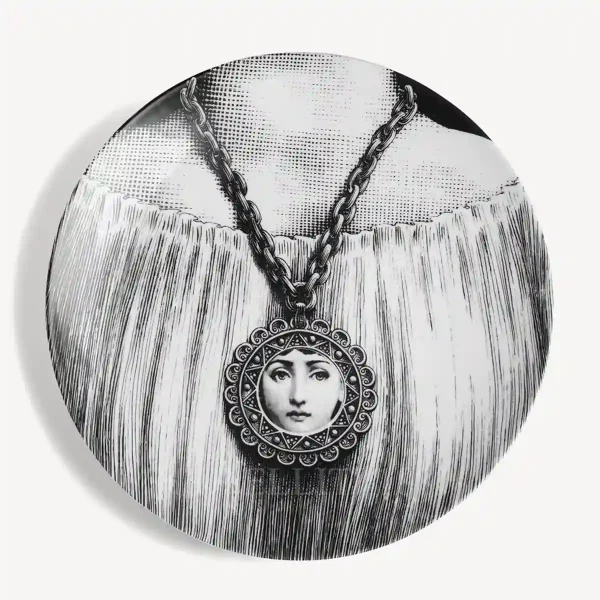
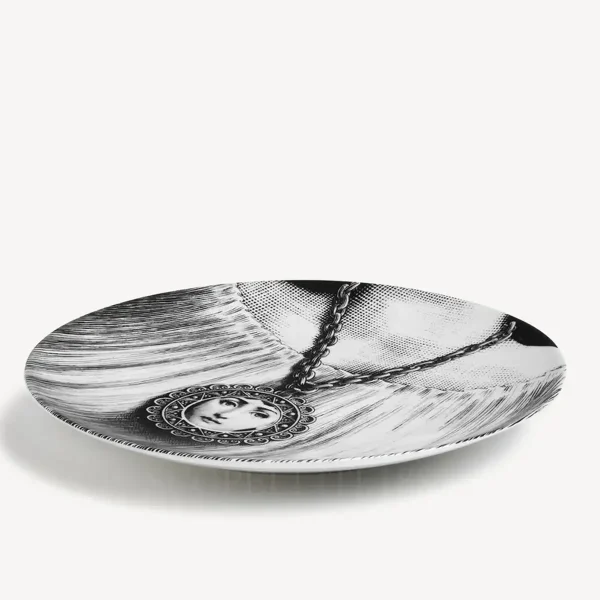

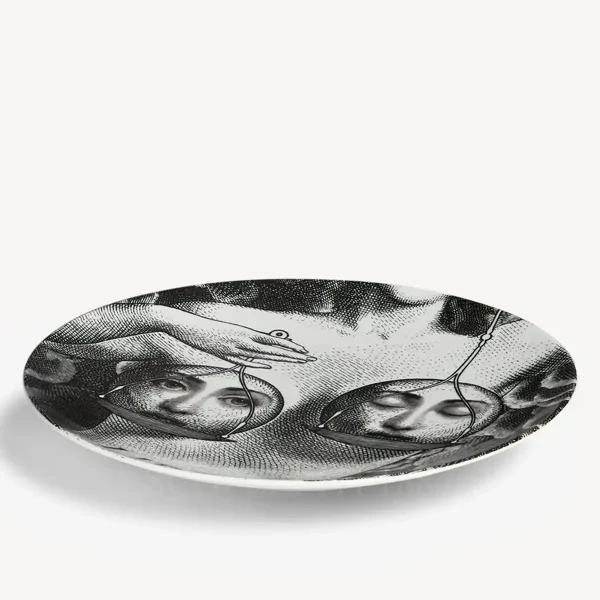
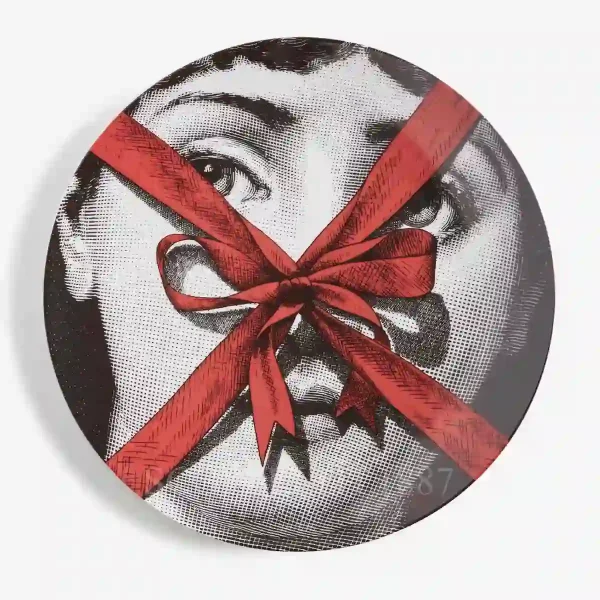
Choose a theme within the theme
With over four hundred Cavalieri variations, trying to own “the series” is neither realistic nor necessary. Better to pick a thread: variations featuring the sky, animals, architecture, masks, or plates where the face is almost hidden. A group of six plates that share an idea reads as curated. Twenty random plates read as accumulation.
Vintage or current production?
Early plates from Piero’s lifetime have their own charm, with slight irregularities and a patina of use, and they belong to the design history market. Current production from the Milan atelier offers consistent quality, clear provenance and the ability to add to a set later. Many serious collections combine both. What matters is that you know which is which, keep any documentation, and buy from an authorised source so that authenticity is never in question.
Check the details
- The printed mark on the back, with the number of the variation where relevant.
- Crisp, unbroken lines with no blurring at the edges of the transfer.
- Even gilding on rims and highlights, without flaking.
- Original packaging, which helps with storage and with any future resale.
Displaying plates on the wall
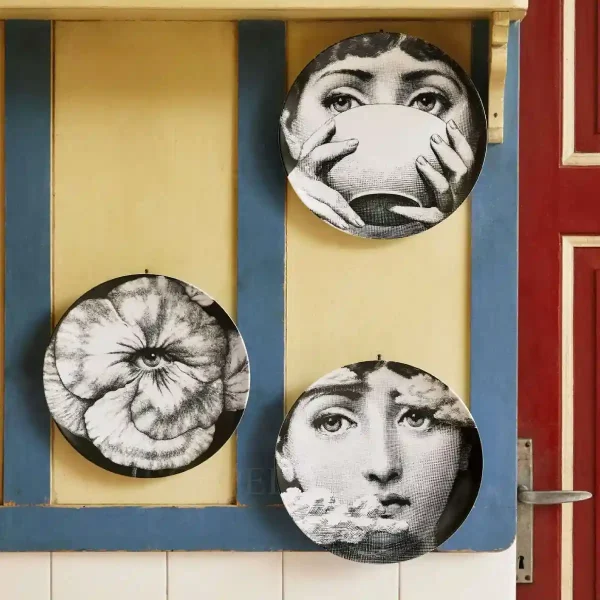
The plates are designed first as wall objects, and a good arrangement can do for a room what a single painting cannot. A few principles make the difference between a gallery wall and a cluttered one.
Start on the floor. Lay the plates out on paper or a large table before any hook goes into the wall. Photograph the arrangement, sleep on it, then adjust. It sounds fussy. It saves plaster.
Pick a geometry. A strict grid of nine or twelve plates, spaced 8 to 10 cm apart, suits modern interiors and lets the variations themselves provide the movement. A loose cloud, centred around one “anchor” plate at eye level, suits period rooms and staircases. A single horizontal row above a sideboard or a headboard is the quiet option, and often the most elegant.
Mind the colour. Black and white Cavalieri plates are almost impossible to over-use. Once you introduce gold or colour, keep it rhythmic: every third plate, or only in the centre column, so the eye has somewhere to rest.
Consider the wall itself. Dark walls, deep green, ink blue or charcoal, make the white porcelain glow. Pale walls give a graphic, almost printed effect that recalls the drawings. And yes, the atelier’s own wallpapers can be combined with the plates, though it takes a confident hand.
Use proper fixings. Use the hooks supplied or specialist plate hangers sized for a 26 cm plate, and check wall anchors for plasterboard. Avoid hanging plates directly above radiators or in steamy bathrooms, where adhesive hangers can fail.
Styling Fornasetti on the table
This is where people hesitate, because the wall plates are marked for ornamental use. Respect that: they should not be used as dinner plates. They can still play a starring role at the table, as long as food does not touch them.
The most elegant use is as a show plate. Set a Cavalieri plate at each place when guests sit down, then remove it before the first course is served, just as you would with a traditional service plate. If you are unsure of the etiquette or the proportions, our guide to choosing and using charger plates covers timing, sizing and layering. For a quieter version, place a single plate on a stand at the centre of the table, flanked by candles, instead of flowers.
Pairing is where the fun begins. Fornasetti’s black and white graphics sit beautifully next to plain white porcelain with a thin gold or platinum rim, clear crystal and simple silver. The fewer competing patterns, the better the face reads. If you enjoy a more layered table, a patterned dinner plate in a single colour can work, but keep the linen plain. Our overview of the best luxury porcelain brands is a useful starting point for choosing a service that complements rather than competes.
A practical tip we often give: seat guests by variation. A Cavalieri plate in a sun mask for one guest, a crowned one for another, and suddenly the table has a conversation starter. It is the kind of detail people remember.
Caring for your plates
Care is straightforward. Dust with a soft microfibre cloth and, when needed, wipe with a cloth barely dampened with a mild, neutral detergent, as the maker recommends. Avoid the dishwasher, abrasive sponges and ammonia-based glass cleaners, which can dull gold. When plates come off the wall, store them flat with a felt or paper separator between each one, never stacked directly porcelain on porcelain.
Key takeaways
Fornasetti is a Milanese decorative arts atelier founded by Piero Fornasetti (1913 to 1988), a printmaker whose meeting with Gio Ponti around 1940 led him to decorate furniture and everyday objects. Their Architettura cabinet, shown at the 1951 Triennale, is held by the V&A. In 1952 Piero began Tema e Variazioni, a series built on the face of the soprano Lina Cavalieri that now counts around four hundred numbered variations. His son Barnaba leads the atelier in Milan today and continues adding designs. The plates are made by applying printed transfers to porcelain, firing, and finishing details and gold by hand, so small differences between pieces are expected. They are intended for ornamental use: hang them in grids, rows or clusters, or use them as show plates removed before food is served. Clean with a soft cloth and mild detergent, never in the dishwasher, and buy from an authorised retailer to guarantee authenticity.
Frequently asked questions about Fornasetti
Who is the woman on Fornasetti plates?
The face belongs to Lina Cavalieri, an Italian soprano admired in the Belle Époque as one of the most beautiful women of her time. Piero Fornasetti found her portrait in an old magazine and, from 1952, reinterpreted it in the Tema e Variazioni series, which now includes around four hundred variations.
Can you eat off Fornasetti plates?
The Tema e Variazioni wall plates are hand-decorated porcelain intended for ornamental use only, so they should not come into contact with food. On the table they work well as show plates set at each place and removed before the first course.
Are Fornasetti plates hand painted?
They are hand-decorated rather than painted freehand. The drawing is printed onto a transfer that is applied by hand to the porcelain, then the plate is fired and details such as gold rims are finished by hand. This is why minor variations between pieces are normal.
Who runs Fornasetti today?
Barnaba Fornasetti, Piero’s son, has led the Milan atelier since his father’s death in 1988. He draws on his father’s vast archive to keep classic designs in production and continues to add new variations to Tema e Variazioni.
How do you hang Fornasetti plates on a wall?
Plan the layout on the floor first, then use the supplied hook or a plate hanger sized for a 26 cm plate with suitable wall anchors. Grids with even spacing of 8 to 10 cm suit modern rooms, while a cluster around a central plate suits period interiors.
Building a collection that lasts
A single plate on a bookshelf can be the start of something. Over time, as variations join it, the wall becomes a record of your own taste as much as Piero’s imagination. Our advice is simple: choose a thread, favour quality over quantity, and let the black and white do the work. You can browse the current plates, trays and objects on our Fornasetti collection page, or see how they sit alongside other decorative and dinner plates.
Contact us: if you are planning a wall arrangement or looking for a specific variation, our team will be glad to advise you personally. Or discover the collection online.