
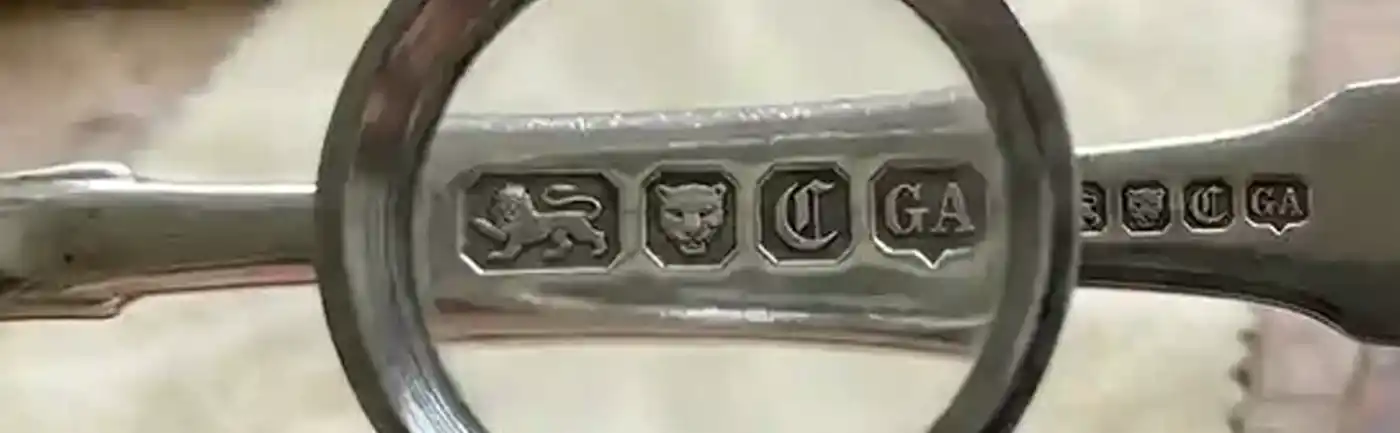
British silver hallmarks are the most complete system of marks ever stamped on silver, and once you know how to read them they tell you four things in a few millimetres: that the metal is genuine sterling, which assay office tested it, the year it was tested and who took responsibility for the work. No other country gives you all four. French silver tells you the standard and the maker but not the year; American silver rarely tells you more than “sterling” and a name. A piece of English or Scottish silver, by contrast, can be dated to a single year with nothing more than a loupe and a good table of date letters. This guide explains the five marks one by one, shows you how to read a real set, gives you the post-1975 date letter table, and ends with a practical workflow for dating antique British silver.
What a British hallmark is, and why it is different
A hallmark is not a maker’s signature. It is an independent guarantee, struck by a public assay office after the metal has been tested, that the piece meets a legal standard of fineness. The word itself comes from Goldsmiths’ Hall in London, where the Worshipful Company of Goldsmiths has been testing and marking silver since the fourteenth century. That is the first thing that sets British silver hallmarks apart from most of what you will find in our broader guide to silver hallmarks: in Britain the system has been continuous, state-backed and documented for roughly seven hundred years, and the records still exist.
The second difference is the date letter. Most hallmarking systems certify purity and identify a maker. The British system also records the year of assay, through a letter that changes annually and is struck in a shield and typeface specific to each office and each cycle. This is why a Georgian coffee pot can be attributed to 1768 rather than “the second half of the eighteenth century”, and why British silver is the easiest antique silver in the world to date with confidence.
The third difference is legal weight. Describing an unhallmarked article as silver is an offence in the United Kingdom under the Hallmarking Act 1973, above a small weight exemption. The marks therefore carry a legal, not merely commercial, meaning. In our experience at Scopelliti 1887, where we have handled fine tableware since 1887, this is exactly why British pieces command such trust in the secondary market: the hallmark is evidence, not advertising.
The five marks of a British silver hallmark, one by one
A full set of traditional British silver hallmarks contains up to five elements. Not all of them appear on every piece, and the order in which they are struck varies by office and period, but each one answers a different question. Here they are, in the order in which an experienced eye usually reads them.
1. The standard mark: the lion passant
The lion passant, a lion walking to the left with its right forepaw raised, is the sterling standard mark for England. It certifies that the alloy contains at least 925 parts of silver per thousand, the sterling standard. The lion has been struck on English silver since the mid-sixteenth century and is still applied today, although since 1999 the legally compulsory fineness mark has been the millesimal figure “925” and the lion is, in the words of the Goldsmiths’ Company Assay Office, “an optional part of the hallmark but applied as standard”.
Two variants matter for dating. Until 1821 the London lion was shown “guardant”, with its head turned to face the viewer; from 1822 it looks straight ahead. And between 1697 and 1720 the lion disappeared altogether: during that period England imposed the higher Britannia standard of 958 parts per thousand, marked with the seated figure of Britannia and a lion’s head erased (a lion’s head torn off at the neck) in place of the lion passant and the leopard’s head. Britannia standard remained available as a voluntary higher standard after 1720, and the Britannia figure is still a legal mark for 958 silver.
Scotland and Ireland used their own standard marks. Edinburgh struck a thistle from 1759, replaced in 1975 by a lion rampant; Glasgow used a lion rampant; Dublin used a crowned harp. When you see a lion rampant, standing upright on its hind legs, rather than a lion passant walking, you are looking at Scottish silver.
2. The town mark: which assay office tested the piece
The town mark identifies the assay office. Four are active today, and each has a symbol that has been stable for centuries:
| Assay office | Town mark | Active | Notes for dating |
|---|---|---|---|
| London | Leopard’s head | c. 1300 to today | Crowned until 1821, uncrowned from 1822. On Britannia standard pieces 1697–1720 replaced by the lion’s head erased. |
| Birmingham | Anchor | 1773 to today | The anchor is the “silver hallmark anchor” people search for. Upright on silver; historically shown on its side for gold. |
| Sheffield | Crown (to 1974), Yorkshire rose (from 1975) | 1773 to today | A crown on Sheffield silver means pre-1975; the rose means 1975 onwards. |
| Edinburgh | Three-towered castle | 1457 to today | Usually accompanied by a thistle (1759–1974) or a lion rampant (1975 onwards). |
Several provincial offices closed in the nineteenth and twentieth centuries, and their marks turn up constantly on antique pieces: Chester (three wheatsheaves and a sword, closed 1962), Exeter (a three-towered castle, closed 1883), Newcastle (three separate castles, closed 1884), York (five lions passant on a cross, closed 1858) and Glasgow (a tree, bird, bell and fish, closed 1964). Dublin, with its crowned harp and Hibernia, is a separate Irish system and not part of the UK framework. A piece bearing a Chester or Exeter mark is automatically dated before those closures, which is often the quickest first narrowing you can make.
3. The date letter
The date letter is the element of British silver hallmarks that identifies the year in which the piece was assayed, through a single letter of the alphabet. London began using it in 1478, and each office ran its own cycles, in its own typeface and shield shape, until the system was harmonised in 1975. The Birmingham Assay Office summarises the change precisely: “Date letters were unique to each UK Assay Office until 1975, when they all began to use the same font and cycle.” Before that date, the same letter in the same decade can mean different years in London, Birmingham, Sheffield and Chester, and the only reliable way to read it is to match the letter, its font and its shield against the published tables for that specific office.
Three practical rules follow. First, read the town mark before the date letter, because the letter has no meaning without the office. Second, look at the shield and the typeface, not only the letter: a lowercase “a” in a rounded shield and an uppercase “A” in a pointed shield can be forty years apart in the same office. Third, remember that before 1975 the London letter changed in late May on the feast of St Dunstan, and Birmingham and Sheffield changed theirs in July, so a date letter corresponds to a marking year that straddles two calendar years. Since 1975 the letter has changed on 1 January at every office, and since 1999 it has been a non-compulsory mark, which means that modern silver may carry no date letter at all.
Because the harmonised cycle is the one you will meet most often on modern and late twentieth-century silver, here it is in full. Note that the letter J is omitted, so a cycle runs through twenty-five letters.
| Cycle | Letters | Years | Example |
|---|---|---|---|
| Harmonised cycle 1 | Capitals A to Z (no J) | 1975–1999 | A = 1975, K = 1984, Z = 1999 |
| Harmonised cycle 2 | Lowercase a to z (no j) | 2000–2024 | a = 2000, k = 2009, z = 2024 |
| Harmonised cycle 3 | Capitals from A | 2025 onwards | A = 2025 |
For anything earlier, use the office-specific tables. The pre-1975 London cycles, for instance, ran 1896–1915 in lowercase, 1916–1935 in a different lowercase font, 1936–1955 in capitals and 1956–1974 in lowercase again, each cycle with its own shield outline. The Birmingham Assay Office holds “a copy of every date letter mark applied by Birmingham Assay Office since we opened in 1773”, and its online archive is the reference we consult whenever a Birmingham letter is ambiguous.
4. The maker’s mark, or sponsor’s mark
The maker’s mark, legally the sponsor’s mark since 1973, identifies the person or firm who submitted the piece for assay and takes responsibility for it. Since 1739 it has consisted of the initials of the maker’s forename and surname in a shaped punch, and the same initials in a different shield are a different registration. The sponsor is not always the craftsman: a retailer, a workshop owner or an importer can register a mark. Paul Storr’s “PS” appears on pieces made under his direction by a large workshop, and twentieth-century marks such as “M&W” (Mappin & Webb) or “W&H” (Walker & Hall) identify the firm, not an individual. Identifying a sponsor means matching initials, shield shape and office against a makers’ register; the Goldsmiths’ Company and the provincial offices keep these registers, and the published directories reproduce them.
5. The duty mark and the commemorative marks
From 1784 to 1890 silver was taxed, and payment was recorded by striking the sovereign’s head in profile: George III, George IV, William IV and, from 1838, Queen Victoria. The duty mark is a gift to the dater. A monarch’s head narrows the piece to that reign before you have even read the date letter, and its absence on a piece whose other marks suggest the nineteenth century tells you to look again. Commemorative marks are the modern equivalent of a signature on a special occasion: the Goldsmiths’ Company lists the Silver Jubilees of 1935 and 1977, the Coronation of 1953, the Millennium mark of 2000 and the Golden and Diamond Jubilees of 2002 and 2012, to which the Platinum Jubilee mark of 2022 and the Coronation mark of 2023 have since been added.
Reading a real set of marks: a worked example
Here is a typical set of marks as you would find them on the underside of a Victorian teaspoon, laid out in the order they are struck. We have drawn it schematically, because photographs of worn marks are harder to read than a diagram.
Schematic of a London sterling hallmark, 1868
George Adams, Chawner & Co.
Sterling, 925
London, post-1821
London cycle 1856–1875: n = 1868
Victoria’s head, 1838–1890
Reading: sterling silver, assayed in London in the marking year 1868–69, duty paid, sponsor Chawner & Co. under George Adams.
Notice the sequence of reasoning. The lion passant confirms the standard. The uncrowned leopard’s head confirms London and places the piece after 1821. Victoria’s head places it between 1838 and 1890. Only then does the date letter come into play, and within the 1856–1875 London cycle a lowercase “n” in that shield is 1868. The sponsor’s mark is the last step, because it is the one that most needs the others to be resolved first. This is the workflow in miniature, and it is the one we follow on every British piece that comes through our hands.
How to date antique British silver: a practical workflow
Antique silver marks reward method, and British silver hallmarks more than any other. The temptation is to start with the date letter, because it looks like the answer; the mistake is that the letter means nothing until you know which office struck it and in which cycle. The sequence below is the one that works, with a loupe of ten times magnification and good raking light.
Step one: confirm the standard. Find the lion passant, the Britannia figure, the thistle or lion rampant, or the millesimal “925”. If none of these is present, you are probably not looking at British sterling: the piece may be electroplate with pseudo-hallmarks, continental silver, or colonial silver marked in imitation of London, and in that case the maker’s mark alone, read against the trade directories, has to carry the identification. Step two: identify the office. Leopard’s head, anchor, crown or rose, castle, or one of the closed provincial marks. Closed offices give you an immediate upper date limit. Step three: resolve the date letter against the table for that office, paying attention to the typeface and the shield outline, and using the duty mark, the lion’s posture and the leopard’s crown as cross-checks. Step four: identify the sponsor from the registers, now that you know the office and the approximate year, which narrows the candidate list enormously. Step five: look for anything that does not fit. Marks that are too crisp on a worn piece, a date letter from one office next to the town mark of another, a sovereign’s head on a piece whose date letter says 1900: each of these is a reason to suspect later additions, transposed marks or outright fakes.
It helps to know how the British system compares with its neighbour across the Channel. The french silver hallmarks system, built around the Minerva head and the maker’s lozenge, certifies standard and responsibility with great rigour but has never used a date letter: a French piece is dated by its maker, its style and the form of the Minerva, not by a yearly cipher. If your piece carries a lozenge-shaped maker’s punch and a helmeted female head, it is French, and the British tables will not help you. Conversely, a lion passant with a rectangular initials punch and a letter in a shield is British, and the Minerva references are irrelevant.
The Hallmarking Act 1973 and the Goldsmiths’ Company today
The modern British system rests on the Hallmarking Act 1973, which consolidated several centuries of separate statutes into one framework and created the British Hallmarking Council to supervise the assay offices. Schedule 2 of the Act sets out the approved marks. For silver it recognises four standards of fineness, 999, 958.4, 925 and 800, each marked with the figures in a shaped outline, and it names the four assay office marks in statutory language: for London “a leopard’s head”, for Edinburgh “a castle”, for Birmingham “an anchor”, for Sheffield “a rose”. The lion passant and the figure of Britannia survive in the Act as optional pictorial marks for 925 and for 958.4 and 999 respectively, and the date letter appears in Schedule 2 as the “optional date letter”, a letter “to denote the year” directed by the Council. The full text is on legislation.gov.uk.
The practical consequence is that a UK hallmark struck today consists of three compulsory marks: the sponsor’s mark, the millesimal fineness mark and the assay office mark. The Goldsmiths’ Company Assay Office, which has marked London silver since the fourteenth century and now describes the leopard’s head simply as “the town mark for London”, applies the traditional lion passant and the date letter as standard even though both are optional. Its page on UK hallmarks is the clearest official description of the current system. The 800 standard, incidentally, was added to accommodate continental silver and is why some modern imported pieces carry a British hallmark with the figures 800: legally hallmarked, but not sterling.
Imported antique silver carries its own marks. From 1867 an “F” in an oval was added to foreign silver assayed in Britain, and from 1904 each office used a distinct import mark, such as the sign of Leo for London or an equilateral triangle for Birmingham, together with a decimal fineness figure (“.925”). A continental piece with British import marks can therefore be dated by its British date letter even though it was made abroad, which is one of the more pleasing quirks of the system.
Common pitfalls when reading British silver hallmarks
The first pitfall in reading British silver hallmarks is electroplate. Victorian and Edwardian manufacturers of EPNS routinely struck sets of four or five small marks designed to resemble a hallmark at a glance: a lion that is not quite passant, a crown, a letter, initials. The giveaway is the absence of a true standard mark and the presence of letters such as “EPNS”, “EP”, “A1” or “Sheffield plate” somewhere on the piece. The second pitfall is Sheffield itself: a crown on silver means the Sheffield Assay Office before 1975, but a crown on plate is a trade mark, and the two are frequently confused.
The third pitfall is wear. Flatware is polished for a century on exactly the spot where the marks sit, and a date letter worn to a blur is read more reliably from its shield outline than from the letter itself. The fourth is the transposed or “let-in” mark: a genuine set of eighteenth-century marks cut from a damaged spoon and soldered into a later piece to pass it off as Georgian. Breathe on the area and watch for a line of solder as the condensation clears. The fifth, and the most common of all, is simply reading the letter without the office. Two pieces with an identical capital “A” in identical light can be 1975 London and 1900 Birmingham. The town mark always comes first.
Key points at a glance
British silver hallmarks are a state-backed guarantee struck by an assay office, not a maker’s signature, and they have been applied continuously since the fourteenth century. A traditional set has up to five marks: the standard mark (a lion passant for 925 sterling in England, a thistle or lion rampant in Scotland, Britannia for the 958 standard), the town mark (leopard’s head for London, anchor for Birmingham, crown then rose for Sheffield, castle for Edinburgh, plus the closed offices of Chester, Exeter, Newcastle, York and Glasgow), the date letter (a yearly letter in an office-specific font and shield until 1975, harmonised across all offices from 1975 and optional since 1999), the sponsor’s mark (registered initials identifying who took responsibility for the piece) and, from 1784 to 1890, the duty mark showing the sovereign’s head. Under the Hallmarking Act 1973 the compulsory marks today are the sponsor’s mark, the millesimal fineness (800, 925, 958 or 999) and the assay office mark. To date antique British silver, read the standard mark first, then the office, then the date letter against that office’s table, then the maker, and treat anything that does not fit as a warning sign.
Frequently asked questions about British silver hallmarks
What hallmarks mean sterling silver?
On British silver the sterling standard of 925 parts per thousand is shown by the lion passant in England, by a thistle (to 1974) or a lion rampant (from 1975) in Scotland, and, since 1999, by the compulsory millesimal figures “925”. A piece carrying only a lion passant without a town mark or date letter should be examined carefully, since electroplate manufacturers used lion-like pseudo-marks.
What does an anchor and a lion mean on silver marks?
An anchor is the town mark of the Birmingham Assay Office, in use since 1773, and a lion passant beside it is the sterling standard mark. Together they tell you the piece is 925 sterling silver assayed in Birmingham. The accompanying date letter, read against the Birmingham tables for the correct cycle, gives the year, and the initials punch identifies the sponsor.
Is there an app to identify silver hallmarks?
Image-recognition apps can sometimes identify a clear town mark or maker’s mark, but no app reliably resolves a worn date letter, because the answer depends on the shield outline and typeface, not only the letter. The dependable tools remain the published date letter tables for each assay office, the online archives of the assay offices themselves, and a makers’ register. Use an app as a first hint, never as a conclusion.
What are the Scottish silver marks?
Edinburgh silver carries a three-towered castle as its town mark, with a thistle as the standard mark from 1759 to 1974 and a lion rampant from 1975. Glasgow, which closed in 1964, used a tree, bird, bell and fish with a lion rampant. Earlier Scottish silver and provincial Scottish towns such as Aberdeen, Perth and Inverness used local marks without a national standard mark, so these pieces are dated by maker and style rather than by date letter.
Reading the marks with confidence
Once the five marks are familiar, British silver hallmarks stop being a code and become a short, legible biography of the object: the standard, the office, the year, the hand responsible, and sometimes the tax paid along the way. The discipline is in the order of reading, standard first, office second, letter third, maker last, and in treating the tables of each office as the final authority rather than the letter alone. Few pleasures in collecting silver compare with turning over a spoon and placing it in a single year of the eighteenth century from marks the size of a grain of rice.
Contact us — if you would like help identifying the marks on a piece of British silver, or advice on choosing sterling tableware with a provenance you can read, our team is happy to assist.