
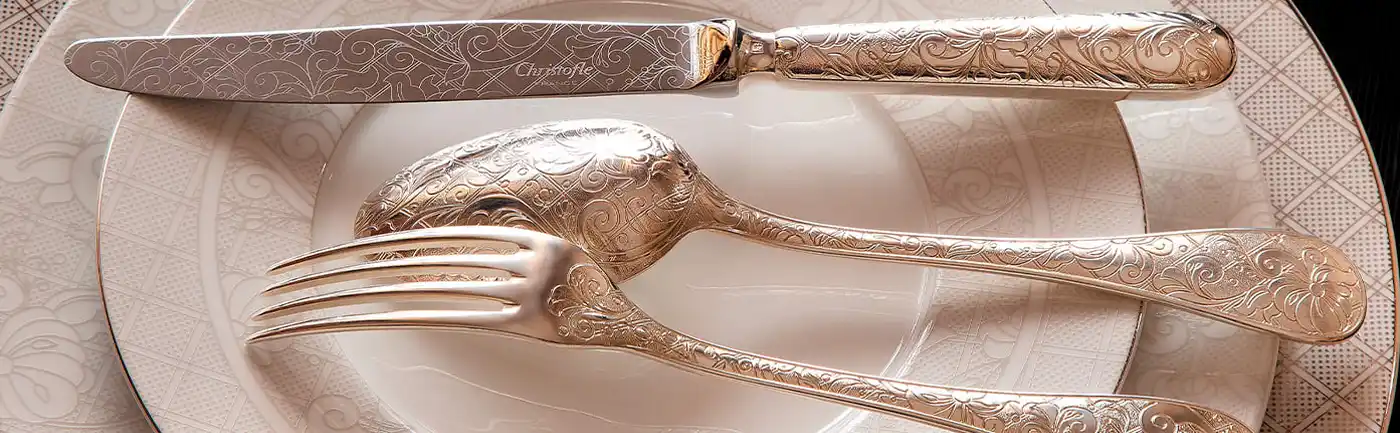
Is silver plated worth anything? As metal, almost nothing: the silver on a plated piece is a layer a few microns thick over copper, brass or nickel alloy, far too little to have bullion value, and a refiner will not pay for it. As an object, it can be worth a great deal: the design, the maker, the condition and the pattern are what give silver plate its value, and the best pieces by Christofle, Ercuis or Elkington are collected and used with the same seriousness as sterling. This article explains why the two answers coexist, how to tell which kind of plate you own, and when it makes sense to keep it, restore it or replace it with sterling.
Why silver plate has no bullion value
Electroplating deposits silver onto a base-metal object by electrolysis. The process was patented by Elkington and Company of Birmingham in the 1840s, as the Victoria and Albert Museum notes in its entry on an electrotype flagon made with the same technology, and within a generation it had replaced the older fused Sheffield plate and put silver-coloured tableware on tables that could never have afforded the solid metal. That was the whole point. A plated fork contains a fraction of a gram of silver; the rest is nickel silver (an alloy of copper, nickel and zinc that contains no silver at all), brass or copper. Even heavy “hotel plate” or Christofle’s generous deposits amount to a few grams of silver spread across an entire piece.
This is why the answer to “is silver plated worth anything” is a flat no at the scrap yard. Recovering a few microns of silver from a base-metal body costs more in chemistry than the silver is worth, so refiners buy plate, if they buy it at all, as copper or brass scrap by weight. The sterling equivalent is a different proposition entirely: a 925 piece is silver all the way through and has a melt value tied to the bullion market whatever its condition. Our comparison of sterling silver vs silver plated tableware goes through this difference in detail. The short version is that sterling has two values, metal and object, while plate has only the second.
Legally the distinction is just as sharp. In the United States, the Federal Trade Commission’s guides for the jewelry and precious metal industries, codified at 16 CFR Part 23, prohibit marking or describing a plated article as “silver” or “sterling” without a clear qualification such as “silver plate” or “electroplate”, and in the United Kingdom a plated piece cannot carry a hallmark at all. If an object has a lion passant, a Minerva head or the word “sterling” on it, it is not plate; if it has “EPNS”, “EP”, “A1” or a plate number, it is.
Where the value of silver plate really lies
Strip out the metal and what is left is everything that makes a piece of tableware worth owning: who designed it, who made it, how well it was made and how it has survived. On those criteria silver plate can outrank sterling. A Christofle “Malmaison” or “Marly” service, an Ercuis “Trianon” cutlery set or an Elkington tea service from the 1860s is a serious object regardless of what it is made of, and the market treats it as such. The maker is the first thing to establish, and marks are how you do it. Christofle has stamped every piece since 1844 with a system of hallmarks and quality numbers that lets you identify the period and the thickness of the silver deposit; our guide to Christofle silver marks explains how to read them, and the Maison’s own collection of hallmarks is the reference for the marks themselves.
Design comes second. Plate from the great nineteenth- and twentieth-century houses was often produced from the same models, by the same designers and in the same workshops as their sterling lines; the body is different, the form is identical. A plated piece by a named designer, in a pattern that is still produced or still sought, has a value that has nothing to do with its silver content. Rarity and completeness follow: a complete canteen for twelve in a discontinued pattern, with its serving pieces and its original case, is worth considerably more than the sum of its loose forks. Condition closes the list. Plate that has worn through to the base metal on the high points, that shows the pink of copper or the yellow of brass, has lost much of its appeal; plate that has been used carefully and polished gently can look like new after a century and a half.
Then there is old Sheffield plate, which deserves a sentence of its own. Made from about 1743 to the 1840s by fusing a sheet of silver to a copper ingot and rolling the two together, it predates electroplating and is a different material, with a much thicker silver layer and a distinctive construction. It is collected as antique silver in its own right, and it is the one category of “plate” where the question is silver plated worth anything gets an unreserved yes from every dealer we know.
How to tell what you have
Turn the piece over and look for marks. Sterling announces itself: “925”, “sterling”, a lion passant, a Minerva head, an eagle’s head on French silver, “800” or “835” on continental pieces. Plate announces itself too, but more quietly: “EPNS” (electroplated nickel silver), “EPBM” (electroplated Britannia metal), “EP”, “A1” (a quality grade on British plate), “silver on copper”, or a maker’s name with a numeral such as Christofle’s “84” and its related quality figures. Pseudo-hallmarks are the trap. Many Victorian manufacturers struck four or five small marks on plate that imitate a hallmark at a glance; the absence of a genuine standard mark, and the presence of one of the abbreviations above, gives them away.
If there are no marks at all, three observations help. Weight: nickel-silver plate is often heavier than sterling of the same size, because the alloy is denser and the gauge thicker. Wear: look at the tines of forks, the backs of spoon bowls and the edges of trays, where a plated piece shows a warm copper or yellowish tone as the silver thins and a sterling piece simply shows more silver. Sound and feel: sterling has a softer, slightly warmer surface under the thumb and a clearer ring when tapped, though this takes practice. When in doubt, a jeweller’s acid test on an inconspicuous spot settles the matter in seconds. What you should not do is scratch or file a piece to “see the base metal”, because a plated piece of real quality is damaged permanently by the attempt.
When to keep silver plate and when to replace it with sterling
Keep plate that is good. A Christofle or Ercuis service in sound condition is a pleasure to use, easy to maintain and perfectly at home at a formal table; the fact that it will never have melt value is irrelevant to the way it performs at dinner. Keep plate that means something, too: an inherited canteen whose pattern you love is worth more to you intact than any scrap price could reflect, and good plate can be re-silvered by a specialist when the high points finally wear through. Re-plating is a legitimate restoration for electroplate in a way that it is not for old Sheffield plate, which should be left alone.
Replace plate when it is anonymous, worn and incomplete. Unmarked EPNS flatware with copper showing at the tips, odd pieces from three different services, a tray that has been machine-polished into softness: these are exactly the objects that fetch nothing on resale and give little in use, and this is where a move to sterling makes sense. The argument for sterling is not only sentimental. Sterling tableware holds its value as metal through every change of fashion, can be polished for generations without ever wearing through, carries a hallmark that documents its origin and, in our experience at Scopelliti 1887, is the one purchase for the table that clients never regret. Begin with the pieces you use daily, flatware and serving pieces, and let the plate you still enjoy continue to earn its place beside them.
So, is silver plated worth anything in the end? It is worth what the object is worth, never what the metal is worth. That is a sobering answer for anyone hoping to sell a drawer of EPNS by the kilo, and a liberating one for anyone who owns a fine plated service and simply wants to go on using it.
Key points at a glance
Silver plate has no bullion value: the silver layer is a few microns thick over nickel silver, brass or copper, and refiners buy it as base-metal scrap if at all. Its value lies entirely in the object, in the maker (Christofle, Ercuis, Elkington and the other great houses), the designer, the pattern, the completeness of a service and its condition; old Sheffield plate, made by fusion before electroplating existed, is collected as antique silver in its own right. Plate is identified by marks such as EPNS, EPBM, EP, A1 or a maker’s quality number and by the absence of any true hallmark, since a plated article cannot be hallmarked in the UK and cannot legally be described as “silver” without qualification in the US. Keep plate that is good, named and in sound condition, and have it re-silvered when it wears; replace plate that is anonymous, worn and incomplete with sterling, which has both metal value and object value and can be used for generations.
Frequently asked questions about the value of silver plate
Is EPNS worth anything?
EPNS, electroplated nickel silver, has no silver value, because the nickel-silver body contains no silver and the plated layer is too thin to recover. Its worth depends on the maker, the pattern, the completeness of the set and its condition: a complete, named service in good order has real value as tableware, while worn, anonymous odd pieces have very little.
Is silver plate food safe?
Silver plate in good condition is safe to eat from; silver is inert and has been used for tableware for centuries. Pieces worn through to the base metal are better retired from food use or re-silvered, since exposed copper and brass can react with acidic foods and taint flavours. Wash plate by hand and dry it promptly, and avoid dishwashers and abrasive polishes.
What is the best way to sell silver plated items?
Sell plate as an object, not as metal. Identify the maker and pattern from the marks first, keep sets complete rather than splitting them, clean the pieces gently and photograph them well. Named services from houses such as Christofle, Ercuis or Elkington, and any old Sheffield plate, belong with a specialist dealer or auction house; anonymous worn plate is realistically a charity-shop or household-clearance item rather than something to sell for its silver.
Judging plate by the right measure
The question is silver plated worth anything has a clear answer once you stop weighing the metal and start looking at the object. Good plate from a good house is worth keeping, using and restoring; poor plate is worth replacing with sterling that will serve the table for the next hundred years. Reading the marks is the first step either way, and it is a skill worth acquiring before any piece of silver-coloured tableware leaves the house.
Contact us — if you would like advice on identifying a plated service or on choosing sterling tableware to replace it, our team will be glad to help.