
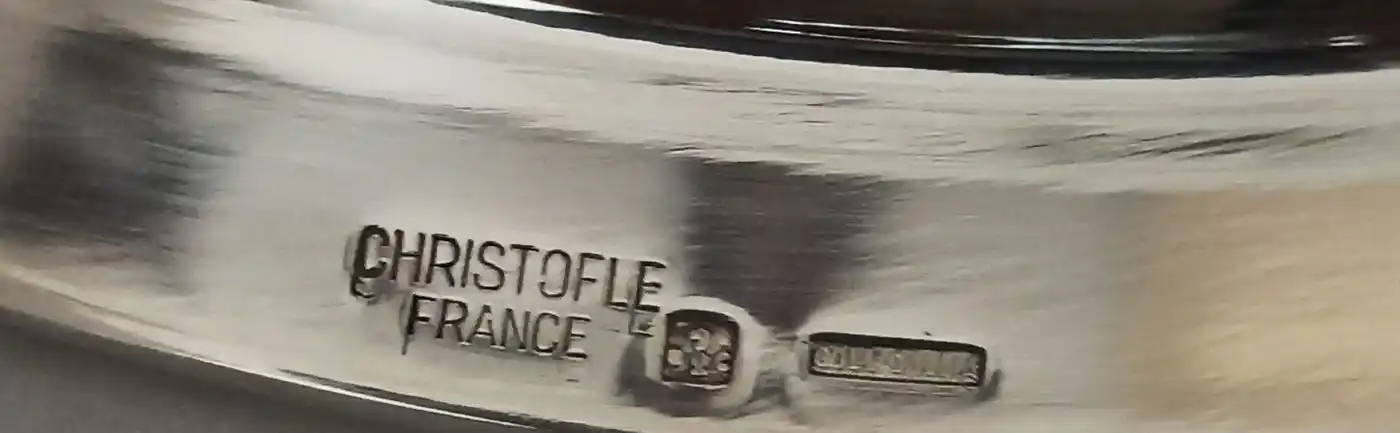
Silver hallmarks are the small stamped symbols that tell you what a piece of silver is made of, who is responsible for it, and often where and when it was tested. Read correctly, they answer the three questions every owner of silver eventually asks: is it solid silver or plate, how pure is the metal, and who made it. Read carelessly, they mislead, because a lion that is not quite a lion, a “925” struck on brass or a crown that belongs to a plating company all look convincing at arm’s length. This guide is the hub of our series on the marks found on silver. It explains what a hallmark is and what it is not, gives you a step-by-step method for reading a set of marks with a magnifier, compares the national systems of Britain, France, Italy, Germany and the United States, shows how to separate sterling from plate at a glance, and tells you where to look for the marks on flatware, hollowware and jewellery. Each section leads to a dedicated guide for the detail. It draws on the experience of a house that has handled silver for the table since 1887, and on the official sources of the assay offices and regulators whose marks these are.
Key points at a glance
Silver hallmarks are a set of stamped marks, not a single symbol. A full set can contain up to four elements: a standard or purity mark (the lion passant or 925 in Britain, the Minerva head in France, 800 or 925 with a star in Italy, the crescent and crown in Germany, the word STERLING in the United States), a maker’s or sponsor’s mark, an assay office mark where an assay system exists, and, on British silver, a date letter giving the year. Read them in that order: standard first, then office, then date, then maker. A piece with no standard mark and letters such as EPNS, EP or A1 is silver plate, not silver; a piece marked 925 with no other mark is a claim, not a guarantee. Marks sit on the back of the stem on flatware, under the base or on the rim of the foot on hollowware, and on clasps, shanks and posts on jewellery. Where no marks exist, weight, colour, a magnet and an acid test settle the question.
What you will find in this guide to silver marks
- British silver hallmarks explained: lion passant, date letters and assay offices — the five marks, the date letter cycles and how to date antique British silver
- French silver hallmarks: the Minerva head and how to date French silver — Minerva 1 and 2, the maker’s lozenge and the great Parisian houses
- Silver makers’ marks: how to identify who made a piece of silver — initials, registers, American, Fabergé and Buccellati marks
- Silver purity explained: 925, 800, 950 and 999 and what the numbers mean — the standards by country, Italian star marks and the German crescent and crown
- Sterling silver vs silver plated: the real differences and how to tell them apart — metal, value, care and the tests that separate them
- Silver plate marks: EPNS, A1 and how to read plated silver — the marks of electroplate and old Sheffield plate
- Vermeil and silver gilt: gold on silver explained — gilded sterling, its legal definition and its marks
- How to tell if silver is real: hallmarks, plate and home tests — the practical tests when the marks are missing or worn
What a silver hallmark is, and what it is not
The word hallmark is used loosely for any mark on silver, and the looseness causes most of the confusion. Strictly, a hallmark is a mark struck by an independent authority, an assay office, after testing the metal: it is a guarantee given by someone other than the maker. Britain has had such a system since the fourteenth century, France since the Middle Ages in a different form, and the Netherlands and a few other countries have their own. Most of the world, including Italy, Germany and the United States, has no assay offices at all. There the marks are applied by the maker under the supervision of the law, and strictly speaking they are not hallmarks but fineness marks and maker’s marks. In everyday use the word covers both, and this guide follows that usage, but the distinction matters when you weigh how much to trust a stamp.
Whatever the system, the marks on a piece of silver fall into four families, and the first skill is telling them apart. The standard or purity mark states how much silver the alloy contains: a figure such as 925 or 800, or a symbol that stands for one, like the British lion passant or the French Minerva head. Our guide to silver purity explains what each number means and why sterling settled at 925. The maker’s mark, called the sponsor’s mark in Britain, identifies who made or sold the piece and takes responsibility for it, usually through initials in a shaped punch or, on the Continent, a name or a device. The assay office mark, where one exists, identifies the office that tested the metal: the leopard’s head of London, the anchor of Birmingham, the castle of Edinburgh. The date letter, essentially a British feature, gives the year of assay. Reading a set of silver marks means recognising which family each symbol belongs to, and the most common mistake of all is taking a maker’s device for a standard mark, or a plating company’s trade mark for a hallmark.
Two kinds of mark are not hallmarks even though they sit beside them. Pattern and retailer names, such as the name of the shop that sold the piece, say nothing about the metal. Plating marks say the opposite of what the hopeful reader wants them to say: EPNS, EP, EPBM, A1 and “silver on copper” are declarations that the object is base metal with a skin of silver. The maker’s marks on plate can be elaborate and are frequently arranged to imitate a hallmark, which is exactly why knowing the real standard marks is the foundation of everything else. Our guide to silver makers marks goes into the registers and directories that turn a set of initials into a name.
How to read a set of silver hallmarks step by step
You need three things: a loupe of ten times magnification, a strong light that you can move so that it rakes across the surface, and patience. Hallmarks are struck small and polished for decades, and a mark that is invisible under a ceiling light will leap out when the light comes from the side. Find the marks first. On a spoon or fork they are on the back of the stem; on a bowl, teapot or candlestick, under the base or around the rim of the foot; on a tray, on the underside near the edge. Then follow the sequence below, which is the one we use on every piece that comes into our hands.
First, find the standard mark. Look for a figure between 800 and 999, a lion passant, a Minerva head, a thistle or lion rampant, a crescent and crown, or the word STERLING. If you find one, the piece is solid silver of that standard and you can move on. If you find none, stop and look for plating marks; a piece with neither is probably plate or base metal, however it looks. Second, identify the system. A lion passant with a town mark and a letter is British; a Minerva head with a lozenge is French; a star with a number and two letters is Italian; a crescent and crown is German; STERLING with a name is American. The system tells you which tables to open. Third, read the office and the date, if the system has them. On British silver the town mark and the date letter, read together against the tables for that office, give the city and the year; on French and Italian silver there is no date letter, and dating comes from the maker and the style. Fourth, identify the maker from the initials or device, now that you know the country and the approximate period, which narrows the search enormously. Fifth, look for anything that does not fit: marks too crisp for a worn piece, marks from two different offices, a sovereign’s head beside a twentieth-century date letter. Inconsistencies are how transposed marks and fakes reveal themselves.
When there are no marks at all, or they are worn beyond reading, the marks cannot help you and the metal itself has to answer. Weight, colour, the warmth of the surface, a magnet and, when it matters, a jeweller’s acid test on an inconspicuous spot will tell you whether you are holding silver. Our guide on how to tell if silver is real sets out each of these tests and what to do when they disagree. In our experience the marks and the metal almost always agree; when they do not, trust the metal and suspect the marks.
British silver hallmarks: the most complete system in the world
Britain is the only country whose hallmarks tell you, as a matter of routine, the year a piece was made. A traditional British set has up to five marks: the lion passant for sterling (a thistle or lion rampant on Scottish silver, Britannia for the higher 958 standard), the town mark of the assay office, the date letter, the sponsor’s mark and, from 1784 to 1890, the sovereign’s head showing that duty had been paid. Four assay offices are active today, London, Birmingham, Sheffield and Edinburgh, and the marks of the closed offices of Chester, Exeter, Newcastle, York and Glasgow turn up constantly on antique pieces. Since 1999 the compulsory marks have been reduced to three, the sponsor’s mark, the millesimal fineness figure and the office mark; the Goldsmiths’ Company Assay Office describes the current system on its page on UK hallmarks, and still applies the lion passant and the date letter as standard even though both are now optional.
The date letter is the feature that makes British silver so rewarding to collect and so demanding to read. Each office ran its own cycles, in its own typeface and shield, until 1975, so the same letter can mean different years in London and Birmingham; since 1975 all offices share one cycle, which began again with a capital A in 2025. The practical rule is to read the town mark before the letter, and the letter against the table for that office. Our full guide to british silver hallmarks explains the five marks one by one, tabulates the date letter cycles, works through a real set of marks on a Victorian spoon and sets out the workflow for dating antique British silver.
French silver hallmarks: the Minerva head and the maker’s lozenge
Reading French marks
French silver is marked under a state guarantee system administered by the customs authority, whose rules on hallmarking precious metals set out the current marks. The standard mark since 1838 is the head of Minerva, the helmeted goddess, accompanied by the figure 1 for the first standard of 950 parts per thousand or the figure 2 for the second standard of 800; since 1973 the 925 standard is also recognised. Beside it sits the maker’s mark, always in a lozenge, a diamond-shaped punch containing the maker’s initials and a small device, which is how French makers’ marks are told apart from everyone else’s at a glance. Imported pieces carry a swan. What French silver does not have is a date letter: a Minerva-marked piece is dated by its maker, by the small variations in the Minerva punch over time and by its style, not by a yearly cipher.
The French system matters to anyone who loves fine tableware, because the great Parisian houses, Christofle, Puiforcat, Odiot and Ercuis among them, set the standard for the European table in the nineteenth and twentieth centuries and their marks are the ones most often asked about. Our guide to french silver hallmarks covers the Minerva head in detail, the earlier marks of the Ancien Régime and the First Empire, the lozenge and the way the houses signed their work. Christofle’s own system of hallmarks and quality numbers, which applies to both its silver and its silver plate, has a guide of its own in the same series.
Italy, Germany and the United States: marks without assay offices
Three of the most important silver-producing countries have no assay offices, and their marks follow a different logic: the maker certifies, the law supervises. Each deserves a short account, and the comparison table that follows puts all five systems side by side.
Italy: 925 or 800 beside a star
Italian silver is stamped by the maker with two things: the fineness in millesimal figures, and an identification mark containing the maker’s registration number and the two-letter code of his province. Since the reform of 1968 that identification mark has been a five-pointed star, so a typical Italian stamp reads 800 or 925 beside a star enclosing, say, a number and MI for Milan or FI for Florence. The legal silver titles under the current decree of 1999 are 925 and 800 only. Before 1968 the mark was a fascio with number and province (from 1934), and before that regional marks that vary from state to state. Buccellati of Milan, whose textured surfaces are recognisable before the marks are read, stamps 925 with the Milan star; the two-digit numbers on Italian plated and steel flatware, such as 18/10 or 90, are grades of steel and plating, never silver purity.
Germany: the crescent and crown
German silver has carried the Halbmond und Krone, a crescent moon and imperial crown, since the fineness law of 1884 came into force in 1888. The crescent and crown is a national symbol, not an assay mark, and it sits beside the fineness, 800, 835 or 925, and the maker’s mark. There is no date letter and no office mark; dating relies on the maker and the style. Any piece with a crescent and crown is post-1888 and genuinely silver at 800 or better. The phrase “German silver”, by contrast, is a trade name for nickel silver, an alloy of copper, nickel and zinc that contains no silver at all; a piece marked German silver, Alpacca or Neusilber is base metal and will never carry the crescent and crown.
United States: the word sterling and the maker’s name
American silver has never had assay offices or a date letter. Nineteenth-century pieces are often marked COIN or with a maker’s pseudo-hallmarks imitating English ones; from the 1860s the word STERLING, or the figures 925, became standard, together with the maker’s name or trade mark. The words are regulated rather than the stamps: the Federal Trade Commission’s guides at 16 CFR Part 23 allow “sterling” only for articles of at least 925 parts per thousand and set the rules for describing plate and vermeil. American silver is identified by its makers, Gorham, Tiffany, Reed & Barton, Kirk and the rest, each with distinctive marks and, in Gorham’s case, a system of date symbols of its own.
The five systems compared
| Country | Standard mark | Maker’s mark | Assay office mark | Date mark | Standards |
|---|---|---|---|---|---|
| Britain | Lion passant (925), Britannia (958), thistle or lion rampant (Scotland); millesimal figures since 1999 | Sponsor’s initials in a shaped punch | Leopard’s head (London), anchor (Birmingham), rose (Sheffield), castle (Edinburgh) | Date letter, office cycles to 1975, shared cycle since | 999, 958, 925, 800 |
| France | Minerva head with 1 (950) or 2 (800); 925 since 1973 | Initials and device in a lozenge | None as such; small marks in the Minerva punch identify the bureau | None | 950, 925, 800 |
| Italy | Figures 925 or 800 | Star with maker’s number and province code (fascio 1934–1944) | None | None | 925, 800 |
| Germany | Crescent and crown with figures | Maker’s name or device | None | None | 800, 835, 925 |
| United States | STERLING or 925; COIN or 900 historically | Maker’s name or trade mark | None | None (Gorham used private date symbols) | 925, 900 |
Sterling versus silver plate at a glance
The question behind most searches for silver hallmarks is simpler than the hallmarks themselves: is this solid silver or plate? The marks answer it in a sentence. Solid silver carries a standard mark, one of the symbols or figures described above. Plate carries none, and instead carries one of the abbreviations of the plating trade: EPNS for electroplated nickel silver, EPBM for electroplated Britannia metal, EP, A1 as a quality grade, “silver on copper”, or a maker’s name with a plate number. The two sets of marks are different in kind, not in degree. A plated piece is base metal, nickel silver, brass or copper, under a layer of silver a few microns thick, and no legal system in the world allows it to be hallmarked as silver. Our comparison of sterling silver vs silver plated tableware goes through what the difference means for weight, value, wear and care.
The complication is that plate was made to look like silver, marks included. Victorian and Edwardian manufacturers struck sets of four or five small punches on their electroplate, a lion-like beast, a crown, a letter and initials, deliberately arranged to pass for a hallmark at a glance. The giveaway is always the same: no true standard mark, and somewhere on the piece the letters that confess what it is. Old Sheffield plate, the earlier fused plate made before electroplating, is a special case with its own marks and a collectors’ market of its own. Our guide to silver plate marks decodes the abbreviations, the pseudo-hallmarks and the quality numbers of the great plating houses, Elkington, Christofle and the Sheffield firms among them, and explains why plate can have real value as an object even though it has none as metal.
Gilded silver: how vermeil is marked
A gold-coloured piece raises its own question, and the marks answer it too. Gilded silver, called vermeil in the trade and defined in the United States as sterling covered with at least 2.5 microns of gold of at least ten karats, is marked as what it is underneath: silver. The lion passant, the Minerva, the star or the 925 are struck before gilding and show through it, and the gold itself is never hallmarked, because it is a finish rather than a metal standard. This is the quickest test of a gilt piece. Marks for silver under the gold mean gilded sterling; no marks, or plating marks, mean gilded base metal. Silver gilt has been the metal of the grandest tables for centuries, from the royal dining services of the Regency to the dessert sets of the Parisian houses, and it is still the natural choice for salt cellars, egg spoons and dessert services, where gold resists what silver would react with.
Where the marks sit: flatware, hollowware and jewellery
Knowing where to look saves more time than any table. On flatware the marks are on the back of the handle, usually near the junction with the bowl or the tines, struck in a straight line; on knives they are on the handle or the blade shoulder, and a sterling handle may carry a stainless blade with no marks of its own. On hollowware, bowls, sauceboats, teapots and candlesticks, look under the base, around the rim of the foot, or on the body near the handle; lids and detachable parts are often marked separately, and a lid whose marks do not match the body has been married to it later. On trays and salvers the marks are on the underside near the rim or, on earlier pieces, on the upper surface in a corner. On jewellery they are small and tucked away: inside the shank of a ring, on the clasp or the tag of a chain, on the post or back of an earring, on the pin or catch of a brooch.
Position also tells you something about completeness and authenticity. A canteen of flatware in which every piece carries the same set of marks is a matched service; one in which the marks differ in office or year has been assembled over time, which is not a fault but is worth knowing. The sterling silver flatware sets we offer are marked consistently piece by piece, and reading those marks before a purchase is a habit we encourage in every client, whether the piece comes from us or from an auction room. Marks on a lid that do not match the body, marks on a foot that look cut and let in, or marks far too sharp for a piece that is otherwise worn are all reasons to look harder.
Reading silver with a house that has done it since 1887
Silver marks are a language, and like any language they are learnt by use. The pieces that pass through a house dealing in fine tableware for well over a century teach it faster than any book: Georgian spoons with their duty marks, Minerva-stamped services from the Parisian houses, Italian 800 with the fascio of the thirties and the star of the seventies, plate masquerading as sterling and sterling hiding under a century of polish. Everything in this guide and in the articles it leads to comes from that practice, checked against the official sources of the assay offices and regulators. You can read more about the house and the way it works on our about us page. Our advice to anyone starting out is the advice we give ourselves on every piece: standard first, then office, then date, then maker, and trust the metal when the marks disagree.
Frequently asked questions about silver hallmarks
What are the British silver hallmarks?
A traditional British set has up to five marks: the standard mark (lion passant for sterling 925, Britannia for 958, thistle or lion rampant in Scotland), the assay office mark (leopard’s head for London, anchor for Birmingham, crown then rose for Sheffield, castle for Edinburgh), the date letter for the year of assay, the sponsor’s mark with the maker’s initials, and on pieces from 1784 to 1890 the sovereign’s head duty mark. Since 1999 the compulsory marks are the sponsor’s mark, the millesimal fineness and the office mark; the lion and the date letter are optional but still usually applied.
How do you check the hallmark on silver?
Use a ten-times loupe and a light that rakes across the surface. Find the marks (back of the stem on flatware, under the base on hollowware, on clasps and shanks on jewellery), then read them in order: standard mark first, which tells you whether it is silver and of what purity; then the national system; then the office and date letter if there are any; then the maker. Compare each mark against the published tables for that country and office rather than guessing from the letter alone.
Is there an app for silver hallmarks?
Image-recognition apps can sometimes identify a clear town mark or maker’s device, but they are unreliable on worn marks and on date letters, where the answer depends on the shield shape and typeface as much as on the letter. The dependable tools remain the official tables of the assay offices, the online archives of the offices themselves and a makers’ register. Treat an app as a first hint, never as a conclusion.
How can you tell silver without hallmarks?
Unmarked pieces are judged by the metal. Silver is heavy, not magnetic, slightly warm and soft to the touch, and tarnishes to a grey-black that polishes off cleanly; plate shows copper or brass at worn edges, and base metal is often lighter or magnetic. A jeweller’s acid test on an inconspicuous spot settles the fineness in seconds without harm. Many genuine pieces are unmarked, especially continental and colonial silver before the nineteenth century, so absence of marks is not proof of plate.
What does 925 mean on silver?
925 means that the alloy contains at least 925 parts of silver per thousand, 92.5 per cent, which is the sterling standard. It is the most widely used silver standard in the world, protected by law in Britain, the United States and the European Union. On its own, however, a 925 stamp is a claim rather than a guarantee: look for the marks that accompany it, a lion passant, an office mark, a Minerva, a star or a maker’s registration, and check weight and colour if there are none.
What do the silver hallmark symbols mean?
Each symbol belongs to one of four families. Animals and figures standing for a standard: the lion passant (sterling), Britannia (958), the Minerva head (French 950 or 800), the crescent and crown (German 800 or more). Town marks identifying an assay office: leopard’s head, anchor, crown or rose, castle. Letters in shields giving the year on British silver. Initials, names, lozenges and stars identifying the maker and, in Italy, his province. Reading a mark means first deciding which family it belongs to.
From the marks to the table
Silver hallmarks reward the few minutes it takes to learn them. Standard, office, date and maker: four families of marks, read in that order, tell you whether a piece is silver, how pure it is, where it was tested, when it was made and who made it, and the same four questions expose plate, pseudo-marks and married pieces for what they are. The guides linked throughout this page take each system and each question further, and they are written to be used with a loupe in the other hand. Whatever you are holding, a family spoon or a service you are considering for your own table, the marks will tell you the truth if you read them in order.
Contact us — if you would like help reading the marks on a piece of silver, or advice on choosing sterling for your table, our team is at your disposal.