
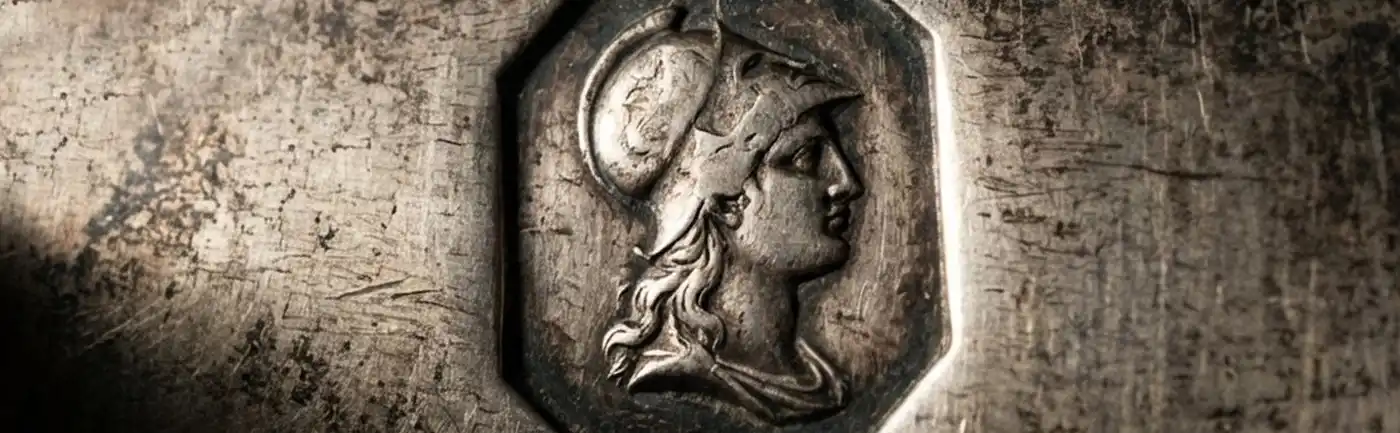
French silver hallmarks have a reputation for being harder to read than British ones, and the reputation is only half deserved. The system is different, not more difficult: instead of a row of four or five punches that spell out standard, town, year and maker, French silver carries two marks that matter, a state guarantee mark whose design tells you the standard and the period, and a maker’s mark in a lozenge that tells you the workshop. Learn to recognise a dozen designs, the Minerva head above all, and you can place almost any piece of French silver made in the last two centuries within a period and a standard. This guide, from a house that has handled the silver of Christofle, Puiforcat and Ercuis since 1887, explains the marks in the order you will meet them: the Minerva and her two standards, the small marks for small pieces, the lozenge, the marks that came before 1838, and how to turn all of it into a date.
How the French system works, and how it differs from the British one
France has guaranteed its precious metals by state mark since the revolutionary law of 1797, and the principle has not changed since. The guarantee is applied by the state, today through the customs administration and a handful of accredited laboratories, and the maker applies a separate mark of responsibility. The French customs service sets this out plainly on its page on hallmarking rules for precious metals: the guarantee mark is a state punch with a figurative design, checked against the official tables of the Monnaie de Paris; the maker’s mark is a lozenge; an importer’s mark of responsibility is an oval; and an object may only be sold as silver if it reaches 800 parts per thousand.
Two things about french silver hallmarks surprise collectors used to British silver. First, there is no town mark: the design of the guarantee punch and, for some periods, a small differentiating letter or number tell you the assay office, but you will not find a leopard’s head or an anchor. Second, there is no annual date letter. French silver is dated by the period in which a particular guarantee design was in use, which gives you a span of years rather than a single year, and then narrowed by the maker’s lozenge and by style. If you are used to reading british silver hallmarks, the adjustment is to stop looking for the year and start looking at the shape of the head.
Where do French marks sit in the broader picture? Our complete guide to silver hallmarks compares the national systems side by side. For France, the essentials are below.
The Minerva head: first and second standard
Since 1838 the guarantee mark for French solid silver has been the head of Minerva, the Roman goddess of wisdom and craft, in profile and wearing a crested helmet. It is the single most useful mark to memorise. If a piece carries the Minerva, it is French solid silver of at least 800 parts per thousand, made in or after 1838. Christofle’s own account of its marks, on the house’s collection of hallmarks, puts it in one line: the Minerva head has guaranteed silver since 1838, the large one for .925 and the small one for .800, and the mark is mandatory in France on silver items over 30 grams.
The Minerva comes in two standards, and the difference is a small numeral beside the head. Minerva 1, the first standard, has a “1” in the cartouche. Historically this meant 950 parts per thousand, the traditional French standard that is finer than sterling, and most French flatware and hollowware of the nineteenth and early twentieth centuries was made to it. In 1973 the first standard was lowered to 925 to align with the international sterling standard, so a Minerva 1 on a modern piece means 925 and on an older piece means 950; the dating guide below explains how to tell which. Minerva 2, with a “2”, means 800 parts per thousand, the second standard, used for heavier or more utilitarian work and for much provincial silver. The two heads also differ slightly in size and in the shape of their cartouche, which is how a practised eye reads the standard without a loupe.
Why does the standard matter beyond the metal content? Because 950 silver is softer and whiter than sterling, and French pieces made to it have a particular surface and heft that collectors prize. It is also why a French 950 spoon and a British 925 spoon of the same pattern and weight are not quite interchangeable in the hand.
Small pieces, small marks: the boar’s head and the crab
The Minerva is a large punch, and small objects cannot take it without damage. From 1838 France therefore used a second family of guarantee marks for small works, the petite garantie, which certify a minimum of 800 parts per thousand without distinguishing the two standards. The best known is the boar’s head, the hure de sanglier, used by the Paris office, and the crab, used by the provincial offices; from the early 1960s the crab served alone. You will find them on teaspoons, salt spoons, napkin rings, small boxes, thimbles and the fittings of dressing-table pieces. A coffee spoon with a crab and a lozenge is perfectly regular French silver; the absence of a Minerva on a small piece is not a warning sign.
One more head to know is the swan. The swan guarantees silver of foreign or uncertain origin sold in France, at a minimum of 800, and it appears on imported pieces and on second-hand silver whose original marks cannot be verified. A French-made piece should not carry it; a British or German piece that passed through the French trade often does, struck next to its original marks. Knowing the swan saves a great deal of confusion in mixed services.
The lozenge: reading the maker’s mark
Initials and a symbol
Beside the guarantee mark sits the maker’s mark, the poinçon de maître, and its shape is fixed by law: a lozenge, a diamond standing on its point. Inside are the maker’s initials and a personal symbol, a device chosen when the punch was registered, so that two silversmiths with the same initials can be told apart. The symbol is the key to identification. A knife between the letters, a star, a crescent, a bee, an animal, a tool of the trade: each was recorded in the register of insculpation at the time the maker began work, and the standard reference works reproduce those registers so that a lozenge can be traced to a name and a span of dates. The lozenge is struck on every piece, including small ones, and it is the mark you photograph first when you set out to identify French silver.
The marks of the great maisons
This is home ground for the houses whose work we have sold for generations. Puiforcat, founded in 1820 and the most admired of the Paris silversmiths of the twentieth century under Jean Puiforcat, used a lozenge with the initials of the firm and a knife as its device; the Minerva beside it is nearly always a Minerva 1, because Puiforcat worked in the first standard. Our article on the house explains how to read Puiforcat marks on a service and what the different periods look like. Christofle registered its first lozenge with the Paris guarantee office in 1832 and has used a sequence of marks since, including the famous balance stamp of 1844 to 1935 and the chess knight framed by OC that has identified the house since 1935; on its solid silver, those marks sit beside the Minerva, on its plate they stand alone with a plating weight. Ercuis, the third great name, built its reputation on silver plate rather than solid silver, so its flatware carries the house mark and the plating figure rather than the Minerva; the current ranges of Ercuis cutlery are marked in exactly that way. The practical rule: Minerva plus lozenge means solid silver; lozenge or house mark plus a number in grams means plate.
Before 1838: the Coq and the Vieillard
The Minerva replaced a sequence of earlier guarantee marks, and because each had a short life they are the most precise dating tools in French silver. After the law of 1797 swept away the royal marks, the new state guarantee was a cockerel, the Coq. According to the French bullion dealer BDOR’s guide to French silver marks, the first Coq, in use until 1809, shows the bird with its head turned to the left and a numeral 1 for the 950 standard or a fighting cockerel with a 2 for 800; the second Coq, from 1809 to 1819, uses four different designs within a double border. From 1819 to 1838 the guarantee was a profile head known as the Vieillard, the old man: in Paris, Michelangelo’s profile for 950 and Socrates for 800, while the provincial offices used a woman’s profile for the first standard and Raphael’s for the second. A piece with a Coq is therefore from the Consulate, Empire or first years of the Restoration; a piece with a Vieillard is from the Restoration or the July Monarchy; a piece with a Minerva is from 1838 onwards. Royal marks before 1797, with their crowned letters and charge and discharge punches, belong to a different world and a different article.
How to date French silver step by step
Put the pieces together and dating french silver hallmarks becomes a sequence of narrowing questions.
| Step | What to look at | What it tells you |
|---|---|---|
| 1 | The guarantee design | Coq: 1797 to 1819. Vieillard: 1819 to 1838. Minerva: 1838 to today. Boar’s head or crab: a small piece, 1838 onwards. Swan: foreign or uncertain origin. |
| 2 | The numeral beside the Minerva | 1 = first standard (950 before 1973, 925 after). 2 = 800. |
| 3 | The letter in the Minerva’s cartouche | From 1973 a letter changes every ten years: A for 1973 to 1982, B for 1983 to 1992, C for 1993 to 2002, D for 2003 to 2012, E for 2013 to 2022. No letter means before 1973. |
| 4 | The lozenge | Initials and symbol identify the maker; the register gives the years the punch was in use. |
| 5 | Style and pattern | Narrows the span within the maker’s active years; pattern books of the great houses date their models. |
An example from the sort of piece that comes across our counter. A set of table forks with a Minerva 1 and no letter, a lozenge with a knife between two initials, and a plain fiddle-thread pattern: French solid silver at 950, before 1973, by Puiforcat, and the pattern places it in the first half of the twentieth century. A sugar bowl with a crab and a lozenge: a small piece of at least 800, from 1838 onwards, whose maker the lozenge will name. A pair of candlesticks with a swan beside a lion passant: British sterling that was later sold through the French trade. In each case the marks did the work in under a minute.
Reading the marks in practice
A few habits make reading french silver hallmarks easier. They are often struck in places the British would not use: on the back of a fork just below the tines rather than on the handle, inside the foot of a bowl, on the rim of a lid. Look in all of them before concluding a piece is unmarked. Marks are small, especially the crab and the boar’s head, and a 10x loupe in raking light is the minimum. The Minerva’s numeral is tiny and sits at the base of the neck; it is the detail most often misread. And a French piece that shows a Minerva but no lozenge has usually had the maker’s mark worn away or polished out, which is a loss to its history but not a reason to doubt the metal.
Does a French mark prove quality? It proves the metal and the responsibility, and that is what a guarantee is for. The quality of the design, the weight of the gauge and the finish of the work are the maker’s contribution, which is why the lozenge of a great maison carries so much more than a name.
Key points at a glance
French silver hallmarks consist of two marks: a state guarantee mark applied by the customs administration, and a maker’s mark in a lozenge. There is no town mark and no annual date letter. Since 1838 the guarantee for solid silver has been the Minerva head: Minerva 1 is the first standard (950 parts per thousand until 1973, 925 since), Minerva 2 is 800. Small pieces carry the small guarantee marks instead, the boar’s head for Paris and the crab for the provinces, both certifying at least 800; the swan marks silver of foreign or uncertain origin. The lozenge contains the maker’s initials and a personal symbol, which the registers of insculpation translate into a name and dates. Before 1838 the guarantee was the Coq (1797 to 1819) and then the Vieillard profiles (1819 to 1838), which date a piece closely. From 1973 a letter in the Minerva’s cartouche changes every ten years. Puiforcat and Christofle solid silver carry the Minerva beside the house lozenge; Christofle and Ercuis plate carry the house mark with a plating weight and no Minerva. Marks are struck in unexpected places and are small: use a loupe and check every surface.
Frequently asked questions about french silver hallmarks
What does the Minerva head mean on silver?
The Minerva head is the French state guarantee mark for solid silver, in use since 1838. A Minerva with the numeral 1 is first-standard silver, 950 parts per thousand on pieces made before 1973 and 925 on later ones; a Minerva with the numeral 2 is 800 parts per thousand. Any piece bearing the Minerva is French solid silver, not plate.
What is the crab mark on French silver?
The crab is one of the French small guarantee marks, used on small pieces such as teaspoons, salt spoons and boxes that cannot take the large Minerva punch. It certifies solid silver of at least 800 parts per thousand. It was used by the provincial assay offices from 1838, alongside the boar’s head used in Paris, and later became the single small mark for the whole country.
How do you date French silver without a date letter?
By the design of the guarantee mark and the maker’s lozenge. The Coq dates a piece to 1797 to 1819, the Vieillard profiles to 1819 to 1838, the Minerva to 1838 onwards; since 1973 a letter in the Minerva’s cartouche changes every ten years. The lozenge identifies the maker, whose registered dates narrow the span further, and the pattern or style settles the rest.
Is 950 silver better than sterling?
950 silver, the traditional French first standard, contains 95 per cent silver against 92.5 per cent for sterling. It is slightly whiter and softer, which gives French pieces made to it a distinctive surface and feel, and it is prized by collectors for that reason. It is not more durable than sterling, which was adopted as the French first standard in 1973 partly because the harder alloy wears better in daily use.
From a head and a lozenge to a date
French silver hallmarks ask you to recognise designs rather than decode letters, and once the Minerva, the crab, the Coq and the lozenge are familiar the system is quick and reliable. Standard, period and maker come off the piece in that order, and the great maisons add a chapter of their own. If you have a French service to identify, a single piece whose marks you cannot place, or you would like to see how the houses we represent mark their work today, we are glad to look at it with you.
Contact us — our team can help you read a French mark or choose a piece.