
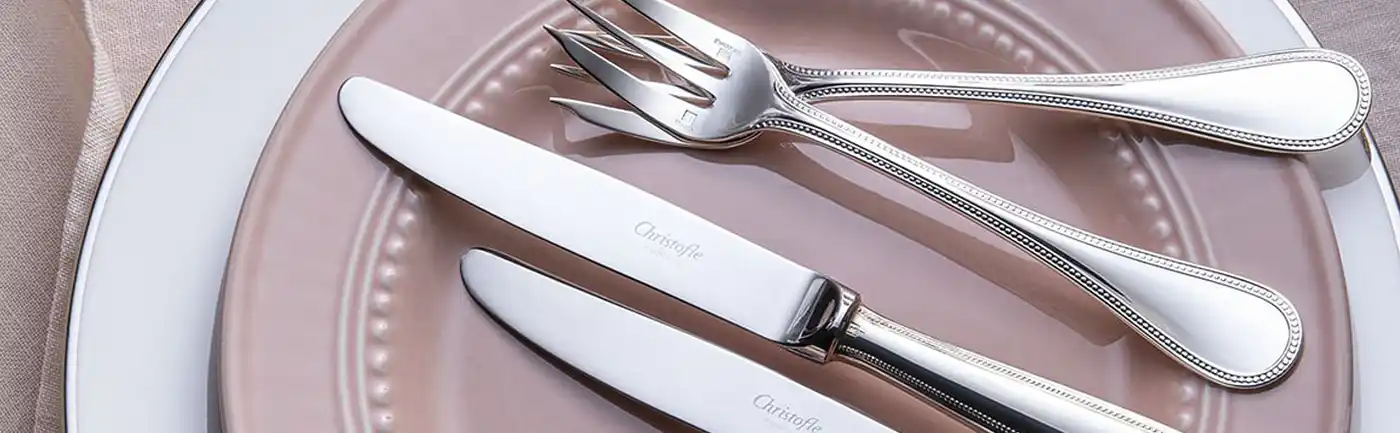
Sterling silver vs silver plated is the first question anyone asks about a piece of silver, and it is the right one, because the two materials look identical on the shelf and behave quite differently over a lifetime of use. Sterling is an alloy that is silver all the way through. Silver plate is a base metal object with a thin skin of silver on the surface. Everything else, the weight, the way the piece ages, what happens when it is scratched, how it can be repaired and what it is worth, follows from that one distinction. A house that has sold both since 1887 has no interest in telling you one is good and the other is not; the interest is in helping you tell them apart with confidence and choose the right one for the table you actually set. This guide does both.
What the two materials actually are
Pure silver is too soft for a fork or a teapot, so solid silver is always an alloy. Sterling is the international standard: 925 parts per thousand of silver, with the balance almost entirely copper for hardness. The metal is the same from the surface to the core, which is why a scratch on sterling exposes more sterling. Other solid standards exist, 800 in Germany and Italy, 950 historically in France, but the principle is the same.
Silver plate is a different object. The piece is made first in a base metal, then electroplated with a layer of silver that is typically a few microns thick, sometimes considerably more on the best flatware. The base can be nickel silver (an alloy of copper, nickel and zinc that contains no silver), brass, copper or Britannia metal. Christofle, which has made both materials since the 1840s, describes the distinction on its own page on silver and metals: its solid pieces use an alloy of at least 93 per cent silver and copper to reach 925 thousandths, while its plated pieces are coated with 99.9 per cent pure silver over a brass body. The plating is purer than sterling; there is simply very little of it.
Why does this matter for a buyer? Because the two products are not a better and a worse version of the same thing. They are two engineering solutions to the same problem, a durable silver surface for the table, and each has a logic of its own.
How to tell them apart: start with the marks
Marks settle most cases in seconds. Solid silver carries a fineness or a national standard mark: 925, 800, 950, the word STERLING, the British lion passant, the French Minerva head, the Italian star stamp with its oval. In Britain the Sheffield Assay Office lists three compulsory elements of a hallmark, the sponsor’s mark, the fineness and the assay office mark, and plated goods can carry none of them in official form because there is not enough silver to assay. In the United States, where there are no assay offices, the word STERLING is itself a legal claim that the piece is at least 925 parts per thousand, under the Federal Trade Commission’s guides for the precious-metal trades (16 CFR 23.5), which also require that any claim of silver plating be clearly qualified as a coating. How the national systems work, mark by mark, is the subject of our complete guide to silver hallmarks.
Plate speaks a different language. Look for letters that describe the base metal, EPNS, EPBM, EP, “Silver on Copper”, for grades such as A1 or “Quadruple Plate”, and for numbers that give the weight of silver deposited, the French 84 and the German 90 among them. A maker’s name alone, without a fineness, is also a signal: reputable firms made both materials under the same name, so the name proves responsibility, not metal. Our guide to silver plate marks decodes every one of these conventions. The one-line rule: a fineness or a national standard mark means solid silver; letters, grades or a plating weight mean plate; a name alone means look harder.
One trap. Plated pieces often carry pseudo-hallmarks, little crowns, shields and animals struck beside the maker’s name to imitate the look of a British hallmark. They never include a legal fineness, and they sit beside letters such as EPNS. If the row of marks looks like a hallmark but you cannot find a standard mark in it, it is plate.
Weight, sound, colour and wear: reading the object itself
When marks are worn or absent, the piece still answers. Pick it up. Sterling is dense for its size and feels substantial; the two most common plate bodies pull in opposite directions, Britannia metal being noticeably light and old fused Sheffield plate on copper being heavier than the sterling equivalent. Tap it gently. Sterling rings with a clear, sustained note; plated pieces, especially on Britannia metal, sound dull and short. Neither test is proof on its own, but together with the marks they are persuasive.
Colour and wear are more reliable still. Sterling has a warm white tone that stays the same when scratched, because the scratch exposes the same alloy. Plate wears through where the hand and the plate rub it most: the tips of fork tines, the back of a spoon bowl, the high points of a handle pattern, the rim of a tray. At those points a different colour shows, yellow or pink where the base is copper or brass, a dull grey where it is nickel silver or Britannia metal. A fork that is bright everywhere except for a faint yellowish shadow at the tine tips is plate, however convincing the rest of it looks.
Two tests you will read about are less useful than they sound. The magnet test tells you only that the piece is not steel: silver, copper, brass and nickel silver are all non-magnetic, so a plated fork on a nickel-silver body passes the magnet test exactly as sterling does. And an acid test, as The Silver Society notes in its guide to identifying silver, may only reveal a silver plate, since it tests just the surface layer; a plated piece reads as silver unless the tester files through the plating, which damages the object. Neither test replaces reading the marks and the wear.
How the two materials age
Both tarnish, because tarnish is a reaction between silver and sulphur in the air, and the surface of a plated piece is silver too. The difference appears with polishing. Every polish removes a microscopic layer of metal. On sterling that layer is replaced by more sterling, indefinitely; a Georgian spoon polished weekly for two centuries is thinner at the edges but still solid silver throughout. On plate the same polishing eats through the skin, and once the base shows there is no more silver to bring up. A well-plated piece from a good house lasts for decades of normal use before that happens; a lightly plated one can show its base within a few years of weekly polishing.
Plate has one answer that sterling does not need: replating. A worn plated service can be stripped and re-silvered, and the great French houses offer this as a service for their own pieces, which is why a heavily plated set from a good maker is a long-term purchase rather than a disposable one. Sterling is repaired differently, by a silversmith who can reshape, re-tip and re-solder the actual metal, and the repair is invisible because it is the same alloy. Scratches, too, behave differently: on sterling they can be polished out entirely; on plate deep scratches reach the base and cannot be polished away without making the problem worse.
The logic of value, without the figures
Sterling has two values stacked on top of each other: the metal and the object. Even a damaged sterling piece is worth its weight in silver, and a fine one is worth a great deal more as a piece of silversmithing. Plate has only the second value. The few grams of silver on a plated fork are not recoverable in any practical sense, so a plated piece is worth exactly what someone will pay for the design, the maker and the condition, and nothing for the metal. For a good Christofle or Ercuis service in fine condition that can still be a considerable amount; for an anonymous worn set it is very little. We set out the full reasoning, including when plate deserves to be kept and when it is time to move to sterling, in our article answering the question is silver plated worth anything.
The corollary matters when buying. The gap between the cost of a sterling service and a plated one from the same house reflects the metal, not the design or the finishing, which are often identical. You are paying for silver by weight and for the fact that it will still be there in a century. Whether that is worth it depends entirely on how the pieces will be used.
When plate is the right choice, and when sterling is
There is a persistent idea that plate is a compromise. In our experience it is often the correct choice, and the decision turns on four questions.
| Question | Plate suits you if | Sterling suits you if |
|---|---|---|
| How often is it used? | Daily, by a household, with the dishwasher a temptation | For occasions, hand-washed, or daily by someone who enjoys the ritual |
| How many pieces? | A large service for twelve or more, with every serving piece | A core service that will be added to over the years |
| What is the horizon? | Decades, with replating as a planned maintenance | Generations, as an heirloom and a store of value |
| What matters most? | The design and the maker’s name at a sensible outlay | The weight in the hand and the knowledge that it is silver throughout |
A plated service from a maison that makes its own sterling line is designed by the same hands and finished to the same standard; the pattern, the balance and the proportions are identical. If the table is used every day and the household is busy, plate wears gracefully, can be renewed and does not ask to be treated as a treasure. Sterling is the answer when the pieces are meant to outlive their owner, when weight and the particular feel of solid silver are part of the pleasure, or when the service is a wedding or anniversary gift intended to become the family’s silver. The sets in our sterling silver flatware sets collection are made for exactly that purpose, and the same houses’ plated lines sit alongside them for the other case.
Is there a wrong choice? Only the uninformed one: sterling bought as an everyday workhorse and resented for its care, or plate bought in the belief that it is solid silver. Read the marks, check the wear points, and decide with the table in mind.
Key points at a glance
Sterling silver is a solid alloy of 925 parts per thousand silver, the same from surface to core; silver plate is a base-metal object (nickel silver, brass, copper or Britannia metal) coated with a thin layer of pure silver. The quickest way to tell them apart is the marks: sterling carries a fineness or national standard mark (925, STERLING, lion passant, Minerva head), plate carries letters describing the base (EPNS, EPBM, EP), grades (A1) or a plating weight (84, 90), and never a legal fineness. The object confirms it: sterling is dense and rings clearly, plate shows a different colour at the wear points, the tine tips, bowl backs and high points of the pattern. The magnet test and the acid test do not distinguish the two reliably. Both tarnish, but polishing wears through plate while sterling renews itself; plate can be re-silvered, sterling can be repaired in the same metal. Sterling has metal value and object value, plate only object value. Plate is the right choice for a large, daily-use service with replating as maintenance; sterling for pieces meant to last generations and to be felt as silver in the hand.
Frequently asked questions about sterling silver vs silver plated
How can you tell sterling silver from silver plate?
Check the marks first: sterling carries a fineness or standard mark such as 925, STERLING, the British lion passant or the French Minerva head, while plate carries letters such as EPNS or EP, grades such as A1, or a plating weight such as 84 or 90, and never a legal fineness. Then look at the wear points, the tips of fork tines and the backs of spoon bowls: plate shows a yellow, pink or grey base metal where the silver has worn through, sterling stays the same colour. Weight and a clear ring when tapped support the verdict.
Does the magnet test work for silver?
Only partly. Silver is not magnetic, so a piece that sticks to a magnet is neither sterling nor good plate. But the usual plate bases, nickel silver, brass and copper, are not magnetic either, so a plated fork passes the magnet test exactly as sterling does. The test rules out steel; it does not separate sterling from plate.
Is silver plate worth buying?
Yes, when it is used for what it does best. A heavily plated service from a maker that also produces sterling is designed and finished to the same standard, wears gracefully in daily use and can be re-silvered when the plating thins. It has no metal value, so it is bought for design, maker and condition rather than as a store of value. Sterling is the better choice for pieces intended to last for generations.
Does sterling silver tarnish more than silver plate?
No. Both tarnish, because the surface of each is silver and tarnish is a reaction between silver and sulphur in the air. The difference is in polishing: on sterling each polish exposes more sterling, indefinitely, while on plate repeated polishing eventually wears through the thin silver layer to the base metal.
Choosing with the table in mind
Sterling silver vs silver plated is not a contest with a winner. One is silver through and through, with the weight, the longevity and the value that implies; the other is a thin skin of silver on a sensible body, made to the same designs and meant for a different kind of life. Read the marks, check the wear, and the material will tell you what it is. Deciding which belongs on your table is the more interesting question, and it is one we are glad to talk through, whether you are assembling a first service or adding to one that has been in the family for a century.
Contact us — our team can help you compare the two and choose a service.