
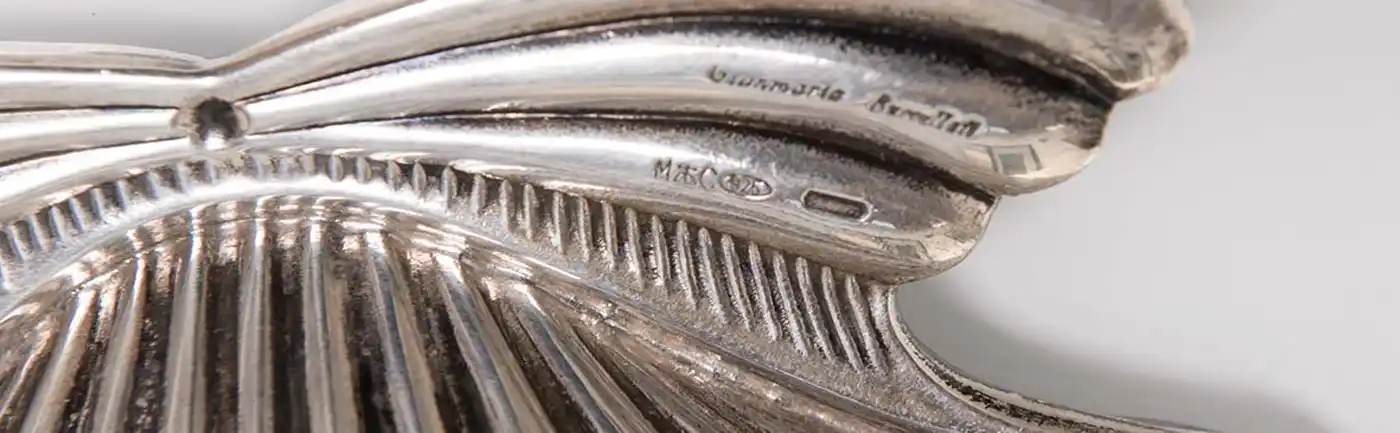
Silver makers marks are the small stamped initials, names or symbols that identify the workshop responsible for a piece of silver, and they are the single most useful mark on the object once you know how to read them. A fineness mark tells you what the metal is; an assay mark tells you who tested it; the maker’s mark tells you who stood behind it, and that is where attribution, dating and value all begin. The difficulty is that every country stamped them differently: initials in a shield in Britain, a symbol inside a lozenge in France, a star and a number in Italy, a full company name in the United States, Cyrillic letters beside an assay head in Russia. This guide, written by a house that has sold and handled fine silver since 1887, sets out how to read each of those systems, how to use the public registers to put a name to a mark, and how to recognise the marks of three makers our clients ask about most often: the great American manufacturers, Fabergé and Buccellati.
What a maker’s mark is, and what it is not
Start with a distinction that saves a lot of confusion. A maker’s mark is not a hallmark. In the British system a hallmark is the group of official marks struck by an assay office after testing, and the maker’s mark is one component of that group, the only one applied by the trade rather than by the office. The Goldsmiths’ Company Assay Office describes it today as the sponsor’s mark: a compulsory punch of between two and five initials inside a shield, registered with an assay office, and unique to the person or company that submits the item. Its stated purpose is “to establish responsibility rather than identify the manufacturer”.
That last phrase matters. The sponsor is whoever sends the piece to be assayed, which may be the silversmith, but may equally be a retailer, an importer or a firm that commissioned the work from a smaller workshop. The Silver Society puts it bluntly: the mark “was never intended for the purpose of identifying who actually made the item”. So when you identify a maker’s mark you are identifying the responsible firm, which is usually, but not always, the maker. On French, Italian, German and American silver the same logic holds under different names: poinçon de maître, marchio di identificazione, Meisterzeichen, manufacturer’s trademark.
How does the maker’s mark sit alongside the other marks on a piece? Our complete guide to silver hallmarks walks through the full set, country by country. For this article, keep the four categories in mind: maker (who was responsible), fineness (how much silver), assay or national mark (who guaranteed it), and date letter (when, where the system has one). Identify which punch belongs to which category before you try to decode any of them.
Reading the shape: shields, lozenges, cartouches and names
With silver makers marks, the outline of the punch often tells you the country before you read a single letter.
Initials in a shield or rectangle point to Britain and Ireland. Two or three letters, occasionally with a pellet or a small device between them, in a shield whose shape was chosen by the maker when the punch was registered. The same initials were used by different firms in different periods, which is why the shield shape and the accompanying date letter are part of the identification, not decoration.
A lozenge, a diamond-shaped outline, is French. Since the nineteenth century the French maker’s mark has by law been struck inside a lozenge containing the maker’s initials and a personal symbol: a star, a crescent, an animal, a tool. The symbol is the identifying element, because many French silversmiths shared initials. The lozenge sits beside the Minerva head, the French guarantee mark for solid silver, and the pairing is unmistakable once seen.
A star followed by a number and two letters in a polygon is Italian, and dates the piece to after 1968. The number is the silversmith’s registration number, the letters are the province (MI for Milan, FI for Florence, VI for Vicenza), and the fineness, 800 or 925, is stamped separately in an oval. We return to this system in the Buccellati section below.
A name or trademark spelled out in full is the American habit, and also that of large German and Scandinavian firms. American silver was never assayed by a state office, so the manufacturer’s name or trademark carries the whole burden of guarantee, usually with the word STERLING beside it. German silver after 1888 carries a crescent and crown with the fineness and, often, the firm’s name or device.
Cyrillic initials beside a woman’s head or beside crossed anchors are Russian. The initials belong to the workmaster, the head in a traditional headdress (the kokoshnik) is the state assay mark used from 1899, and a two-digit number such as 84 or 88 gives the fineness in zolotniks. Fabergé pieces follow this system exactly, as we shall see.
How to use the registers to identify a silversmith
Once you know the country, the registers of silver makers marks do the rest. The method is the same everywhere, and it is worth following in order rather than jumping to the first similar-looking mark in an image search.
First, record the mark properly. Photograph it in raking light with a macro lens or a phone against a 10x loupe, then write down every element: letters in order, the shape of the outline, any symbol, the position of pellets. On British silver, note the town mark and date letter next to it; they fix the assay office and the year, which narrows the search enormously, because each office kept its own register of sponsors. The structure of those marks, and how the date-letter cycles work, is covered in our guide to british silver hallmarks.
Second, consult the right register. For British and Irish marks, The Silver Society points researchers to the assay office websites (London, Birmingham, Sheffield, Edinburgh, Dublin) and to two long-standing online directories, silvermakersmarks.co.uk and 925-1000.com, with Bradbury’s Book of Hallmarks as the pocket reference and Jackson’s Silver and Gold Marks for serious work. For French marks, the registers of insculpation held in the national archives have been transcribed in the standard reference works, and the lozenge symbol is the key to the entry. For Italian marks, the province letters and the registration number lead to the chamber of commerce register of the province concerned.
Third, confirm with the object. A mark attributed to a London retailer on a piece whose construction is plainly Birmingham factory work is telling you something: the retailer sponsored it, a manufacturer made it. A workmaster’s initials on a Fabergé piece whose quality is below the house standard should raise a question rather than settle one. The register gives you a name; the piece has to agree with it.
American silver marks: STERLING, coin silver and the great manufacturers
American silver has no assay offices and no date letters. What it has instead is a legal vocabulary of fineness words and a tradition of large manufacturers whose trademarks are documented in detail. This makes American marks easy to classify and, with the big names, easy to date.
STERLING and coin silver
The word STERLING stamped in full, or the abbreviations STER or “Sterling Silver”, is a legal claim. Under the United States Federal Trade Commission’s guides for the jewellery and precious-metal trades (16 CFR 23.5), a product described as “solid silver”, “Sterling Silver”, “Sterling” or “Ster.” must be at least 925 parts per thousand pure silver, and anything described as “coin” or “coin silver” must be at least 900 parts per thousand. Earlier American silver, roughly before 1870, was often made to the coin standard and marked COIN, PURE COIN, DOLLAR or simply with the maker’s name, because the metal literally came from melted coinage. The appearance of STERLING on American flatware is itself a dating clue: it becomes general in the last third of the nineteenth century.
Gorham: the lion, the anchor and the G
The Gorham Manufacturing Company of Providence, Rhode Island, used a three-part trademark that is among the most recognisable in American silver: a lion passant, an anchor and a Gothic letter G, struck in a row. The lion borrows the British sterling symbol, the anchor is the arms of Rhode Island, the G is the firm. Gorham adopted the sterling standard for its wares in the 1860s and from then on added a system of year marks to hollowware, a letter in the early decades and then a sequence of small symbols, so that a Gorham bowl or tea service can be dated to the year from its marks alone. Flatware was not year-marked, but carries the trademark, STERLING and the pattern name or number.
Tiffany & Co. and the New England firms
Tiffany & Co. of New York marked its silver with the firm’s name in capitals, the word STERLING (and often the fineness 925-1000), a pattern number and an order number, and, from the 1870s, a small letter that changed with the president of the firm: an M during the long tenure of Edward C. Moore, then other initials as the directorship passed. Specialists use the letter and the number sequence to date a Tiffany piece within a few years. Reed & Barton of Taunton, Massachusetts, International Silver, Whiting, Wallace, Kirk and Dominick & Haff all used name or symbol trademarks with STERLING; most also produced plated lines marked EPNS or with plating grades, so the presence or absence of STERLING is the first thing to check on any American piece. The same manufacturers set the pattern for the complete services that remain the reference point for today’s luxury cutlery sets: a named pattern, a place setting of five to seven pieces and a long list of serving pieces, every one marked.
Fabergé hallmarks: workmasters, the kokoshnik and the zolotnik standards
The firm’s mark and the workmasters’ initials
The House of Fabergé did not make most of its objects in a single factory. It worked through independent workmasters, each with his own workshop, who produced to the firm’s designs and stamped their own initials on the finished piece. A Fabergé mark is therefore usually two marks: the firm’s name in Cyrillic, ФАБЕРЖЕ, sometimes preceded by the initial K for Karl, and the workmaster’s initials. On Moscow pieces the firm’s name generally appears under the imperial double-headed eagle, the warrant of a supplier to the court; on St Petersburg pieces the workmaster’s initials carry more of the weight, and some pieces bear only those.
The initials are the collector’s key. Michael Perchin, head workmaster from 1886 to his death in 1903, signed M.P. in Cyrillic; his successor Henrik Wigström used H.W. in Latin letters; August Holmström, the firm’s chief jeweller, A.H.; Julius Rappoport, the principal supplier of large silver, I.P. in Cyrillic for his Russian initials. Erik Kollin (E.K.), Anders Nevalainen (A.N.), Stephan Wäkevä (S.W.) and the First Silver Artel (1CA) account for much of the remaining silver. The names behind these initials, and the story of the house from its founding to 1917, are told in our article on Faberge history.
The Russian assay marks: 84, 88 and the kokoshnik
Beside the workmaster’s initials sit the state marks, and these are what date a Fabergé piece. Russian fineness was expressed in zolotniks, of which there were 96 in a pound: 84 zolotnik silver is 875 parts per thousand, the standard for most Russian silver, and 88 zolotnik is 916 parts per thousand, the finer grade used for the best Fabergé work; 91 zolotnik, rarer still, is roughly 948. Before 1899 the assay mark was the city arms, crossed anchors and a sceptre for St Petersburg, Saint George for Moscow, with the assayer’s initials and the year. From 1899 the empire adopted a single mark, a woman’s head in profile wearing the kokoshnik headdress, with the initials of the assay district; from 1908 to 1917 the head faces the other way and a Greek letter identifies the district. A Fabergé piece with crossed anchors is therefore pre-1899; one with a kokoshnik facing left is 1899 to 1908; one with the head facing right and a letter alpha is St Petersburg between 1908 and the Revolution.
Modern Fabergé marks
The name did not die in 1917, and the pieces made under it since then carry their own marks. The German workshop of Victor Mayer produced Fabergé objects under licence from the late 1980s with the mark VM alongside the Fabergé name, and the current house, revived under the Fabergé family’s historic name, marks its jewellery and objects with the name in Latin letters and the fineness of the country of assay. A contemporary egg pendant or a modern enamelled frame from Faberge will show a 925 or 750 mark and a European assay stamp, never a kokoshnik, and that is as it should be: the marks tell the truth about the period.
Buccellati and the Italian star stamp
The 1934 lozenge and the 1968 star
Italy regulated its maker’s marks late and then very precisely. According to the guide to Italian punches at silvercollection.it, a law of 5 February 1934 imposed a uniform mark for silversmiths: a lozenge containing the maker’s registration number, the fascio emblem and two letters for the province, paired with an oval giving the fineness, 800 or 925. A decree of October 1944 ordered the fascio removed, so for a few years pieces carry the old lozenge with the emblem struck out. The law of 30 January 1968, with its 1970 regulation, replaced the lozenge with a polygon and added a star on the left; the number and province letters stayed, and fineness marks of 925, 835 and 800 in an oval were permitted. That system is still in force, which is why every piece of Italian silver made in the last half-century shows the same three-part stamp: star, number, province.
Reading it is simple. The star tells you Italy and post-1968. The two letters tell you the province of the workshop. The number identifies the firm in that province’s register, and it is unique: two Milanese silversmiths cannot share a number. The separate oval gives the standard, 800 being the traditional Italian grade for hollowware and flatware and 925 the sterling grade favoured for export and for jewellery.
Reading a Buccellati piece
Buccellati, founded in Milan in 1919 by Mario Buccellati, is the Italian house most often brought to us for identification, partly because its silver is so distinctive and partly because its marks changed with the family firms over the decades. A Buccellati piece carries the house name, usually in full, together with the Italian star stamp with the MI of Milan and the fineness oval. Earlier pieces may show the pre-1968 lozenge. What confirms the attribution, though, is the surface: the engraved textures that the house made its signature, the fine parallel lines of rigato, the cross-hatched telato that imitates linen, the granular segrinato, worked by hand on every piece. We describe those techniques and the family’s history in our article on Buccellati silver, and the current collections of the house, still marked in exactly this way, are on our Buccellati page. The marks tell you the piece is Milanese and Italian-standard silver; the hand tells you it is Buccellati.
Maker’s mark and fineness: why you need both
Silver makers marks on their own prove responsibility, not metal. Plated goods from the nineteenth century onwards carry perfectly genuine makers’ marks, and some of the most reputable names in the trade, in Sheffield, Birmingham and Paris, made both sterling and plate under the same name. So the identification is only complete when the maker’s mark is read together with the fineness: 925, 800, 950, STERLING, the lion passant, the Minerva head, the star-number-province group with its oval. If the maker is identified and the fineness mark is missing, assume plate until proven otherwise. The standards themselves, what 925, 800, 950 and 999 mean and which countries use which, are set out in our guide to silver purity.
Two cautions from long experience. Marks can be transposed: a genuine old maker’s mark cut from a damaged spoon and let into a later piece, a practice outlawed in Britain but not unknown. Look for a faint outline or a change in surface colour around the mark. And marks can be imitated: pseudo-marks on plate copy the look of a British maker’s mark and date letter without the substance. In both cases the object settles the matter, not the stamp.
Key points at a glance
Silver makers marks identify the firm responsible for a piece of silver, which is usually but not always the workshop that made it; in Britain it is the sponsor’s mark, two to five initials in a shield registered with an assay office. The shape of the punch tells you the country: initials in a shield for Britain, a lozenge with a symbol for France, a star with a number and province letters for Italy after 1968, a full name or trademark with STERLING for the United States, Cyrillic initials beside a kokoshnik head for Russia. To identify a mark, record every element, fix the country and date from the accompanying marks, then consult the right register: assay office records and the standard directories for Britain, the insculpation registers for France, the provincial registers for Italy. American silver uses legal fineness words (sterling at least 925, coin at least 900) and documented trademarks such as Gorham’s lion, anchor and G and Tiffany’s name with a president’s letter. Fabergé pieces carry the firm’s name and a workmaster’s initials (M.P., H.W., A.H.) with Russian assay marks: 84 or 88 zolotnik and, from 1899, the kokoshnik. Buccellati silver shows the house name with the Milanese star stamp and is confirmed by its hand-engraved textures. Always read the maker’s mark together with the fineness mark: a maker’s mark alone does not prove the metal.
Frequently asked questions about silver makers marks
How do I identify a maker’s mark on silver?
Photograph the mark under magnification and note every element: the letters, the shape of the outline, any symbol and the marks next to it. Use the outline and the neighbouring marks to fix the country (a shield with initials is British, a lozenge is French, a star with a number is Italian, a full name with STERLING is American). Then look the mark up in that country’s register of silver makers marks: the assay office records and directories such as silvermakersmarks.co.uk or 925-1000.com for Britain, the insculpation registers for France, the provincial registers for Italy. Finally check that the quality and construction of the piece agree with the name you have found.
Is a maker’s mark the same as a hallmark?
No. A hallmark is the group of official marks applied after the metal has been tested by an assay office, and it guarantees the fineness. The maker’s mark, called the sponsor’s mark in Britain, is the one element of that group applied by the trade, and it identifies the firm responsible for the piece rather than the metal. A piece can carry a genuine maker’s mark and still be silver plate, so the two must always be read together.
What do the marks on Fabergé silver mean?
A Fabergé piece normally shows the firm’s name in Cyrillic, the initials of the workmaster who made it (for example M.P. for Michael Perchin or H.W. for Henrik Wigström) and the Russian state assay marks: a fineness in zolotniks, 84 (875 parts per thousand) or 88 (916 parts per thousand), and either the city arms used before 1899 or the kokoshnik head used from 1899 to 1917. Modern Fabergé pieces carry the name in Latin letters with a European fineness such as 925 or 750.
What does the star on Italian silver mean?
The star is the Italian state mark for silversmiths introduced by the law of 1968. It is struck in a polygon together with the maker’s registration number and two letters for the province of the workshop, such as MI for Milan, and it is accompanied by a separate oval giving the fineness, usually 800 or 925. The number is unique within the province and identifies the firm in the chamber of commerce register.
What does STERLING mean on American silver?
STERLING on American silver is a legal statement that the piece is at least 925 parts per thousand pure silver, as set out in the Federal Trade Commission guides for the jewellery and precious-metal industries. Older American pieces marked COIN or PURE COIN are at least 900 parts per thousand. Because the United States has no assay offices, the manufacturer’s trademark together with the word STERLING is the whole guarantee.
Putting a name to the mark
Silver makers marks are an invitation to do a little research, and the reward is a piece with a story: a workshop, a city, a decade, sometimes a name you can follow through the registers for three generations. Read the shape first, then the letters, then the marks beside it, and let the object confirm what the register tells you. If a mark on a piece of silver, old or new, is giving you trouble, or you would like to know more about the houses whose work we carry, we are glad to look at it with you.
Contact us — our team can help you identify a mark or choose a piece.