
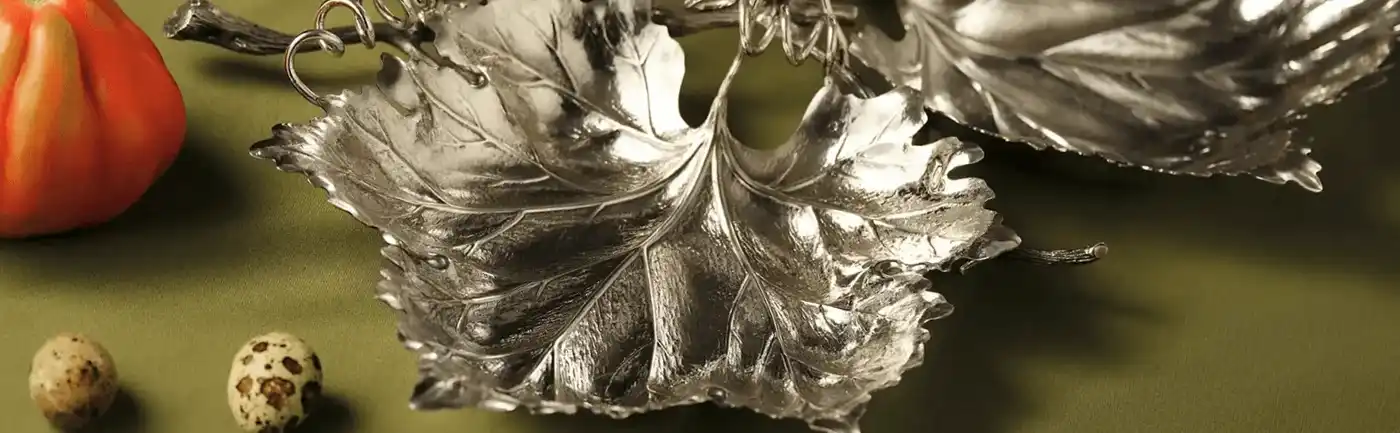
Buccellati is the Milanese goldsmith house whose engraved surfaces make gold and silver look like silk, linen or lace, and it has been doing so since 1919. Most people meet the name through jewellery. Collectors and hosts who spend time with the house soon discover a second world: silver bowls with leaves so fine they seem to move, animals chased fur by fur, fruit-shaped jars of Murano glass with silver stalks, and flatware that feels different in the hand. As a family retailer that has advised clients on fine silver since 1887, we find that the more people understand how these pieces are made, the more they enjoy living with them. Many of the pieces discussed here can be seen on our Buccellati silver and homeware page. This guide covers the story of the family, the engraving techniques that define the style, the silver and homeware collections, and how to care for and collect them.
From Mario to a century-old maison
The family’s connection with goldsmithing is older than the company itself. Mario, born in Ancona in 1891, came from a line that includes the eighteenth century jeweller Contardo Buccellati, and he began as an apprentice in Milan in 1903. As a young man he worked at the historic goldsmith workshop of Beltrami and Besnati, and in 1919 he took over the business and opened his own store in Via Santa Margherita. The official Buccellati maison history traces the expansion that followed: Rome’s Via Condotti in 1925, Florence’s Via Tornabuoni in 1929, and later New York, where Mario’s son Luca opened a store on 51st Street in 1951.
Milan gave the house its temperament. The city combined an old guild tradition with a modern, industrial confidence, and Mario’s clients were the aristocrats, industrialists and artists who wanted objects that looked back to the Renaissance without feeling like museum copies. The house’s Milanese hallmark, “15 MI”, is among the oldest in the city.
D’Annunzio and the “Prince of Goldsmiths”
No client shaped the legend more than Gabriele d’Annunzio, poet, aviator and one of the most flamboyant figures of twentieth century Italy. He commissioned numerous pieces from Mario, and the two men exchanged letters for well over a decade; the house counts 83 of them, written between 1922 and 1936. In 1936 d’Annunzio called Mario “the Prince of Goldsmiths”. The phrase stuck so firmly that the house still uses it; as Richemont’s announcement of the Venice exhibition recalls, it became the title of the retrospective staged on the Giudecca in 2024.
Generations at the bench
After Mario’s death, the business passed to his sons. Gianmaria, the best known of them as a designer, led the Italian house for decades, while Luca developed the brand in the United States. Gianmaria’s son Andrea joined as a teenager and later became creative director, and Andrea’s daughter Lucrezia began her apprenticeship alongside him in 2013. In 2020 Buccellati joined the Richemont group, a step that reunited the family branches under one name. Four generations, one visual language. That continuity is rare, and it is visible in the objects: a tray designed in the 1960s sits naturally beside a piece made this year.
The engraving techniques behind the Buccellati look
What makes these surfaces recognisable across a room? It is almost never polished plain metal. Every millimetre is worked by hand with a burin, a small steel engraving tool, and the house has names for each texture. The Buccellati craftsmanship page describes them in detail, and they are worth knowing before you look at a piece, because they change how you see it.
Rigato
Rigato consists of many fine lines cut parallel to one another. The effect is a soft, silky sheen that shifts as the light moves, like brushed fabric. It is the texture most people picture when they think of the house.
Telato
Telato uses fine lines that cross at right angles, recalling the weave of linen or canvas. It reflects less light than rigato but gives more tactile texture, and it works beautifully as a contrast to brighter areas.
Segrinato
Segrinato is built from crossed, overlapping strokes engraved in many directions. The result is a velvety, diffused glow, delicate rather than brilliant, and it is often used for naturalistic subjects such as flowers.
Ornato and modellato
Ornato adds ornamental motifs over a rigato ground, echoing brocades, damasks and lace. Modellato, the most complex of the family, reproduces shapes in high relief so that leaves and petals become tiny sculptures. The house also practises tulle, an openwork technique in which the metal is pierced into a honeycomb of small polygonal holes, each one refined by hand several times.
These methods have roots in the Renaissance workshop. As Phillips notes in its essay on Buccellati, the house looks to artists such as Lorenzo Ghiberti and Benvenuto Cellini, who trained as goldsmiths before they became famous as sculptors. That lineage explains a great deal. This silver is not decorated after it is made; the decoration is the making.
Buccellati silver: more than a sideline
Silver has been part of the house since the very beginning, and many of the most celebrated pieces are not jewels at all. Silversmithing draws on the same skills, scaled up: the chasing of a leaf on a centrepiece, the engraved feathers of a duck, the woven texture on the handle of a spoon. If you want to understand the broader craft that these pieces belong to, our overview of the art of crafting silverware covers alloys, hallmarks and workshop methods across the great houses.
The animals
The silver animals are perhaps the house’s most beloved objects. The menagerie includes ducks, bears, rabbits, squirrels, pigs, dogs, lobsters, dragons and the three wise monkeys, many in sterling silver and some with vermeil details. Their charm lies in the engraving: fur rendered in thousands of short strokes, feathers built up layer by layer. A long-standing tradition at the house is to choose a theme each year for the Christmas decorations, which is why animals, sea creatures and natural forms keep returning in new guises.
Tahiti and the natural world
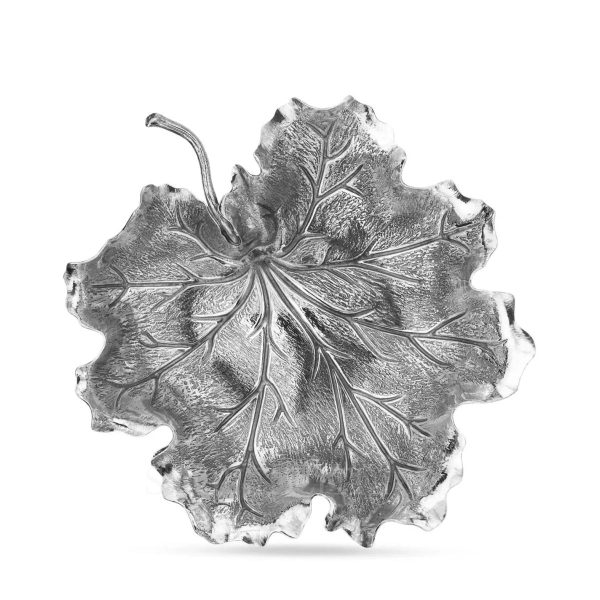
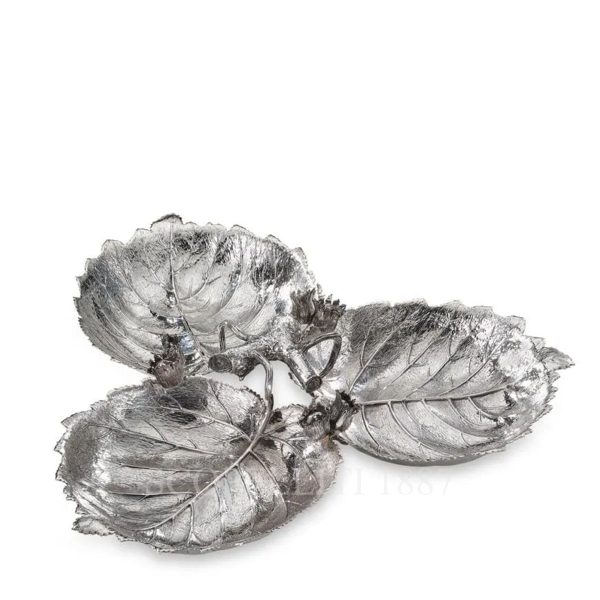
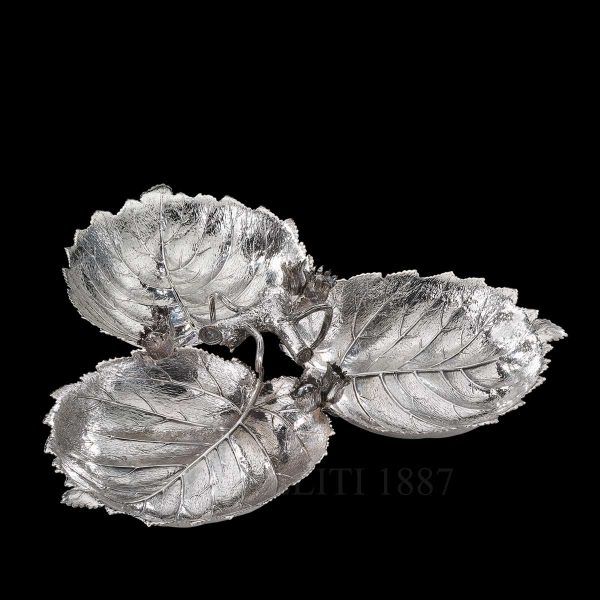
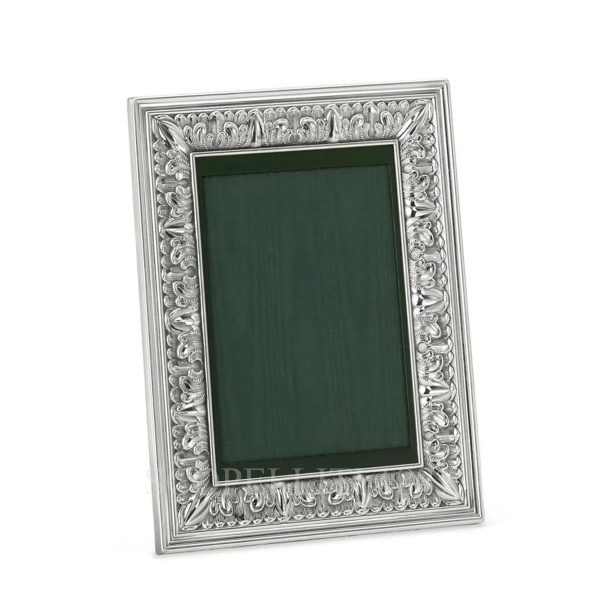
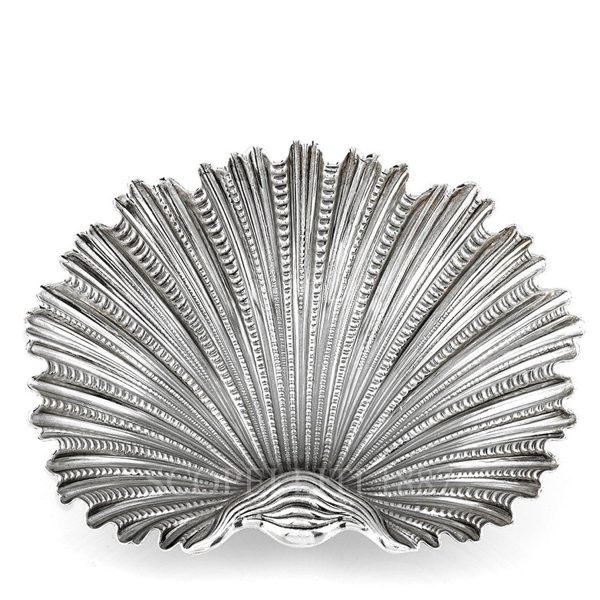
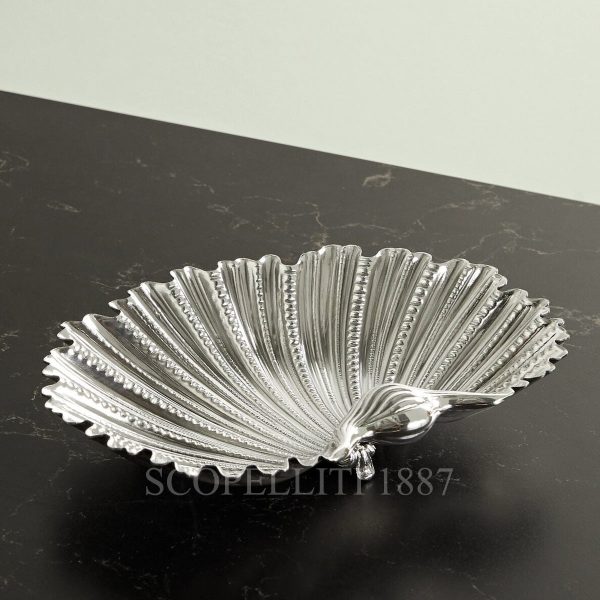
Tahiti is one of the house’s signature table collections. Designed by Gianmaria in the 1960s, it began as a commission from an Italian industrialist for his yacht and pairs silver with a bamboo motif inspired by the Polynesian island Gauguin painted. Today it spans flatware, bowls, trays, barware and even chess sets. Around it sit other collections rooted in nature, among them Nature, Sea and Boscoreale, with shells, leaves, fruit and vegetables translated into silver.
Murano glass
The Murano glass collection brings together Venetian mouth-blown glass and Buccellati silver mounts. Pears, lemons, apples, oranges, tomatoes, mushrooms and pumpkins become jam jars and containers, their glass bodies crowned with silver stalks and leaves. The house presents the collection as a tribute to its long affinity with Venice. On a breakfast table or a sideboard, these pieces introduce colour and wit without losing any sense of refinement.
Buccellati tableware and flatware at the table
The house’s tableware rewards a restrained setting. Because the surfaces are so richly textured, they look best against plain white porcelain, simple crystal and linen in a single tone. A Tahiti place setting on an ivory cloth is a lesson in how little else a table needs.
Flatware deserves particular attention. Engraved handles feel different from mirror-polished ones: the texture catches the fingers slightly and hides fine scratches that would show on plain silver. Before choosing a pattern, it helps to understand weight, balance and the difference between solid sterling and plated pieces. Our guide to choosing high quality cutlery that lasts a lifetime explains what to check in the hand, and our collector’s guide to sterling silver flatware sets covers composition, place settings and serving pieces.
A practical approach many of our clients follow is to start with the objects that live on the table every day, such as a pair of salt cellars, a bread basket or a small bowl, and build towards flatware for eight or twelve over time. Silver used daily develops a soft, even patina that many collectors prefer to the brightness of a freshly polished piece.
How to care for Buccellati silver
Engraved silver asks for a gentler routine than plain silver, because aggressive polishing can soften the crisp edges of rigato or segrinato. The good news is that regular use is the best protection.
- Wash by hand. Use warm water and a mild, phosphate-free detergent, then dry immediately with a soft cotton or linen cloth. Avoid the dishwasher, which can dull the finish and stain the recesses of the engraving.
- Keep acids and salt brief. Egg, mayonnaise, vinegar, salt and citrus accelerate tarnish. Rinse pieces soon after contact.
- Polish rarely and softly. Use a dedicated silver cloth rather than dips or abrasive pastes, moving along the direction of the engraving. A soft brush can lift residue from deep textures.
- Store away from air and sulphur. Wrap pieces in anti-tarnish cloth or pouches, and keep them away from rubber bands, felt with adhesives and oak cabinets, which release compounds that tarnish silver.
For step-by-step methods, our guide on how to clean silver cutlery without damaging it applies equally to engraved serving pieces. For silver animals and vermeil details, we recommend dusting with a soft brush and asking for professional cleaning if tarnish reaches the fine textures.
Collecting Buccellati: what to look for
Building a collection is less about rarity for its own sake and more about choosing pieces with character. A few principles help.
Follow a theme. Animals, the Tahiti bamboo motif, sea creatures or Murano fruit each make a coherent collection. A shelf of silver animals gathered over years tells a story; a random mix rarely does.
Read the surface. Look closely at the engraving. Lines should be even and continuous, textures consistent across the piece, and relief crisp rather than rounded by over-polishing. On older pieces, gentle wear in raised areas is normal and part of the history.
Check the marks. Look for the maker’s mark and the silver standard. Keep boxes, pouches and any documentation, which support provenance.
Buy from an authorised source. The house’s reputation attracts imitations, particularly of the animals. Buying through an authorised retailer guarantees authenticity and gives you access to after-sales care.
Gifts are often where a collection starts. A silver animal marking a birth, a Tahiti piece for a wedding, or a Murano jar for a host: each carries the same craftsmanship and becomes the first of many.
Key takeaways
Buccellati was founded in Milan in 1919 by Mario Buccellati, whose friend and client Gabriele d’Annunzio called him “the Prince of Goldsmiths” in 1936. The house expanded to Rome, Florence and New York, passed through four generations of the family and joined the Richemont group in 2020. Its style rests on hand engraving with named techniques: rigato (parallel lines with a silky sheen), telato (cross-hatching like linen), segrinato (overlapping strokes with a velvety glow), ornato (brocade-like ornament) and modellato (high relief), alongside tulle openwork. Silver has been part of the house since the start, from the engraved animals to the Tahiti bamboo collection designed by Gianmaria in the 1960s and Murano glass pieces with silver mounts. To care for Buccellati silver, wash by hand, dry at once, polish gently along the engraving and store in anti-tarnish cloth. Collect by theme, inspect the engraving and marks, and buy from an authorised retailer.
Frequently asked questions about Buccellati
Who founded Buccellati?
Buccellati was founded in Milan in 1919 by Mario Buccellati, who took over the goldsmith workshop of Beltrami and Besnati and opened a store in Via Santa Margherita. Gabriele d’Annunzio later called him “the Prince of Goldsmiths”.
What is Buccellati known for?
Buccellati is known for hand engraving that gives gold and silver the look of fabrics such as silk, linen and lace. Its signature techniques include rigato, telato, segrinato, ornato and modellato, and it is equally renowned for silver objects, from animals to tableware.
Is Buccellati silver sterling?
Buccellati silver objects such as the animals and tableware are made in sterling silver, and some pieces include vermeil, which is silver finished with gold. Check the marks and product details of each piece for its exact standard.
Who owns Buccellati now?
Buccellati joined the Richemont group in 2020, which reunited the family branches of the business under a single brand. Andrea, grandson of the founder, has served as creative director, with his daughter Lucrezia also working in the house.
How do you clean Buccellati silver?
Wash by hand in warm water with a mild detergent and dry immediately with a soft cloth. Polish rarely with a silver cloth, following the direction of the engraving, avoid dips and the dishwasher, and store pieces in anti-tarnish cloth.
Bringing Buccellati to your table
Whether you are drawn to a single engraved animal or planning a full service of flatware, this silver is made to be used, handled and handed down. Take time to look at the surfaces, choose a theme that suits the way you live and entertain, and let the collection grow with you. You can explore the current silver, tableware and gifts on our Buccellati collection page, where each piece is presented with its details.
Contact us: if you are looking for a specific pattern, a gift or advice on starting a collection, speak with our team. Or discover the collection online.