
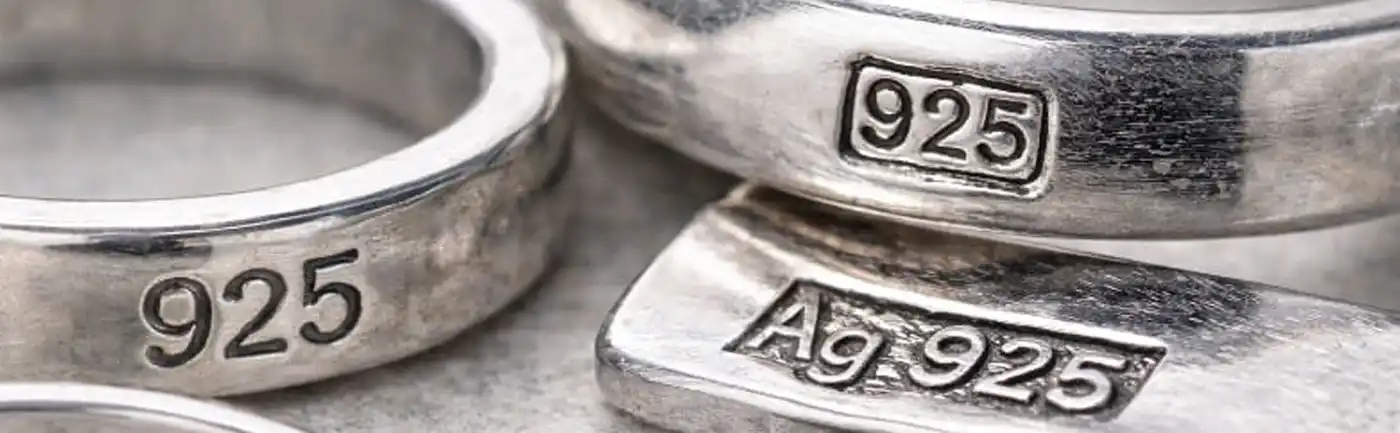
925 silver is an alloy of 92.5 per cent pure silver and 7.5 per cent other metals, almost always copper, and the three digits stamped on the piece are simply that proportion expressed in parts per thousand. The same logic explains every other number you will find on silver: 800 means 80 per cent silver, 950 means 95 per cent, 999 means as pure as the metal is sold. Behind those figures sit centuries of national law, a handful of different traditions and a few traps for the unwary buyer. This guide explains what the numbers mean, why sterling settled at 925, how 800 silver differs in colour and weight, where the higher standards come from, and how to read the purity stamps on Italian and German silver, which follow their own rules.
What silver purity means and how it is measured
Pure silver is a beautiful and nearly useless metal for the table. It is so soft that a fork made of it would bend in the hand, and it scratches at the touch of a steel knife. Every piece of silverware ever made for use is therefore an alloy, and silver purity, or fineness, is the measure of how much of that alloy is actually silver. Since the nineteenth century the convention has been millesimal: the fineness is written as parts of silver per thousand parts of metal, so that 925 means 925 parts silver and 75 parts something else. Older systems expressed the same idea differently. Britain spoke of ounces and pennyweights to the troy pound, Russia counted in zolotniks (84 zolotnik is 875 millesimal), and France still speaks of its two “titres” by the Minerva marks that denote them. All of them answer the same question: how much of this is silver?
The remaining parts are not filler. Copper is the usual choice because it hardens the alloy without changing its colour very much, and the precise balance between hardness, workability and resistance to tarnish is what each national standard tried to fix. This is also why a purity number alone tells you less than a full hallmark. In countries with an assay system the number is one element among several, struck beside a maker’s mark and an office mark, and our guide to silver hallmarks explains how those elements fit together. In countries without one, the number may be the only guarantee you get, and it is only as trustworthy as the person who stamped it.
What does 925 mean on silver? Sterling explained
925 on silver means sterling: 925 silver is an alloy of at least 92.5 per cent silver. The word is English and very old. The standard was fixed for the coinage in the twelfth century and extended to wrought silver in 1300, when Edward I required that silverware be “of the sterling alloy” and tested at Goldsmiths’ Hall before sale. Why 925? Because the proportion is a working compromise that has never been improved upon: enough copper to make flatware that survives daily use and holds a crisp edge, enough silver to keep the white colour, the weight in the hand and the resistance to corrosion that distinguish silver from everything else. In our experience at Scopelliti 1887, where we have handled fine tableware since 1887, sterling is the standard that every serious maker returns to when the object is meant to be used rather than displayed.
Sterling silver 925 is also the most widely regulated standard in the world. In the United Kingdom it is the sterling standard under the Hallmarking Act 1973, marked with the figures 925 and, by tradition, the lion passant. In the United States, where there is no assay system, the Federal Trade Commission’s guides for the jewelry and precious metal industries at 16 CFR Part 23 allow the words “sterling” or “sterling silver” only for articles that are at least 925 parts per thousand silver, which is why American pieces so often say STERLING in capitals rather than carrying a number. In the European Union 925 is one of the recognised standards in every member state and the one used for export almost everywhere. When you see 925 silver stamped on a piece, you are looking at the one purity number that means the same thing from London to Los Angeles to Milan.
For tableware this matters in a very practical way. Flatware takes more abuse than any other category of silver: it is used, washed, dried and polished thousands of times. A 925 alloy stands up to that regime, which is why the sterling silver flatware sets we select are all made to it, whatever the country of origin of the house. Higher purities are softer than 925 silver and reserved for pieces that are handled gently; lower purities are a little harder still but pay for it in colour, as the next section explains.
What does 800 mean on silver? The continental standard
800 on silver means 80 per cent silver and 20 per cent other metal, and it is the historic standard of continental Europe: Germany, Austria, Hungary, Italy and much of Central Europe used it as their everyday grade for tableware from the nineteenth century onward. The extra copper makes 800 silver fractionally harder and noticeably cheaper to produce, but it also gives the metal a slightly warmer, greyer tone than sterling and makes it tarnish faster, because tarnish is a reaction of copper as much as of silver. Side by side on a white cloth the difference is visible to a trained eye; in a single piece under ordinary light it is not.
What 800 silver lacks in purity its makers often made up in weight. Continental flatware and hollowware in 800 are frequently made in a heavier gauge than their British or American equivalents, so that a German or Italian 800 fork can contain as much actual silver as a lighter sterling one. This is the point to remember when someone describes 800 silver as inferior: it is a different standard, not a lesser craft, and some of the most beautiful European silver of the last two centuries was made to it. It is also a legal standard in Britain today. The Hallmarking Act’s Schedule 2, available on legislation.gov.uk, lists four silver finenesses, 999, 958.4, 925 and 800, so a continental 800 piece can be fully hallmarked in the UK, with the figures 800 but without a lion passant, which is reserved for 925 and above.
Between 800 and 925 sit two intermediate grades you will meet on antique pieces. 835 is a German and Dutch standard, common on twentieth-century German flatware and on Dutch silver of all periods. 830 is Scandinavian, found on Danish, Norwegian and Swedish silver before many of those makers moved to 925 for export. Both behave like 800 in colour and care, and both are genuine silver.
950, 958 and 999: the higher standards
Above 925 silver lie three standards, each with a story. 950 is the first French standard, the “premier titre”, marked since 1838 with the head of Minerva accompanied by the figure 1. France is unusual in having set its principal standard above sterling, which is one reason French silver from the great Parisian houses has a particular brightness and a particular softness; the pieces are gorgeous and they mark easily. The French second standard was 800, Minerva with the figure 2, and in 1973 France also adopted 925 so that its makers could compete on export markets.
Britannia silver 958 is an English invention of 1697, when Parliament raised the standard for wrought plate to 95.84 per cent in order to stop silversmiths from melting down sterling coin for raw material. The lion passant was replaced by the seated figure of Britannia, and the standard remained compulsory until 1720. It survives today as a voluntary higher standard, still marked with Britannia, and it is favoured by some contemporary silversmiths precisely for its softness and its slightly whiter colour. Fine silver 999 is the metal in its commercial purity, 99.9 per cent. It is used for bullion, for some modern jewellery and for the thin sheets of silver leaf used in gilding and in confectionery, but almost never for tableware, because an object made of it would not survive its first dinner. 900, finally, is the American coin silver of the nineteenth century, so called because it was the standard of United States coinage before 1965 and because early American silversmiths often made their spoons from melted coins.
Silver purity standards by country
The table below gathers the standards you are most likely to find on tableware and the marks that normally accompany them. Standards are legal minima: a maker may always exceed them.
| Country | Standards in use | Typical marks | Notes |
|---|---|---|---|
| United Kingdom | 999, 958 (Britannia), 925 (sterling), 800 | Millesimal figures plus lion passant (925), Britannia (958), assay office mark, sponsor’s mark, date letter | Full assay system; 800 added for continental imports. |
| France | 950 (premier titre), 800 (second titre), 925 | Minerva head with 1 or 2; maker’s mark in a lozenge; swan on imported pieces | No date letter; dating is by maker and style. |
| Germany | 800, 835, 925 | Crescent and crown (Halbmond und Krone) with the fineness number and maker’s mark | Mandatory system since 1888; “German silver” is not silver. |
| Italy | 925, 800 | Fineness figures plus a star enclosing the maker’s number and province code | Legal titles fixed by D.Lgs. 251/1999; star stamp dates from 1968 law onwards. |
| United States | 925 (“sterling”), historically 900 (“coin”) | The word STERLING or 925; maker’s name or trademark | No assay offices; FTC rules govern the words. |
| Netherlands | 925, 835 | Lion passant for 925, lion rampant for 835, Minerva head office mark | Date letters used. |
| Scandinavia | 925, 830 | 830S, 925S, maker’s mark; Denmark’s three towers | 830 common on pre-war pieces. |
| Russia (Imperial) | 84 zolotnik (875), 88 (916), 91 (947) | Zolotnik number, kokoshnik head from 1899, assayer’s initials | Zolotnik system, not millesimal. |
Italian silver marks: 800, 925 and the star-and-number stamp
Italian silver marks are among the easiest in the world to read once you know the system, and among the most confusing if you do not. Italy has no assay offices in the British sense; responsibility lies with the maker, who is registered with the local Chamber of Commerce and stamps the pieces with an identification mark of his own. Under Legislative Decree 251 of 1999, which replaced the law of 1968 and whose text is published by the Chamber of Commerce of Mantua, every article of precious metal must carry two things: the fineness in millesimal figures and the maker’s identification mark, which contains “the number identifying the producer or importer and the abbreviation of the province in which he resides”. The legal silver titles under the decree are two, 925 and 800, which is why Italian silver is almost always one or the other.
The identification mark is the star. Since the 1968 reform it has taken the form of a five-pointed star enclosing the maker’s number and the two-letter province code: MI for Milan, FI for Florence, VI for Vicenza, AL for Alessandria (the seat of the Valenza goldsmiths), NO for Novara, and so on. Read the star and you know the city and, with a register, the workshop. Read the figures beside it and you know the purity. Before 1968 the system was different: from 1934 Italian silver carried a fascio mark with the maker’s number and province, and before 1934 regional marks that vary from state to state in pre-unification Italy. A piece with a fascio is therefore 1934 to 1944 or thereabouts; a piece with a star is post-1968; a piece with only “800” and a name may be anything from the 1870s onward.
Two worked examples show how this plays out. Buccellati silver is made in Milan to the 925 standard and carries the house’s engraved signature together with the 925 figure and the Milan star; it is one of the few Italian houses whose pieces are recognised at sight before the marks are even read, because the textured, engraved surfaces are a signature in themselves. Sambonet, by contrast, is a case where the numbers confuse. The firm’s best-known tableware is stainless steel, and the “18/10” on it is a steel grade (18 per cent chromium, 10 per cent nickel), not a silver purity. Its silver-plated lines carry figures such as “90”, which refer to the weight of silver deposited in the plating, following a continental convention, and again not to purity. Only a Sambonet piece that carries 800 or 925 with a star is solid silver. The rule is general: on Italian tableware, a two-digit number is almost never a fineness, and a three-digit number without a star should be treated with suspicion.
German silver marks: the crescent and crown
German silver marks are governed by one of the oldest fineness laws still in force. The Gesetz über den Feingehalt der Gold- und Silberwaren was passed on 16 July 1884 and took effect on 1 January 1888; its consolidated text is on gesetze-im-internet.de. It requires that the fineness of silverware be stated only in “800 or more parts per thousand” and that the stamp show the number of thousandths together with the maker’s firm. The national symbol that accompanies these, the crescent moon and imperial crown, the Halbmond und Krone, was introduced with the same reform and has been struck on German silver ever since. Crescent and crown silver is therefore post-1888 by definition, and the number beside it, 800, 835 or 925, is its fineness.
Unlike the British system, the German one has no assay office mark and no date letter. Dating a German piece relies on the maker’s mark, the style and sometimes the retailer’s mark struck alongside, and the system is one of trust backed by law rather than of independent testing. Austria-Hungary used its own symbol for the same purpose, the Diana head introduced in 1872, and pieces from those lands often carry both the fineness and a numbered head that identifies the assay town.
A final clarification, because the phrase causes endless confusion: “German silver” contains no silver at all. It is an old trade name for nickel silver, an alloy of copper, nickel and zinc also sold as Alpacca or Neusilber, which was developed in Germany in the early nineteenth century as a cheap base for silver plating. A piece marked “German silver”, “Alpacca” or simply “nickel silver” is base metal, usually plated, and it will never carry a crescent and crown. The crescent and crown, by contrast, is a guarantee of real silver at 800 or better. The two terms are opposites, and knowing which is which saves a great deal of disappointment at auction.
How to read the purity number on your own silver
Start by finding the number. On flatware it is on the back of the stem near the bowl or the tines; on hollowware it is on the underside or the rim of the foot. Then ask three questions. Is there a number at all? A piece with no fineness figure and no hallmark is probably plated or base metal, whatever it looks like. Is the number three digits between 800 and 999? If so it is a fineness, 925 silver being by far the most common, and the table above tells you what to expect. Is the number accompanied by anything else? A lion passant, a Minerva, a crescent and crown or an Italian star turn a bare number into a legal guarantee; a number on its own, especially “925” struck on a cheap chain or on a piece that feels too light, is only a claim.
Be especially careful with two things. The first is pseudo-marks: “925” is now stamped on a great deal of plated and even base-metal jewellery sold online, and the figure means nothing without the weight, the colour and the behaviour of real silver behind it. The second is gilt silver, which carries the purity of its base metal, not of its gold surface. A vermeil piece is sterling silver with a layer of gold over it, so it is marked 925 and is, legally and physically, silver; a gold-coloured piece with no silver mark is most likely gilt brass. When in doubt, weight and a magnet are the quickest first checks (silver is heavy and not magnetic), and a jeweller’s acid test on an inconspicuous spot will settle the fineness in seconds without harming the piece.
Key points at a glance
Silver purity is expressed in parts per thousand, and the number stamped on a piece is that proportion: 925 silver is 92.5 per cent silver (sterling), 800 is 80 per cent (the historic continental standard), 950 is the French first standard, 958 is Britannia silver, 999 is fine silver and 900 is American coin silver. Sterling is the most widely regulated standard in the world, fixed in England around 1300 and protected today by the UK Hallmarking Act and by the US Federal Trade Commission’s rules on the word “sterling”; it is the standard best suited to flatware because it balances hardness, colour and tarnish resistance. 800 silver is warmer in tone, tarnishes faster and is often made heavier to compensate; 835 and 830 are German, Dutch and Scandinavian variants. Italian silver carries 925 or 800 beside a five-pointed star enclosing the maker’s number and province code, under Legislative Decree 251/1999; German silver carries 800, 835 or 925 beside the crescent and crown, under a law of 1884 in force since 1888, while “German silver” is a nickel alloy with no silver in it. A purity number is a guarantee only when it is accompanied by a legal mark; on its own it is a claim.
Frequently asked questions about 925 silver and silver purity
Is 925 sterling silver real silver?
Yes. 925 sterling silver is real silver: 92.5 per cent of the alloy is silver and 7.5 per cent is other metal, usually copper, added to make the metal hard enough to use. Sterling and 925 silver are the same thing. The only silver that is “more real” is fine silver at 999, which is too soft for tableware or most jewellery.
What is the difference between 925 and 999 silver?
999 is fine silver, 99.9 per cent pure, used for bullion and for a few modern jewellery pieces; 925 is sterling, 92.5 per cent silver alloyed with copper. Fine silver is whiter and tarnishes a little less, but it is far too soft for cutlery, hollowware or anything that is handled daily. Sterling gives up a small amount of purity for the hardness that makes silver usable, which is why nearly all silver tableware is 925.
Is silver marked 925 worth anything?
A genuine 925 piece is solid sterling silver and therefore has an intrinsic metal value tied to its weight, in addition to whatever value its maker, design and condition give it. The caveat is the word genuine: “925” is also stamped on plated and base-metal pieces, so the mark alone is not proof. Weight, colour, the presence of a legal hallmark and, if necessary, an acid test confirm whether the number is telling the truth.
Does 925 silver scratch or tarnish easily?
Sterling is softer than steel, so it will show fine surface scratches with use; on good flatware these merge over the years into the soft patina that collectors prize. It tarnishes because the copper in the alloy, and the silver itself, react with sulphur compounds in the air; regular use, hand washing and prompt drying slow this considerably, and tarnish polishes off without harming the metal. 800 silver, with more copper, tarnishes faster; 999 silver tarnishes more slowly but scratches far more easily.
Choosing the right standard for the table
Once the numbers make sense, the choice becomes simple. For flatware and anything used daily, 925 silver is the standard to look for, because it was devised for exactly that purpose and has not been bettered in seven centuries. For antique continental pieces, 800 and its cousins are honest silver with their own character and a weight that often surprises. For the collector, the higher standards of France and Britannia offer a softer, whiter metal that rewards gentle handling. Whichever you choose, read the number together with the mark beside it, because that combination, not the digits alone, is what turns a stamp into a guarantee.
Contact us — if you would like help reading the marks on a piece of silver, or advice on choosing sterling tableware for your home, our team is at your disposal.