
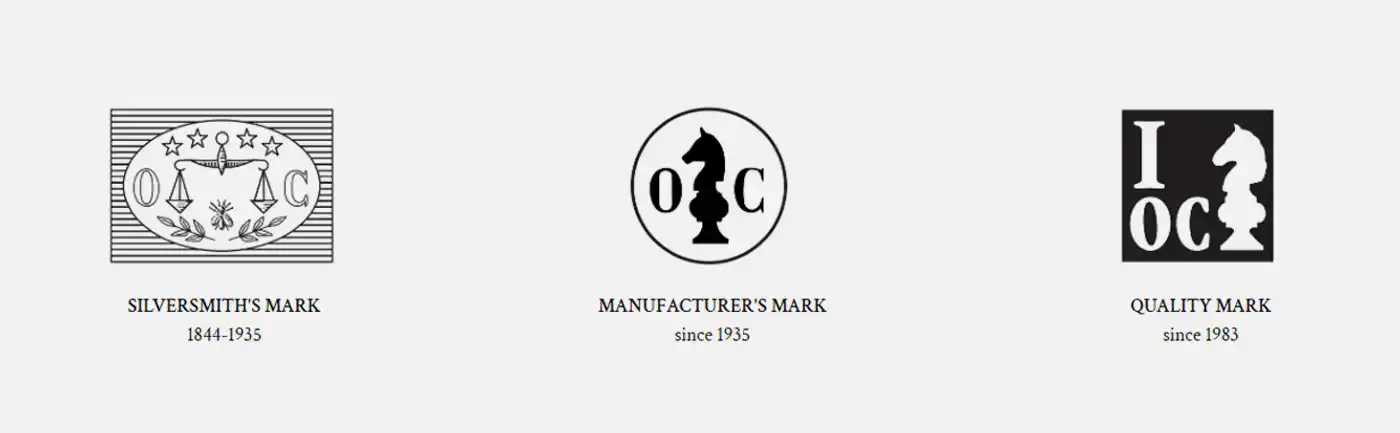
Christofle silver marks are among the best documented in the trade, which is good news for anyone holding a Christofle fork, tray or tea service and wondering what it is and when it was made. The house has changed its marks in clear, dated steps since 1832, it has published its own account of them, and the sequence of symbols, a bayonet, a balance, a bee, two Cs, a chess knight, reads like a timeline once you know the order. This guide, from a house that has sold Christofle since the days of the balance stamp, sets out the marks in chronological order, explains the numbers that sit beside them, covers the special marks for Gallia, vermeil and the current Haute Orfèvrerie pieces, and ends with a quick method for dating a piece from its marks alone.
The maker’s marks in order, from 1832 to today
1832 to 1862: the bayonet, the balance and the bee
Charles Christofle began as a jeweller, and the first maker’s mark he registered with the Paris guarantee office, in 1832, was a jeweller’s lozenge showing a rifle bayonet and the letters CC. The house’s own history of its marks, published on its collection of hallmarks page, records what came next. When the firm turned to silver plate in the 1840s it adopted a second, distinctive stamp: a pair of scales, the balance, which Christofle describes as “the silversmith’s hallmark” and which it used from 1844 to 1935. In 1853 a new mark was registered showing a bee hovering under three stars, framed by the two Cs of Christofle & Cie. On the earliest plated pieces, a collector’s study published by the Association of Small Collectors of Antique Silver (ASCAS, 2010) describes the standard mark of 1844 to 1862 as an oval containing the balance and a bee, with the name CHRISTOFLE in a separate cartouche, an item number and a lozenge-shaped box for the silver content.
1862 to 1935: the two Cs in a square
A decree of 26 May 1860 required French manufacturers of plated goods to strike a poinçon de responsabilité in a square, and from 1862 Christofle’s mark became the CC inside a square box, with the balance alongside and, from the late 1870s, a lozenge reading MÉTAL BLANC on pieces made on a nickel-alloy body rather than copper or brass. This is the mark on the great majority of antique Christofle you will meet: the Second Empire services, the Belle Époque hollowware, the Art Deco flatware of the 1920s. Between about 1930 and 1935 an intermediate version appears, the CC oval and square inside a lined rectangle with a bee, and then the system changes.
Since 1935: OC and the chess knight
From 1935 the two Cs were replaced by the letters OC, for Orfèvrerie Christofle, and the manufacturer’s mark became the one the house still uses: the knight from a chess set, in a square, surrounded by the initials OC. The balance was retired in the same year. A Christofle piece with the chess knight is therefore 1935 or later; one with the balance is 1935 or earlier; one with both is from the transition. On solid silver pieces the house mark sits beside the Minerva head, the French state guarantee, which we explain in our guide to french silver hallmarks; on plated pieces, which are the bulk of the house’s production, there is no Minerva, because plate cannot be assayed, and the OC knight stands with the plating figure instead.
1983 and today: the quality square and the year stamp
Two later marks refine the picture. Since 1983 France has standardised a quality mark for plated goods, a small square containing the Roman numeral I or II, which you will see beside the OC knight on pieces from the last four decades; a “II” on a modern Christofle piece is this quality grade, not a separate house mark. And on its current Haute Orfèvrerie pieces the house strikes a diamond with a letter for the century, A for the nineteenth, B for the twentieth, C for the twenty-first, flanked by two numbers that give the year of manufacture, which is the closest Christofle has come to a date letter.
The numbers: 84, the item number and what they mean
Numbers on Christofle plate puzzle more people than the symbols do. The most important is the plating figure. In the late 1860s the house adopted the German convention of marking flatware with the weight of fine silver deposited on a standard lot of twelve table spoons and twelve table forks; according to the plate-numbers guide at 925-1000, Christofle first worked to 80 grams and then raised its standard to 84, which is why so many pieces read “84 Gr.” Smaller pieces carry a figure for their own size, such as 12 G. or 18 G. The number is a statement of how much silver you are holding, and it is generous by any standard: it is the reason a Christofle plated fork from 1900 can still be bright at the tines today. The other marks of this family, EPNS, A1 and the German 90, are decoded in our guide to silver plate marks.
Beside the plating figure you will often find a longer number. On early pieces this is an item or model number, running into the hundreds of thousands by the 1860s, which identifies the design in the house’s archives; on later pieces similar numbers identify the pattern. Occasionally a short code such as 3·32 appears, which the ASCAS study reads as a month and year of production. None of these is a fineness: a Christofle plated piece never carries 925 or 800, and a Christofle piece that does is solid silver and will show the Minerva as well.
Gallia, vermeil and the collection marks
A few marks belong to particular lines rather than periods. Gallia was Christofle’s lighter range on a white-metal body, launched at the turn of the twentieth century for a broader clientele and much collected today for its Art Nouveau and Art Deco designs; the house marks it with a rooster, and the ASCAS study notes that the standard oval mark on Gallia pieces is struck smaller than on the main line. Vermeil pieces, silver or plate finished with gold, carry the maker’s mark with a V. A cat’s head appears on certain silver and gilded pieces. These marks sit alongside the house mark of the period, so a Gallia bonbon dish with a rooster and the CC in a square is pre-1935, and a vermeil-finished OC piece with a V is from after it.
Dating a Christofle piece by its marks
Put the sequence of christofle silver marks together and most pieces date themselves to within a generation.
| What you see | Period |
|---|---|
| Lozenge with bayonet and CC | 1832 to the 1840s, jewellery and early silver |
| Oval with balance and bee, name in a cartouche, lozenge silver-content box | 1844 to 1862 |
| CC in a square with the balance; MÉTAL BLANC lozenge on some pieces | 1862 to about 1930 |
| CC oval and square in a lined rectangle with a bee | About 1930 to 1935 |
| Chess knight with OC, no balance | 1935 onwards |
| Chess knight with OC plus a square with I or II | 1983 onwards |
| Diamond with A, B or C and two numbers | Current Haute Orfèvrerie, dated to the year |
Pattern names narrow the span further, because the house’s archives record when each was introduced. A set of Marly or Albi with the OC knight is mid-century or later; a Perles service with the CC in a square is between the wars; the clean lines of Mood, the house’s modern egg-shaped case of flatware, place a piece firmly in the twenty-first century. We describe the patterns and their periods in our guide to Christofle flatware, and the contemporary case and its contents in our article on Mood by Christofle.
What the marks mean for a buyer
Three practical conclusions about christofle silver marks. First, a Christofle mark is a guarantee of design and finish, not of solid silver: unless the Minerva is present, assume plate, and read the 84 as the measure of how much silver is on it. Second, the house’s marks are so well documented that an inconsistent set, a chess knight on a pattern discontinued in 1920, say, or a balance beside a 1983 quality square, is a reason to pause. Third, a worn Christofle piece is not a lost cause: the house replates its own work, and the marks survive the process. The current collections of Christofle, in silver plate, sterling and vermeil, carry the OC knight, the quality square and, on the finest pieces, the dated diamond, so a piece bought today will be as legible to a collector in fifty years as a Second Empire fork is to us now.
Key points at a glance
Christofle silver marks follow a dated sequence. The first mark, registered in 1832, was a lozenge with a bayonet and CC. From 1844 to 1935 the house used the balance stamp, joined in 1853 by the bee under three stars between two Cs; from 1862 the CC sat in a square as the legally required mark of responsibility, with a MÉTAL BLANC lozenge on nickel-alloy bodies from the late 1870s. Since 1935 the mark has been the chess knight surrounded by OC, for Orfèvrerie Christofle. Since 1983 a small square with I or II gives the plating quality grade, and current Haute Orfèvrerie pieces carry a diamond with a century letter and the year. The figure 84 is the weight in grams of silver deposited on twelve spoons and twelve forks, the house standard since the late 1860s; smaller pieces carry their own figure. Plated pieces never carry 925 or 800; solid silver pieces show the Minerva head beside the house mark. Gallia pieces carry a rooster, vermeil a V, certain gilded pieces a cat’s head. Balance means before 1935, chess knight means after, and the pattern name narrows the date further.
Frequently asked questions about christofle silver marks
How do I know if my Christofle is silver or silver plate?
Look for the French state guarantee mark. Christofle solid silver carries the Minerva head beside the house mark, and usually a 925 or 950 fineness. Christofle silver plate, which is most of the house’s production, has no Minerva and no fineness; instead it shows the house mark (the balance before 1935, the chess knight with OC after) together with a plating figure such as 84 Gr. that gives the weight of silver deposited on the piece.
What does 84 mean on Christofle?
84 is the weight in grams of fine silver deposited on a standard lot of twelve table spoons and twelve table forks, the plating standard Christofle adopted in the late 1860s after first working to 80 grams. Smaller pieces carry their own figure, such as 12 G. or 18 G. It is a measure of plating thickness, not a fineness, and it is not related to the Russian 84 zolotnik mark for solid silver.
How can I tell how old a Christofle piece is?
From the house mark. A balance stamp means the piece was made between 1844 and 1935; the CC in a square places it between 1862 and the early 1930s; the chess knight surrounded by OC means 1935 or later; a small square with I or II beside the knight means 1983 or later; and current Haute Orfèvrerie pieces carry a diamond with a century letter and the year. The pattern name narrows the date within those spans.
A timeline in the palm of your hand
Few makers have left as clear a trail as Christofle. Turn the piece over, find the balance or the knight, read the 84 and the pattern, and you have the material, the period and the design in a few seconds. If you have a Christofle service to identify, a single piece whose marks puzzle you, or you are choosing between the house’s plated, sterling and vermeil lines for a table of your own, we are glad to go through the marks with you.
Contact us — our team can help you identify a Christofle piece or choose a service.