
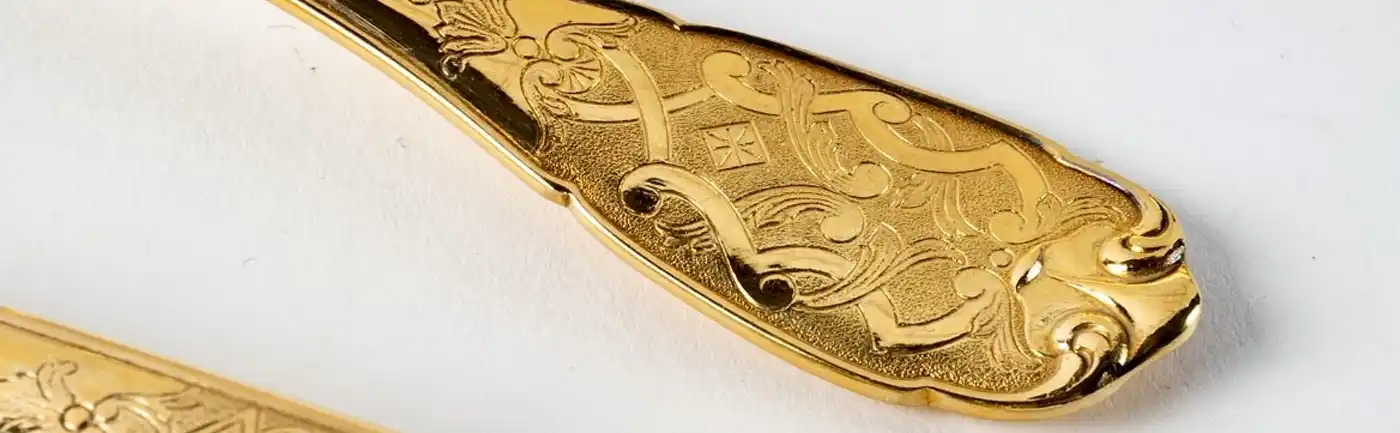
Vermeil, pronounced “ver-may”, is sterling silver covered with a layer of gold: an object that is silver all the way through and gold on every surface you see. The French word has become the international term for what English silversmiths have always called silver gilt, and in the United States it also has a precise legal meaning, with a minimum thickness and a minimum gold fineness attached. Behind the definition sits one of the oldest luxuries of the table. Gilded silver was the metal of royal banquets long before anyone thought of gold-coloured jewellery, and it is still the material of the finest dessert services, salt cellars and caviar spoons made today. This guide explains what vermeil is, how it differs from ordinary gold plating, how it is made and marked, why it has such a long history in tableware, and how to look after it.
What is vermeil? The definition and the legal threshold
Vermeil is gold on silver, and both halves of that phrase matter. The base is not brass, copper or steel but solid sterling, the same alloy explained in our guide to silver purity: at least 925 parts of silver per thousand. The surface is real gold, applied in a layer thick enough to be measured in microns rather than fractions of one. Take the silver away and you have gold plate. Take the gold away and you have sterling. Vermeil is the combination, and the combination is why it behaves differently from either.
In the United States the word is defined in law. The Federal Trade Commission’s guides for the jewelry and precious metal industries, at 16 CFR 23.4, allow a product to be marked vermeil only if it has “a base of sterling silver coated or plated on all significant surfaces with gold, or gold alloy of not less than 10 karat fineness”, with “a minimum thickness throughout equivalent to two and one half (2½) microns (or approximately 100/1,000,000ths of an inch) of fine gold”. The same rule adds that it is deceptive to call a piece vermeil if the sterling has been covered with a base metal such as nickel before the gold goes on, unless that construction is disclosed. Three conditions, then: sterling underneath, gold of at least ten karats on top, and at least 2.5 microns of it.
Europe has no equivalent statutory definition of the word. In Britain and France a gilded silver piece is simply hallmarked as silver, with the gilding treated as a finish, and the trade uses “silver gilt” or “vermeil” descriptively. In practice the American threshold has become the working standard everywhere, and a serious maker who writes vermeil on a piece sold in Europe means the same thing: sterling, real gold, a substantial layer. Our own rule at Scopelliti 1887, where we have handled gilded silver since 1887, is simpler still. If the piece is not hallmarked as silver underneath, it is not vermeil, whatever the label says.
Vermeil vs gold plated: what the difference really is
The question vermeil vs gold plated comes up constantly, and the answer is two differences, not one. The first is the base metal. Gold plated jewellery and tableware are usually brass, copper, nickel alloy or steel under the gold; vermeil is sterling silver. This matters when the gold wears, because a vermeil piece that thins at the high points shows warm white silver, which is itself precious and attractive, while a plated piece shows yellow brass or grey nickel. It also matters for the skin: silver is inert and hypoallergenic, nickel is a common irritant. The second difference is thickness. Ordinary gold plating is often a fraction of a micron, applied as a colour rather than a layer; vermeil begins at 2.5 microns, five to ten times more, and good makers go well beyond the minimum.
Two neighbouring terms complete the picture. Gold-filled is a mechanical bond of a thick gold sheet onto a brass core, used almost only in jewellery and never in tableware. Solid gold is gold throughout, and for a dinner service it would be both prohibitively heavy and too soft to use. Gold plated silver, finally, is the honest description of a piece that is sterling underneath but gilded more thinly than the vermeil threshold: real silver, real gold, but a lighter finish. Between the four, gilded silver is the one that gives you a precious metal all the way through and a gold surface made to last, which is exactly why it became the material of the grand table.
How silver gilt is made: from fire-gilding to electrogilding
Silver gilt is far older than the word vermeil. For most of its history it was made by fire-gilding, also called mercury gilding. The silversmith dissolved gold in mercury to make an amalgam, painted it onto the finished silver, and heated the piece. As Britannica puts it, “the mercury evaporates when the piece is fired, leaving a gold deposit”, which was then burnished, usually with a polished agate, to a deep, slightly matte lustre that modern gilding struggles to imitate. The results were superb and the process was lethal. Mercury vapour poisoned generations of gilders, and fire-gilding was progressively abandoned across Europe in the nineteenth century as the alternative became available.
That alternative is electrogilding, the same principle as silver electroplating applied with gold. The silver object becomes the cathode in a bath, a gold anode dissolves into the solution, and current deposits gold ions onto every surface of the piece. The method is controllable to the micron, which is what makes a legal thickness standard possible, and it allows the maker to choose the gold alloy, from a pale 14-karat to a rich 22 or 24-karat yellow. Virtually all gilded silver made since the mid-nineteenth century is electrogilt. The distinction still matters to collectors: an eighteenth-century fire-gilt piece has a different colour and wear pattern from a modern one, and re-gilding an antique by electrolysis changes its character in a way that is hard to undo.
Silver gilt in historic tableware
Why gild silver at all, if the object is precious already? Partly for splendour, and partly for chemistry. Gold does not tarnish and does not react with food. Silver does both: salt pits it, egg yolk blackens it, fruit acids and vinegar dull it. The parts of a silver service that touch these things were therefore gilded first, which is why antique salt cellars are gilt inside, egg spoons and fruit knives have gilt bowls and blades, and dessert services, meant for fruit, sweets and wine, were so often gilded all over. The technical word for a piece gilded only in part is parcel gilt, and reading where the gilding falls on an antique tells you what it was for.
Then there is splendour. The most famous dining service in the world is silver gilt. The Grand Service, described by the Royal Collection Trust as a “magnificent silver-gilt dining service”, was commissioned by George IV while Prince of Wales from the royal goldsmiths Rundell, Bridge & Rundell, with the first pieces delivered to Carlton House in 1811. It now runs to “over 4,000 pieces”, the King gradually ordered every element gilded to give the whole a consistent appearance, and it “remains in use to this day” at State Banquets at Windsor Castle and Buckingham Palace. It has never been replaced. On the Continent the great Parisian houses made gilded silver their signature for exactly the same reasons, and the dessert services and centrepieces of the Empire and Restoration periods are among the most sought-after silver of the nineteenth century. In our experience the appeal has not faded: a gilded dessert set still transforms a table in a way nothing else does.
How vermeil and silver gilt are marked
A gilded piece is marked as what it is underneath: silver. In Britain it carries the full set of silver hallmarks, the sponsor’s mark, the 925 fineness, the assay office mark and usually the lion passant and date letter, all struck before the gilding and visible through it. In France it carries the Minerva head and the maker’s lozenge. In Italy, the 925 figure and the maker’s star. The gold layer itself is never hallmarked, because it is a finish rather than a metal standard, and a hallmark for gold on a gilded piece would be a sign that something is wrong. American pieces, with no assay system, carry the word STERLING or 925 together with the maker’s name, and often the words “vermeil” or “gold over sterling” as a description.
This is also the surest way to tell true vermeil from a gilt impostor. Turn the piece over and look for the silver marks. If you find a lion passant, a Minerva, a star or a plain 925 beneath the gold, you have gilded sterling. If you find nothing, or EPNS, or a brand name alone, you have gilded base metal, however convincing the colour. Gilding hides the colour of the metal beneath it, which is precisely why the marks matter more on gilded silver than on anything else in the silver cabinet.
How to care for vermeil
Gilded silver is easier to live with than plain silver in one respect and more delicate in another. Easier, because gold does not tarnish: a gilded piece kept in a cabinet stays bright for decades without polishing, and it shrugs off the salt, acid and sulphur that blacken plain sterling. More delicate, because the gold is a layer, and layers wear. Every rule of care follows from that single fact.
Wash gilded pieces by hand in warm water with a mild detergent, rinse, and dry at once with a soft cloth. Never use silver polish, silver dip or any abrasive on a gilded surface: polish is designed to remove a microscopic layer of metal, and here that layer is the gold. If the piece tarnishes at all, it will be in a worn spot where silver is showing, and the right response is a soft dry cloth, not a chemical. Keep gilded pieces out of the dishwasher, where heat, detergent and contact with other items strip gold faster than years of use. Store them wrapped in acid-free tissue or anti-tarnish cloth, separated so they do not rub against each other. When the gold finally thins on a handle or a bowl, which on a well-made piece takes decades, a specialist can re-gild it; on an antique, ask first whether re-gilding will harm the value, because original fire-gilding is worth preserving even when worn.
Choosing gilded silver flatware for the table
Where does gilded silver belong on a modern table? Where it has always belonged: at dessert, with salt, with eggs, with caviar and with anything the silver would otherwise fight. A complete gilded service is a statement reserved for the grandest occasions; a more usual and, to our eye, more elegant choice is to pair sterling for the main courses with gilded pieces for the dessert course, the salt cellars and the serving spoons, so that the gold arrives as the meal reaches its final act. Gilded silver flatware also mixes well with gold-rimmed porcelain and with crystal, and a single vermeil caviar spoon or set of dessert forks is one of the most useful pieces a table can own.
When choosing, apply the three tests in this guide. Check that the piece is hallmarked as silver beneath the gold. Ask the maker, or read the description, for the gold thickness and karat; a house that gilds properly is proud to say so. And choose the colour deliberately: a high-karat gilding is a warm, deep yellow, a lower karat is paler and slightly harder, and both are legitimate. The gold plated flatware we select is chosen on exactly these criteria, from houses whose gilding is a craft rather than a coating, and we are always happy to explain what sits beneath the gold of any piece before it reaches your table.
Key points at a glance
Vermeil is the French and now international name for silver gilt: sterling silver covered on all visible surfaces with a layer of real gold. In the United States the term is defined by the FTC at 16 CFR 23.4: a sterling base, gold of at least 10 karats, and a minimum thickness of 2.5 microns; Europe hallmarks gilded silver simply as silver. It differs from gold plating in two ways, the precious base metal and a gold layer five to ten times thicker, and it differs from gold-filled and solid gold in construction and weight. Historically it was made by fire-gilding with a gold-mercury amalgam, abandoned in the nineteenth century for electrogilding, which is controllable to the micron. Gold does not tarnish or react with salt, egg and acid, which is why salt cellars, egg spoons and dessert services were gilded first, and why the royal Grand Service of over 4,000 silver-gilt pieces, begun in 1811, is still used at State Banquets. Vermeil is identified by the silver hallmarks beneath the gold, washed by hand, never polished with silver cleaners or put in a dishwasher, and re-gilded by a specialist when the gold eventually thins.
Frequently asked questions about vermeil
What does the word vermeil mean?
Vermeil is a French word, pronounced “ver-may”, that originally described a bright red or vermilion colour and came to mean gilded silver, by analogy with the warm tone of gold over white metal. In English it is the standard term for sterling silver plated with a substantial layer of gold, and it is used interchangeably with “silver gilt” and “gilded silver”.
What does “14k gold vermeil” or “18k gold vermeil” mean?
The karat figure describes the gold alloy used for the surface layer, not the piece as a whole. 14k vermeil is sterling silver gilded with 14-karat gold (58.5 per cent gold), paler and slightly harder; 18k vermeil uses 18-karat gold (75 per cent), warmer and richer in colour; 22k and 24k gilding are deeper yellow still. In every case the body of the piece is sterling silver, and under the US definition the gold layer must be at least 10 karat and at least 2.5 microns thick.
Is gold vermeil a good buy?
For tableware, gilded sterling is the only practical way to have a gold surface on a usable piece: solid gold flatware would be too soft and too heavy, and gold over base metal has neither the value nor the longevity. A well-made vermeil piece is solid sterling with a lasting gold finish, does not tarnish, resists salt and acid, and can be re-gilded when the gold eventually wears. Its worth depends, as with all silver, on the maker, the design and the condition, and on confirming the silver hallmarks beneath the gold.
Does vermeil wear off?
Eventually, yes, because the gold is a layer, but on tableware gilded to a proper thickness this takes decades of use, and the wear shows first on handles and the rims of bowls as a warm white where the silver comes through. Hand washing, prompt drying, no silver polish or dip, and no dishwasher slow it dramatically. When a piece has worn enough to matter, a specialist can re-gild it; antique fire-gilt pieces are usually better left with their original gilding.
Gold on silver, done properly
Vermeil is the oldest trick of the grand table and still one of the best: the weight, the hallmarks and the permanence of sterling, with a surface of gold that never tarnishes and never reacts with what you serve on it. The word has a legal meaning in America and a practical one everywhere, and both come down to the same three things, sterling beneath, real gold above, and enough of it to last. Check the marks, ask about the thickness, and gilded silver will reward you for a lifetime.
Contact us — if you would like advice on a vermeil piece you own, or on choosing gilded silver for your table, our team is at your disposal.