
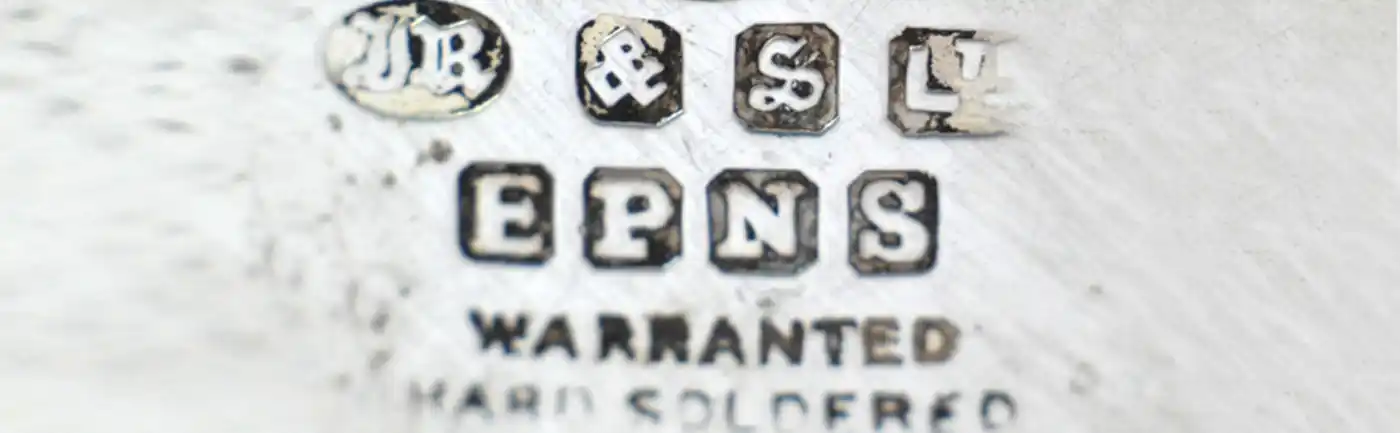
Silver plate marks are the small stamped letters, numbers and symbols that tell you a piece is silver-plated rather than solid silver, and they follow their own logic. There is no assay office behind them, no legal standard, no date letter you can look up in a table. What you find instead is a set of trade conventions that grew up in Sheffield, Birmingham, Paris and the German manufacturing towns from the 1840s onwards: EPNS, EPBM, A1, a lone 84 or 90 inside a rectangle, a maker’s name in a cartouche. Once you know how to read them, those marks tell you who made the piece, roughly when, how much silver was deposited on it and, above all, that it is plate. A house that has handled fine silver and silver plate since 1887 learns to read these marks before anything else, and this guide sets out that reading method so you can apply it to the cutlery drawer, the auction catalogue or the piece you inherited.
What silver plate marks are, and why they are not hallmarks
A hallmark is an official guarantee. In Britain it is struck by one of the assay offices after the metal has been tested, and it certifies a minimum silver content. Plated goods contain no silver worth testing: a thin layer of pure silver, usually a few microns, sits on a base metal body. So they cannot be hallmarked. The Sheffield Assay Office lists three compulsory elements of a genuine UK hallmark: the sponsor’s mark, the fineness mark in parts per thousand and the assay office mark. A plated spoon will show none of these in their official form.
Why does this matter? Because manufacturers of plate borrowed the look of hallmarks for over a century. They struck little shields, crowns and lion-like animals next to their names precisely so that the casual eye would read “silver”. The marks on plate are therefore best understood as trade marks and quality grades, not as certificates. Our complete guide to silver hallmarks explains how the official marks work country by country; this article covers the other side of the drawer, the pieces that imitate them.
One rule of thumb holds everywhere. If a mark spells out what the piece is made of in letters (EPNS, EP, PLATED, SILVER ON COPPER) or gives a weight of silver in grams (84, 90, 100), you are looking at plate. Solid silver is marked with a fineness (925, 800, 950) or with a national symbol such as the lion passant or the Minerva head, never with a plating weight.
Old Sheffield plate: the first plated silver and how it was marked
Plated silver begins in Sheffield around 1743. The cutler Thomas Boulsover found that a sheet of sterling silver could be fused to a copper ingot by heat and then rolled out as a single bimetallic sheet. According to The Silver Society, this fused plate, known today as Old Sheffield Plate, was made for almost a century before electroplating of silver onto base metal began in Birmingham around 1840. Old Sheffield Plate was formed from the sheet, so the silver layer is comparatively thick, and on worn edges you will see a warm copper line rather than a grey or yellowish base.
Marks on Old Sheffield Plate are inconsistent. Early makers often struck marks that imitated silver hallmarks, which caused enough confusion that an Act of 1784 allowed Sheffield platers to register a mark consisting of their name together with a device, such as a bell, a hand or a crossed arrows, provided it could not be mistaken for a hallmark. Many pieces carry no mark at all. A detail worth remembering: the words “Sheffield Plate” stamped in full on a piece almost always indicate later electroplate made in Sheffield, not fused plate. Genuine Old Sheffield Plate was rarely labelled as such.
How do you tell fused plate from electroplate without a mark? Look at the seams and the edges. Fused plate was made from sheet, so hollow pieces have soldered seams, and the exposed edges of trays and candlesticks were usually hidden with applied silver wire or borders. Electroplate was made first and plated afterwards, so it has no seams showing a copper core and no applied edges. Weight helps too: a fused plate piece is generally heavier for its size than a Britannia metal electroplate of the same form.
EPNS, EPBM, A1 and the other British plate abbreviations
From 1840 the vocabulary of plate changes. Electroplating deposits silver from a solution onto a finished object, so the body can be any metal that takes the current, and the abbreviations describe that body.
EPNS: electroplated nickel silver
EPNS is by far the most common mark you will meet, and the most misunderstood. It stands for Electro-Plated Nickel Silver. The “nickel silver” is the base, an alloy of copper, nickel and zinc that is silvery-grey in colour and contains no silver at all; the only silver is the plated skin. The Silver Society notes that EPNS is the mark most frequently encountered on plated goods and that it was sometimes set in small shields to echo a hallmark. Nickel silver was favoured because it wears well and, when the plating thins, the grey base is less visible than copper would be. On a well-used EPNS fork, look at the tips of the tines and the back of the bowl: a faint yellowish-grey tone there is the alloy showing through.
EPBM, EP and the base-metal codes
EPBM means Electro-Plated Britannia Metal. Britannia metal is a tin alloy with antimony and copper, softer and lighter than nickel silver, and it was the standard body for teapots, coffee pots and cheaper hollowware. EPBM pieces dent easily and feel light in the hand; where the plating has worn, the base is dull grey like pewter. Plain EP means electroplated, with the base unspecified. You will also find EP on Copper or “Silver on Copper”, common on trays and entrée dishes, and in the United States terms such as “Quadruple Plate” and “Triple Plate”, which refer to the number of times the piece passed through the plating bath rather than to a measured thickness.
A1 and the quality grades
A1 is a quality grade, not a material. In the British trade it designated the maker’s heaviest standard of plating, and you will see it on flatware from the better Sheffield houses, often beside EPNS. Some firms used their own ladders of grades (A, AA, A1, or a row of stars), and because no outside body checked them, A1 from one maker is not comparable with A1 from another. Treat it as a relative statement: this is the best plate that this manufacturer sold. Marks such as “Hard Soldered”, “Reinforced” or a small symbol at the wear point of a fork indicate that extra silver was deposited where the piece would rub against the plate.
Pseudo-hallmarks
Beside the letters you will often find a row of three or four small punches: a shield with initials, a crown, an animal, a letter. These are pseudo-hallmarks, designed to resemble the lion passant, town mark and date letter of solid silver. The crown in particular was borrowed from the Sheffield assay mark so freely that its use on plated goods was prohibited in Britain at the end of the nineteenth century. The giveaway is the letters next to them: a real hallmark never sits beside EPNS.
Numbers on French and German plate: the 84 and 90 standards
Continental plate speaks in numbers rather than letters, and the numbers are a measure of silver. The system originated in Germany in the middle of the nineteenth century, when the large manufacturers agreed to mark their flatware with the weight of fine silver used to plate a standard lot of twelve table spoons and twelve table forks. The reference figure was 90 grams for the twenty-four pieces, and the plate-numbers guide at 925-1000 records that the “90” was punched on the pieces, while firms that used less silver stamped 60, 40 or 20, and a few stamped 100 or 150 for luxury grades. A second, smaller number often appears for the actual size of the piece: a tablespoon marked 90 and 45 carries roughly 3.75 grams of silver.
France adopted the German logic in the late 1860s. The same source cites a 1927 thesis by Gotthold Kehr on the point: Christofle first worked to 80 grams per dozen and then raised its standard to 84, which is why so much French flatware reads “84 Gr.” on the front of the handle or inside the bowl of the spoon. Smaller pieces carry their own figure, such as 12 G. or 18 G., and the house of Ercuis used a plain “10” on some pieces to indicate ten grams of silver on the whole item. This is the origin of the “84” you see on the pieces that Christofle has made for generations, and it is still a useful reassurance: a dozen forks and spoons carrying 84 grams of silver between them is a generous plate by any standard.
A caution for anyone handling Russian silver as well. The French “84” is a plating weight; the Russian “84” is a fineness mark meaning 84 zolotniks, or 875 parts per thousand, on solid silver. They look identical. The context is different: Russian marks sit on the back of the handle in a group with an assay mark and a maker’s mark, French plate figures sit on the front of the working end, usually alone or with the maker’s cartouche.
Reading a Christofle mark in practice
Christofle is the best case study in French plate because the firm changed its marks in documented steps and because it has been plating since the technique was new. A study published by the Association of Small Collectors of Antique Silver (ASCAS, 2010) sets out the sequence. From 1844 to 1862 the standard mark was an oval containing a balance and a bee, with the name in a separate cartouche, item numbers and lozenge-shaped boxes for the silver content. From 1862 the initials CC appear in a square, the poinçon de responsabilité required by a decree of 26 May 1860, and from the late 1870s a “Métal Blanc” lozenge identifies pieces on a nickel-alloy body. Between 1930 and 1935 an intermediate mark in a lined box appears, and from 1935 to 1983 the initials become OC, for Orfèvrerie Christofle, with a chess knight in a square denoting silver plate. The Gallia line, the firm’s lighter range on a white-metal body, carries a smaller version of the oval mark.
So a Christofle fork can be placed within a couple of decades from its mark alone: balance-and-bee means Second Empire, CC in a square means the long period up to the 1930s, OC means mid-century. We go through the individual punches, the numbers and the pattern names piece by piece in our dedicated guide to christofle silver marks, which is the natural next step if you have a Christofle service to identify.
Plate or sterling? A five-point check
When the silver plate marks are worn or ambiguous, the object itself answers. Run through these five checks in order; the first two settle most cases.
| Check | Silver plate | Solid silver |
|---|---|---|
| Letters and numbers | EPNS, EPBM, EP, A1, PLATED, 84, 90, 100 | 925, 800, 950, STERLING, lion passant, Minerva head |
| Wear points | Different colour showing through at tines, bowl backs, rims | Same colour all the way through, scratches stay bright |
| Weight and sound | Light (Britannia metal) or very heavy (fused plate); dull ring | Dense for its size; clear, sustained ring |
| Seams and edges | Applied edge wires on fused plate; copper line at seams | Clean edges, no second metal at seams |
| Set of marks | Maker’s name plus abbreviations or a grade; pseudo-hallmarks without a fineness | Fineness plus assay or national mark, plus sponsor’s mark |
Is plate therefore the poor relation? Not necessarily. A good electroplate from Christofle or from the better Sheffield houses was made to the same designs as the sterling line and finished by the same hands; the difference is the body, not the craftsmanship. The question of which to choose for a table that is actually used, and how the two age over decades of service, is one we take up in full in sterling silver vs silver plated. For identification purposes, the table above is enough.
What the marks mean for a buyer today
Modern plate from the great French houses is still marked with a weight of silver, and among all the silver plate marks on a new piece that remains the figure to look for. A heavier deposit means decades more use before the base shows at the tines. It also means the piece can be replated when the time comes, which the manufacturers themselves offer as a service, so a well-marked set of plated flatware is a long-term purchase rather than a disposable one. The current ranges of Ercuis cutlery, for instance, carry the house mark and the plating figure in the same positions their nineteenth-century predecessors used, which is a small but telling sign of continuity in a trade that has otherwise changed completely.
Two practical notes. First, never let an acid test decide the matter on plate: it only reads the surface layer, so a plated piece will test as silver. Second, keep the marks legible. Over-polishing with abrasive pastes wears the plating fastest exactly where the marks are struck, on the back of the handle, and an illegible mark costs the piece most of its story.
Key points at a glance
Silver plate marks are trade marks and quality grades, not hallmarks: plated goods contain too little silver to be assayed, so they never carry a legal fineness or an assay office mark. British plate is marked with abbreviations that describe the base metal (EPNS for nickel silver, EPBM for Britannia metal, EP for unspecified electroplate) and with grades such as A1 that are set by each maker. Old Sheffield Plate, fused silver on copper made from about 1743, is often unmarked or carries a registered name-and-device mark; the words “Sheffield Plate” in full usually indicate later electroplate. Continental plate is marked with the weight of silver used: the German 90 standard means 90 grams on twelve spoons and twelve forks, and Christofle’s 84 derives from the same system adopted in France in the late 1860s. Christofle’s own marks date a piece by their form: balance and bee (1844 to 1862), CC in a square (from 1862), OC (1935 to 1983). Pseudo-hallmarks beside the letters are decorative imitations. When in doubt, check wear points, weight, seams and the full set of marks before trusting any single stamp.
Frequently asked questions about silver plate marks
What does EPNS mean on silver?
EPNS stands for Electro-Plated Nickel Silver. The piece has a body of nickel silver, an alloy of copper, nickel and zinc that contains no silver, covered with a thin electroplated layer of pure silver. It is the most common mark on British plated cutlery and hollowware from the 1840s onwards and it always indicates plate, never solid silver.
What does A1 mean on silver plate?
A1 is a quality grade used by British manufacturers to indicate their heaviest standard of silver plating. It was set by each firm rather than by an assay office, so it is not comparable between makers, but on a given maker’s flatware A1 marks the best plate that firm produced.
What does 84 or 90 mean on silver-plated cutlery?
On French and German plate the number is the weight of fine silver, in grams, deposited on a standard set of twelve table spoons and twelve table forks. The German reference standard was 90 grams; Christofle adopted 84 grams as its own standard in the late 1860s, so “84 Gr.” on French flatware is a plating weight, not a fineness. The Russian “84”, by contrast, is a solid-silver fineness mark of 875 parts per thousand.
Can silver plate have a hallmark?
No. A hallmark certifies a minimum silver content after assay, and plated goods have only a surface layer of silver on a base metal, so they cannot be assayed or hallmarked. Plated pieces may carry pseudo-hallmarks, small punches shaped like crowns, shields or animals that imitate the real thing, but these sit beside abbreviations such as EPNS and never include a legal fineness mark.
Reading the drawer with confidence
Silver plate marks reward a little patience. Letters tell you the base metal, grades tell you how the maker ranked the piece, numbers tell you how much silver was spent on it, and the maker’s cartouche places it in a workshop and a period. None of it is certified, all of it is informative, and the five-point check settles whatever the stamps leave open. If you are identifying a service, assembling one, or deciding whether a set of plated flatware deserves replating, we are glad to look at the marks with you.
Contact us — our team can help you identify a piece or choose a service.